Differential Propositional Calculus • 27

Commentary On Small Models

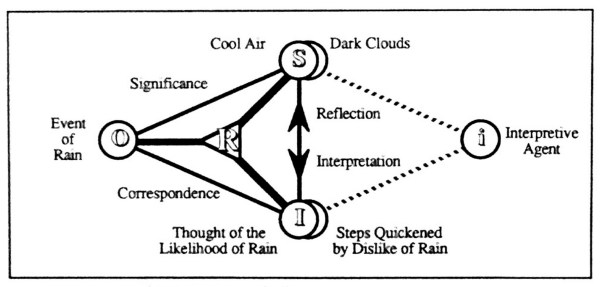
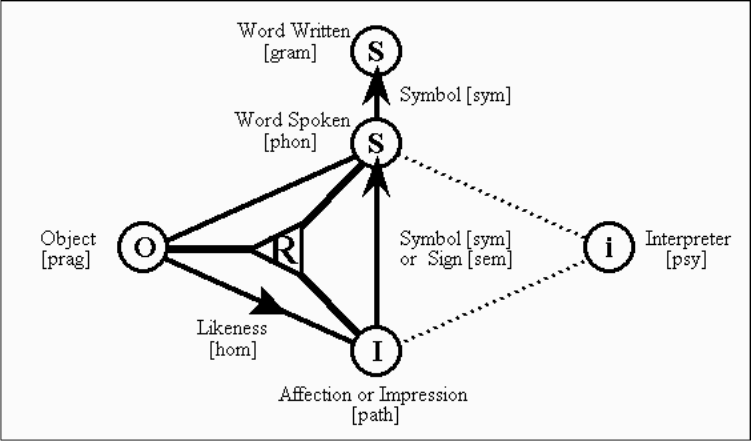
One reason for engaging in our present order of extremely reduced but explicitly controlled case study is to throw light on the general study of languages, formal and natural, in their full array of syntactic, semantic, and pragmatic aspects.  Propositional calculus is one of the last points of departure where it is possible to see that trio of aspects interacting in a non‑trivial way without being immediately and totally overwhelmed by the complexity they generate.  Often that complexity leads investigators of formal and natural languages to adopt the strategy of focusing on a single aspect and abandoning all hope of understanding the whole, whether it’s the still living natural language or the dynamics of inquiry crystallized in formal logic.

From the perspective I find most useful here, a language is a syntactic system designed or evolved in part to express a set of descriptions.  When the explicit symbols of a language have extensions in its object world which are actually infinite, or when the implicit categories and generative devices of a linguistic theory have extensions in its subject matter which are potentially infinite, then the finite characters of terms, statements, arguments, grammars, logics, and rhetorics force a surplus intension to color all its symbols and functions, across the spectrum from object language to metalinguistic reflection.

In the aphorism of W. von Humboldt often cited by Chomsky, language requires “the infinite use of finite means”.  That is necessarily true when the extensions are infinite, when the referential symbols and grammatical categories of a language possess infinite sets of models and instances.  But it also voices a practical truth when the extensions, though finite at every stage, tend to grow at exponential rates.

Resources

cc: FB | Differential LogicLaws of FormMathstodonAcademia.edu
cc: Conceptual Graphs (1) (2)CyberneticsStructural ModelingSystems Science

Posted in Amphecks, Boolean Functions, C.S. Peirce, Cactus Graphs, Category Theory, Change, Computational Complexity, Cybernetics, Differential Analytic Turing Automata, Differential Calculus, Differential Logic, Discrete Dynamics, Dynamical Systems, Equational Inference, Functional Logic, Gradient Descent, Graph Theory, Group Theory, Hologrammautomaton, Indicator Functions, Logic, Logical Graphs, Mathematical Models, Mathematics, Minimal Negation Operators, Painted Cacti, Peirce, Propositional Calculus, Propositional Equation Reasoning Systems, Time, Visualization | Tagged , , , , , , , , , , , , , , , , , , , , , , , , , , , , , , | 2 Comments

Differential Propositional Calculus • 26

Example 1. A Square Rigging (concl.)

If we eliminate from view the regions of \mathrm{E}^2 X ruled out by the dynamic law \mathrm{d}^2 A = \texttt{(} A \texttt{)} then what remains is the quotient structure shown in the following Figure.  The picture makes it easy to see how the dynamically allowable portion of the universe is partitioned between the respective holdings of A and \mathrm{d}^2 A.  As it happens, the fact might have been expressed “right off the bat” by an equivalent formulation of the differential law, one which uses the exclusive disjunction to state the law as \texttt{(} A \texttt{,} \mathrm{d}^2 A \texttt{)}.

Example 1. The Tiller
\text{Example 1. The Tiller}

What we have achieved in this example is to give a differential description of a simple dynamic process.  We did this by embedding a directed graph, representing the state transitions of a finite automaton, in the share of a boolean lattice or n‑cube cut out by nullifying all the regions the dynamics outlaws.

With growth in the dimensions of our contemplated universes it becomes essential, both for human comprehension and for computer implementation, that dynamic structures of interest be represented not actually, by acquaintance, but virtually, by description.  In our present study we are using the language of propositional calculus to express the relevant descriptions, and to grasp the structures embodied in subsets of n‑cubes without being forced to actualize all their points.

Resources

cc: FB | Differential LogicLaws of FormMathstodonAcademia.edu
cc: Conceptual Graphs (1) (2)CyberneticsStructural ModelingSystems Science

Posted in Amphecks, Boolean Functions, C.S. Peirce, Cactus Graphs, Category Theory, Change, Computational Complexity, Cybernetics, Differential Analytic Turing Automata, Differential Calculus, Differential Logic, Discrete Dynamics, Dynamical Systems, Equational Inference, Functional Logic, Gradient Descent, Graph Theory, Group Theory, Hologrammautomaton, Indicator Functions, Logic, Logical Graphs, Mathematical Models, Mathematics, Minimal Negation Operators, Painted Cacti, Peirce, Propositional Calculus, Propositional Equation Reasoning Systems, Time, Visualization | Tagged , , , , , , , , , , , , , , , , , , , , , , , , , , , , , , | 2 Comments

Differential Propositional Calculus • 25

Example 1. A Square Rigging (cont.)

Because the initial space X = \langle A \rangle is one‑dimensional we can easily fit the second order extension \mathrm{E}^2 X = \langle A, \mathrm{d}A, \mathrm{d}^2 A \rangle within the compass of a single venn diagram, charting the pair of converging trajectories as shown in the following Figure.

Example 1. The Anchor
\text{Example 1. The Anchor}

Resources

cc: FB | Differential LogicLaws of FormMathstodonAcademia.edu
cc: Conceptual Graphs (1) (2)CyberneticsStructural ModelingSystems Science

Posted in Amphecks, Boolean Functions, C.S. Peirce, Cactus Graphs, Category Theory, Change, Computational Complexity, Cybernetics, Differential Analytic Turing Automata, Differential Calculus, Differential Logic, Discrete Dynamics, Dynamical Systems, Equational Inference, Functional Logic, Gradient Descent, Graph Theory, Group Theory, Hologrammautomaton, Indicator Functions, Logic, Logical Graphs, Mathematical Models, Mathematics, Minimal Negation Operators, Painted Cacti, Peirce, Propositional Calculus, Propositional Equation Reasoning Systems, Time, Visualization | Tagged , , , , , , , , , , , , , , , , , , , , , , , , , , , , , , | 2 Comments

Differential Propositional Calculus • 24


Urge and urge and urge,
Always the procreant urge of the world.

— Walt Whitman • Leaves of Grass

Example 1. A Square Rigging

Returning to the universe of discourse based on a single feature A, suppose we are given the initial condition A = \mathrm{d}A and the second order differential law \mathrm{d}^2 A = \texttt{(} A \texttt{)}.  Since the equation A = \mathrm{d}A is logically equivalent to the disjunction A ~ \mathrm{d}A \lor \texttt{(} A \texttt{)(} \mathrm{d}A \texttt{)} we may infer two possible trajectories, as shown in the following Table.

\text{A Pair of Commodious Trajectories}
Commodious Trajectories

In either case the state A ~ \texttt{(} \mathrm{d}A \texttt{)(} \mathrm{d}^2 A \texttt{)} is a stable attractor or terminal condition for both starting points.

Resources

cc: FB | Differential LogicLaws of FormMathstodonAcademia.edu
cc: Conceptual Graphs (1) (2)CyberneticsStructural ModelingSystems Science

Posted in Amphecks, Boolean Functions, C.S. Peirce, Cactus Graphs, Category Theory, Change, Computational Complexity, Cybernetics, Differential Analytic Turing Automata, Differential Calculus, Differential Logic, Discrete Dynamics, Dynamical Systems, Equational Inference, Functional Logic, Gradient Descent, Graph Theory, Group Theory, Hologrammautomaton, Indicator Functions, Logic, Logical Graphs, Mathematical Models, Mathematics, Minimal Negation Operators, Painted Cacti, Peirce, Propositional Calculus, Propositional Equation Reasoning Systems, Time, Visualization | Tagged , , , , , , , , , , , , , , , , , , , , , , , , , , , , , , | 2 Comments

Differential Propositional Calculus • 23


The clock indicates the moment . . . . but what does
     eternity indicate?

— Walt Whitman • Leaves of Grass

A One-Dimensional Universe (concl.)

It might be thought an independent time variable needs to be brought in at this point but it is an insight of fundamental importance to recognize the idea of process is logically prior to the notion of time.  A time variable is a reference to a clock — a canonical, conventional process accepted or established as a standard of measurement but in essence no different than any other process.  This raises the question of how different subsystems in a more global process can be brought into comparison and what it means for one process to serve the function of a local standard for others.  But inquiries of that order serve but to wrap up puzzles in further riddles and are obviously too involved to be handled at our current level of approximation.

Observe how the secular inference rules, used by themselves, involve a loss of information, since nothing in them tells whether the momenta \{ \texttt{(} \mathrm{d}A \texttt{)}, \mathrm{d}A \} are changed or unchanged in the next moment.  To know that one would have to determine \mathrm{d}^2 A, and so on, pursuing an infinite regress.  In order to rest with a finitely determinate system it is necessary to make an infinite assumption, for example, that \mathrm{d}^k A = 0 for all k greater than some fixed value M.  Another way to escape the regress is through the provision of a dynamic law, in typical form making higher order differentials dependent on lower degrees and estates.

Resources

cc: FB | Differential LogicLaws of FormMathstodonAcademia.edu
cc: Conceptual Graphs (1) (2)CyberneticsStructural ModelingSystems Science

Posted in Amphecks, Boolean Functions, C.S. Peirce, Cactus Graphs, Category Theory, Change, Computational Complexity, Cybernetics, Differential Analytic Turing Automata, Differential Calculus, Differential Logic, Discrete Dynamics, Dynamical Systems, Equational Inference, Functional Logic, Gradient Descent, Graph Theory, Group Theory, Hologrammautomaton, Indicator Functions, Logic, Logical Graphs, Mathematical Models, Mathematics, Minimal Negation Operators, Painted Cacti, Peirce, Propositional Calculus, Propositional Equation Reasoning Systems, Time, Visualization | Tagged , , , , , , , , , , , , , , , , , , , , , , , , , , , , , , | 2 Comments

Differential Propositional Calculus • 22

A One-Dimensional Universe (cont.)

The first order differential extension of \mathcal{X} is \mathrm{E}\mathcal{X} = \{ x_1, \mathrm{d}x_1 \} = \{ A, \mathrm{d}A \}.  If the feature A is interpreted as applying to some object or state then the feature \mathrm{d}A may be taken as an attribute of the same object or state which tells it is changing significantly with respect to the property A, as if it bore an “escape velocity” with respect to the state A.  In practice, differential features acquire their meaning through a class of temporal inference rules.

For example, relative to a frame of observation to be left implicit for now, if A and \mathrm{d}A are true at a given moment, it would be reasonable to assume \texttt{(} A \texttt{)} will be true in the next moment of observation.  Taken all together we have the fourfold scheme of inference shown below.

Differential Inference Rules

Resources

cc: FB | Differential LogicLaws of FormMathstodonAcademia.edu
cc: Conceptual Graphs (1) (2)CyberneticsStructural ModelingSystems Science

Posted in Amphecks, Boolean Functions, C.S. Peirce, Cactus Graphs, Category Theory, Change, Computational Complexity, Cybernetics, Differential Analytic Turing Automata, Differential Calculus, Differential Logic, Discrete Dynamics, Dynamical Systems, Equational Inference, Functional Logic, Gradient Descent, Graph Theory, Group Theory, Hologrammautomaton, Indicator Functions, Logic, Logical Graphs, Mathematical Models, Mathematics, Minimal Negation Operators, Painted Cacti, Peirce, Propositional Calculus, Propositional Equation Reasoning Systems, Time, Visualization | Tagged , , , , , , , , , , , , , , , , , , , , , , , , , , , , , , | 2 Comments

Differential Propositional Calculus • 21


There was never any more inception than there is now,
Nor any more youth or age than there is now;
And will never be any more perfection than there is now,
Nor any more heaven or hell than there is now.

— Walt Whitman • Leaves of Grass

A One‑Dimensional Universe

Let \mathcal{X} = \{ A \} be a logical basis containing one boolean variable or logical feature A.  The basis element A may be regarded as a simple proposition or coordinate projection A : \mathbb{B} \to \mathbb{B}.  Corresponding to the basis \mathcal{X} = \{ A \} is the alphabet \mathfrak{X} = \{ ``A" \} which serves whenever we need to make explicit mention of the symbols used in our formulas and representations.

The space X = \langle A \rangle = \{ \texttt{(} A \texttt{)}, A \} of points (cells, vectors, interpretations) has cardinality 2^n = 2^1 = 2 and is isomorphic to \mathbb{B} = \{ 0, 1 \}.  Moreover, X may be identified with the set of singular propositions \{ x : \mathbb{B} \xrightarrow{s} \mathbb{B} \}.

The space of linear propositions X^* = \{ \mathrm{hom} : \mathbb{B} \xrightarrow{\ell} \mathbb{B} \} = \{ 0, A \} is algebraically dual to X and also has cardinality 2.  Here, ``0" is interpreted as denoting the constant function 0 : \mathbb{B} \to \mathbb{B}, amounting to the linear proposition of rank 0, while A is the linear proposition of rank 1.

Last but not least we have the positive propositions \{ \mathrm{pos} : \mathbb{B} \xrightarrow{p} \mathbb{B} \} = \{ A, 1 \} of rank 1 and 0, respectively, where ``1" is understood as denoting the constant function 1 : \mathbb{B} \to \mathbb{B}.

All told there are 2^{2^n} = 2^{2^1} = 4 propositions in the universe of discourse \mathcal{X}^\bullet = [\mathcal{X}], collectively forming the set X^\uparrow = \{ f : X \to \mathbb{B} \} = \{ 0, \texttt{(} A \texttt{)}, A, 1 \} \cong (\mathbb{B} \to \mathbb{B}).

Resources

cc: FB | Differential LogicLaws of FormMathstodonAcademia.edu
cc: Conceptual Graphs (1) (2)CyberneticsStructural ModelingSystems Science

Posted in Amphecks, Boolean Functions, C.S. Peirce, Cactus Graphs, Category Theory, Change, Computational Complexity, Cybernetics, Differential Analytic Turing Automata, Differential Calculus, Differential Logic, Discrete Dynamics, Dynamical Systems, Equational Inference, Functional Logic, Gradient Descent, Graph Theory, Group Theory, Hologrammautomaton, Indicator Functions, Logic, Logical Graphs, Mathematical Models, Mathematics, Minimal Negation Operators, Painted Cacti, Peirce, Propositional Calculus, Propositional Equation Reasoning Systems, Time, Visualization | Tagged , , , , , , , , , , , , , , , , , , , , , , , , , , , , , , | 2 Comments

Differential Propositional Calculus • 20


I would have preferred to be enveloped in words, borne way beyond all possible beginnings.

— Michel Foucault • The Discourse on Language

Back to the Beginning • Exemplary Universes

To anchor our understanding of differential logic let’s look at how the various concepts apply in the simplest possible concrete cases, where the initial dimension is only 1 or 2.  In spite of the simplicity of these cases it is possible to observe how central difficulties of the subject begin to arise already at this stage.

Resources

cc: FB | Differential LogicLaws of FormMathstodonAcademia.edu
cc: Conceptual Graphs (1) (2)CyberneticsStructural ModelingSystems Science

Posted in Amphecks, Boolean Functions, C.S. Peirce, Cactus Graphs, Category Theory, Change, Computational Complexity, Cybernetics, Differential Analytic Turing Automata, Differential Calculus, Differential Logic, Discrete Dynamics, Dynamical Systems, Equational Inference, Functional Logic, Gradient Descent, Graph Theory, Group Theory, Hologrammautomaton, Indicator Functions, Logic, Logical Graphs, Mathematical Models, Mathematics, Minimal Negation Operators, Painted Cacti, Peirce, Propositional Calculus, Propositional Equation Reasoning Systems, Time, Visualization | Tagged , , , , , , , , , , , , , , , , , , , , , , , , , , , , , , | 2 Comments

Differential Propositional Calculus • 19


Failing to fetch me at first keep encouraged,
Missing me one place search another,
I stop some where waiting for you

— Walt Whitman • Leaves of Grass

Life on Easy Street

The finite character of the extended universe [\mathrm{E}\mathcal{A}] makes the task of solving differential propositions relatively straightforward.  The solution set of the differential proposition q : \mathrm{E}A \to \mathbb{B} is the set of models q^{-1}(1) in \mathrm{E}A.  Finding all models of q, the extended interpretations in \mathrm{E}A which satisfy q, can be carried out by a finite search.

Being in possession of complete algorithms for propositional calculus modeling, theorem checking, and theorem proving makes the analytic task fairly simple in principle, even if the question of efficiency in the face of arbitrary complexity remains another matter entirely.

The NP‑completeness of propositional satisfiability may weigh against the prospects of a single efficient algorithm capable of covering the whole space [\mathrm{E}\mathcal{A}] with equal facility but there appears to be much room for improvement in classifying special forms and developing algorithms tailored to their practical processing.

Resources

cc: FB | Differential LogicLaws of FormMathstodonAcademia.edu
cc: Conceptual Graphs (1) (2)CyberneticsStructural ModelingSystems Science

Posted in Amphecks, Boolean Functions, C.S. Peirce, Cactus Graphs, Category Theory, Change, Computational Complexity, Cybernetics, Differential Analytic Turing Automata, Differential Calculus, Differential Logic, Discrete Dynamics, Dynamical Systems, Equational Inference, Functional Logic, Gradient Descent, Graph Theory, Group Theory, Hologrammautomaton, Indicator Functions, Logic, Logical Graphs, Mathematical Models, Mathematics, Minimal Negation Operators, Painted Cacti, Peirce, Propositional Calculus, Propositional Equation Reasoning Systems, Time, Visualization | Tagged , , , , , , , , , , , , , , , , , , , , , , , , , , , , , , | 2 Comments

Differential Propositional Calculus • 18

The Extended Universe of Discourse

The extended basis \mathrm{E}\mathcal{A} of a universe of discourse [\mathcal{A}] is formed by taking the initial basis \mathcal{A} together with the differential basis \mathrm{d}\mathcal{A}.  Thus we have the following formula.

\mathrm{E}\mathcal{A} ~=~ \mathcal{A} \cup \mathrm{d}\mathcal{A} ~=~ \{ a_1, \ldots, a_n, \mathrm{d}a_1, \ldots, \mathrm{d}a_n \}.

This supplies enough material to construct the differential extension \mathrm{E}A of the space A, also called the tangent bundle of A, in the following fashion.

\mathrm{E}A ~=~ \langle \mathrm{E}\mathcal{A} \rangle ~=~ \langle \mathcal{A} \cup \mathrm{d}\mathcal{A} \rangle ~=~ \langle a_1, \ldots, a_n, \mathrm{d}a_1, \ldots, \mathrm{d}a_n \rangle

and also

\mathrm{E}A ~=~ A \times \mathrm{d}A ~=~ A_1 \times \ldots \times A_n \times \mathrm{d}A_1 \times \ldots \times \mathrm{d}A_n.

That gives \mathrm{E}A the type \mathbb{B}^n \times \mathbb{D}^n.

Finally, the extended universe \mathrm{E}A^\bullet = [\mathrm{E}\mathcal{A}] is the full collection of points and functions, or interpretations and propositions, based on the extended set of features \mathrm{E}\mathcal{A}, a fact summed up in the following notation.

\mathrm{E}A^\bullet ~=~ [\mathrm{E}\mathcal{A}] ~=~ [a_1, \ldots, a_n, \mathrm{d}a_1, \ldots, \mathrm{d}a_n].

That gives the extended universe \mathrm{E}A^\bullet the following type.

(\mathbb{B}^n \times \mathbb{D}^n\ +\!\to \mathbb{B}) ~=~ (\mathbb{B}^n \times \mathbb{D}^n, (\mathbb{B}^n \times \mathbb{D}^n \to \mathbb{B})).

A proposition in the extended universe [\mathrm{E}\mathcal{A}] is called a differential proposition and forms the logical analogue of a system of differential equations, constraints, or relations in ordinary calculus.

With these constructions, the differential extension \mathrm{E}A and the space of differential propositions (\mathrm{E}A \to \mathbb{B}), we arrive at the launchpad of our space explorations.

Table 11 summarizes the notations needed to describe the first order differential extensions of propositional calculi in a systematic manner.

\text{Table 11. Differential Extension} \stackrel{_\bullet}{} \text{Basic Notation}
Differential Extension • Basic Notation

The adjective differential or tangent is systematically attached to every construct based on the differential alphabet \mathrm{d}\mathfrak{A}, taken by itself.  In like fashion, the adjective extended or the substantive bundle is systematically attached to any construct associated with the full complement of {2n} features.

Resources

cc: FB | Differential LogicLaws of FormMathstodonAcademia.edu
cc: Conceptual Graphs (1) (2)CyberneticsStructural ModelingSystems Science

Posted in Amphecks, Boolean Functions, C.S. Peirce, Cactus Graphs, Category Theory, Change, Computational Complexity, Cybernetics, Differential Analytic Turing Automata, Differential Calculus, Differential Logic, Discrete Dynamics, Dynamical Systems, Equational Inference, Functional Logic, Gradient Descent, Graph Theory, Group Theory, Hologrammautomaton, Indicator Functions, Logic, Logical Graphs, Mathematical Models, Mathematics, Minimal Negation Operators, Painted Cacti, Peirce, Propositional Calculus, Propositional Equation Reasoning Systems, Time, Visualization | Tagged , , , , , , , , , , , , , , , , , , , , , , , , , , , , , , | 2 Comments