
This is a Survey of work in progress on Differential Logic, resources under development toward a more systematic treatment.
Differential logic is the component of logic whose object is the description of variation — the aspects of change, difference, distribution, and diversity — in universes of discourse subject to logical description. A definition as broad as that naturally incorporates any study of variation by way of mathematical models, but differential logic is especially charged with the qualitative aspects of variation pervading or preceding quantitative models. To the extent a logical inquiry makes use of a formal system, its differential component treats the use of a differential logical calculus — a formal system with the expressive capacity to describe change and diversity in logical universes of discourse.
Elements
- Differential Logic • Part 1 • Part 2 • Part 3
- Differential Logic and Dynamic Systems
- Part 1 • Part 2 • Part 3 • Part 4 • Part 5
- Appendices • References
Blog Series
- Differential Logic • (1) • (2) • (3) • (4) • (5) • (6) • (7) • (8) • (9) • (10) • (11) • (12) • (13) • (14) • (15) • (16) • (17) • (18)
- Differential Propositional Calculus • (1) • (2) • (3) • (4) • (5) • (6) • (7) • (8) • (9) • (10) • (11) • (12) • (13) • (14) • (15) • (16) • (17) • (18) • (19) • (20) • (21) • (22) • (23) • (24) • (25) • (26) • (27) • (28) • (29) • (30) • (31) • (32) • (33) • (34) • (35) • (36) • (37)
- Differential Logic, Dynamic Systems, Tangent Functors • (1)
Architectonics
Applications
Blog Dialogs
- The Present Is Big With The Future • Leibniz • (1) • (2)
- All Process, No Paradox • (1) • (2) • (3) • (4) • (5) • (6) • (7) • (8) • (9)
- Time, Topology, Differential Logic • (1) • (2) • (3) • (4) • (5) • (6)
Explorations
cc: FB | Differential Logic • Laws of Form • Mathstodon • Ontolog • Academia.edu
cc: Conceptual Graphs • Cybernetics • Structural Modeling • Systems Science
 is an equivalence relation on a set
  then every element
  of
of ![[x]_E](https://s0.wp.com/latex.php?latex=%5Bx%5D_E&bg=ffffff&fg=000000&s=0&c=20201002) or the simpler form
or the simpler form ![[x]](https://s0.wp.com/latex.php?latex=%5Bx%5D&bg=ffffff&fg=000000&s=0&c=20201002) when the subscript
when the subscript  are equivalent under
 ![\begin{array}{clc} (x, y) & \in & E \\[4pt] x & \in & [y]_E \\[4pt] y & \in & [x]_E \\[4pt] [x]_E & = & [y]_E \\[4pt] x & =_E & y \end{array}](https://s0.wp.com/latex.php?latex=%5Cbegin%7Barray%7D%7Bclc%7D++%28x%2C+y%29+%26+%5Cin+%26+E++%5C%5C%5B4pt%5D++x+%26+%5Cin+%26+%5By%5D_E++%5C%5C%5B4pt%5D++y+%26+%5Cin+%26+%5Bx%5D_E++%5C%5C%5B4pt%5D++%5Bx%5D_E+%26+%3D+%26+%5By%5D_E++%5C%5C%5B4pt%5D++x+%26+%3D_E+%26+y++%5Cend%7Barray%7D&bg=ffffff&fg=000000&s=0&c=20201002)
![\begin{array}{ccc} [x]_E & = & \{ y \in X : (x, y) \in E \} \\[6pt] x =_E y & \Leftrightarrow & (x, y) \in E \end{array}](https://s0.wp.com/latex.php?latex=%5Cbegin%7Barray%7D%7Bccc%7D++%5Bx%5D_E+%26+%3D+%26+%5C%7B+y+%5Cin+X+%3A+%28x%2C+y%29+%5Cin+E+%5C%7D++%5C%5C%5B6pt%5D++x+%3D_E+y+%26+%5CLeftrightarrow+%26+%28x%2C+y%29+%5Cin+E++%5Cend%7Barray%7D&bg=ffffff&fg=000000&s=0&c=20201002)
 is a sign relation whose connotative component
  is an equivalence relation on
  let
let ![[s]_L](https://s0.wp.com/latex.php?latex=%5Bs%5D_L&bg=ffffff&fg=000000&s=0&c=20201002) be the equivalence class of
be the equivalence class of  under
under  In short,
 ![[s]_L = [s]_{L_{SI}}.](https://s0.wp.com/latex.php?latex=%5Bs%5D_L+%3D+%5Bs%5D_%7BL_%7BSI%7D%7D.&bg=ffffff&fg=000000&s=0&c=20201002) A statement that the signs
A statement that the signs ![\begin{array}{clc} [x]_L & = & [y]_L \\[6pt] x & =_L & y \end{array}](https://s0.wp.com/latex.php?latex=%5Cbegin%7Barray%7D%7Bclc%7D++%5Bx%5D_L+%26+%3D+%26+%5By%5D_L++%5C%5C%5B6pt%5D++x+%26+%3D_L+%26+y++%5Cend%7Barray%7D&bg=ffffff&fg=000000&s=0&c=20201002)
 in a sign relation
  it is permissible to let
 ![[o]_L](https://s0.wp.com/latex.php?latex=%5Bo%5D_L&bg=ffffff&fg=000000&s=0&c=20201002) be defined as
be defined as ![[s]_L.](https://s0.wp.com/latex.php?latex=%5Bs%5D_L.&bg=ffffff&fg=000000&s=0&c=20201002) This lets the notation for semiotic equivalence classes harmonize more smoothly with the frequent use of similar devices for the denotations of signs and expressions.
This lets the notation for semiotic equivalence classes harmonize more smoothly with the frequent use of similar devices for the denotations of signs and expressions. and
and  will serve to illustrate their use and utility.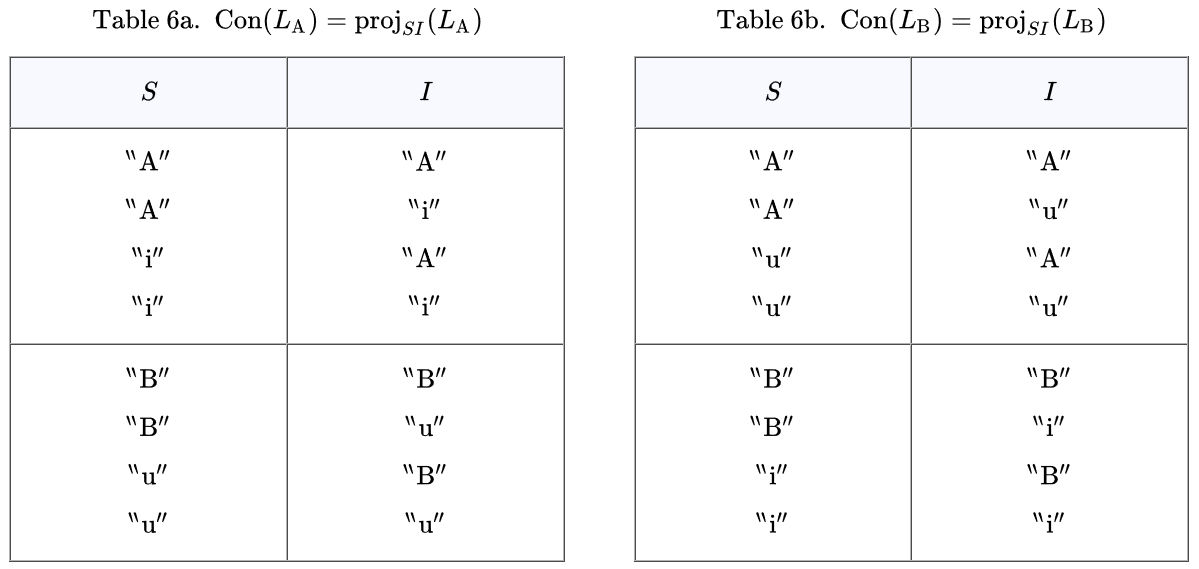
 yields the following semiotic equations.
![\begin{matrix} [ {}^{\backprime\backprime} \mathrm{A} {}^{\prime\prime} ]_{L_\mathrm{A}} & = & [ {}^{\backprime\backprime} \mathrm{i} {}^{\prime\prime} ]_{L_\mathrm{A}} \\[6pt] [ {}^{\backprime\backprime} \mathrm{B} {}^{\prime\prime} ]_{L_\mathrm{A}} & = & [ {}^{\backprime\backprime} \mathrm{u} {}^{\prime\prime} ]_{L_\mathrm{A}} \end{matrix}](https://s0.wp.com/latex.php?latex=%5Cbegin%7Bmatrix%7D++%5B+%7B%7D%5E%7B%5Cbackprime%5Cbackprime%7D+%5Cmathrm%7BA%7D+%7B%7D%5E%7B%5Cprime%5Cprime%7D+%5D_%7BL_%5Cmathrm%7BA%7D%7D++%26+%3D+%26++%5B+%7B%7D%5E%7B%5Cbackprime%5Cbackprime%7D+%5Cmathrm%7Bi%7D+%7B%7D%5E%7B%5Cprime%5Cprime%7D+%5D_%7BL_%5Cmathrm%7BA%7D%7D++%5C%5C%5B6pt%5D++%5B+%7B%7D%5E%7B%5Cbackprime%5Cbackprime%7D+%5Cmathrm%7BB%7D+%7B%7D%5E%7B%5Cprime%5Cprime%7D+%5D_%7BL_%5Cmathrm%7BA%7D%7D++%26+%3D+%26++%5B+%7B%7D%5E%7B%5Cbackprime%5Cbackprime%7D+%5Cmathrm%7Bu%7D+%7B%7D%5E%7B%5Cprime%5Cprime%7D+%5D_%7BL_%5Cmathrm%7BA%7D%7D++%5Cend%7Bmatrix%7D&bg=ffffff&fg=000000&s=0&c=20201002)
![\begin{matrix} {}^{\backprime\backprime} \mathrm{A} {}^{\prime\prime} & =_{L_\mathrm{A}} & {}^{\backprime\backprime} \mathrm{i} {}^{\prime\prime} \\[6pt] {}^{\backprime\backprime} \mathrm{B} {}^{\prime\prime} & =_{L_\mathrm{A}} & {}^{\backprime\backprime} \mathrm{u} {}^{\prime\prime} \end{matrix}](https://s0.wp.com/latex.php?latex=%5Cbegin%7Bmatrix%7D++%7B%7D%5E%7B%5Cbackprime%5Cbackprime%7D+%5Cmathrm%7BA%7D+%7B%7D%5E%7B%5Cprime%5Cprime%7D++%26+%3D_%7BL_%5Cmathrm%7BA%7D%7D+%26++%7B%7D%5E%7B%5Cbackprime%5Cbackprime%7D+%5Cmathrm%7Bi%7D+%7B%7D%5E%7B%5Cprime%5Cprime%7D++%5C%5C%5B6pt%5D++%7B%7D%5E%7B%5Cbackprime%5Cbackprime%7D+%5Cmathrm%7BB%7D+%7B%7D%5E%7B%5Cprime%5Cprime%7D++%26+%3D_%7BL_%5Cmathrm%7BA%7D%7D+%26++%7B%7D%5E%7B%5Cbackprime%5Cbackprime%7D+%5Cmathrm%7Bu%7D+%7B%7D%5E%7B%5Cprime%5Cprime%7D++%5Cend%7Bmatrix%7D&bg=ffffff&fg=000000&s=0&c=20201002)

 yields the following semiotic equations.
![\begin{matrix} [ {}^{\backprime\backprime} \mathrm{A} {}^{\prime\prime} ]_{L_\mathrm{B}} & = & [ {}^{\backprime\backprime} \mathrm{u} {}^{\prime\prime} ]_{L_\mathrm{B}} \\[6pt] [ {}^{\backprime\backprime} \mathrm{B} {}^{\prime\prime} ]_{L_\mathrm{B}} & = & [ {}^{\backprime\backprime} \mathrm{i} {}^{\prime\prime} ]_{L_\mathrm{B}} \end{matrix}](https://s0.wp.com/latex.php?latex=%5Cbegin%7Bmatrix%7D++%5B+%7B%7D%5E%7B%5Cbackprime%5Cbackprime%7D+%5Cmathrm%7BA%7D+%7B%7D%5E%7B%5Cprime%5Cprime%7D+%5D_%7BL_%5Cmathrm%7BB%7D%7D++%26+%3D+%26++%5B+%7B%7D%5E%7B%5Cbackprime%5Cbackprime%7D+%5Cmathrm%7Bu%7D+%7B%7D%5E%7B%5Cprime%5Cprime%7D+%5D_%7BL_%5Cmathrm%7BB%7D%7D++%5C%5C%5B6pt%5D++%5B+%7B%7D%5E%7B%5Cbackprime%5Cbackprime%7D+%5Cmathrm%7BB%7D+%7B%7D%5E%7B%5Cprime%5Cprime%7D+%5D_%7BL_%5Cmathrm%7BB%7D%7D++%26+%3D+%26++%5B+%7B%7D%5E%7B%5Cbackprime%5Cbackprime%7D+%5Cmathrm%7Bi%7D+%7B%7D%5E%7B%5Cprime%5Cprime%7D+%5D_%7BL_%5Cmathrm%7BB%7D%7D++%5Cend%7Bmatrix%7D&bg=ffffff&fg=000000&s=0&c=20201002)
![\begin{matrix} {}^{\backprime\backprime} \mathrm{A} {}^{\prime\prime} & =_{L_\mathrm{B}} & {}^{\backprime\backprime} \mathrm{u} {}^{\prime\prime} \\[6pt] {}^{\backprime\backprime} \mathrm{B} {}^{\prime\prime} & =_{L_\mathrm{B}} & {}^{\backprime\backprime} \mathrm{i} {}^{\prime\prime} \end{matrix}](https://s0.wp.com/latex.php?latex=%5Cbegin%7Bmatrix%7D++%7B%7D%5E%7B%5Cbackprime%5Cbackprime%7D+%5Cmathrm%7BA%7D+%7B%7D%5E%7B%5Cprime%5Cprime%7D++%26+%3D_%7BL_%5Cmathrm%7BB%7D%7D+%26++%7B%7D%5E%7B%5Cbackprime%5Cbackprime%7D+%5Cmathrm%7Bu%7D+%7B%7D%5E%7B%5Cprime%5Cprime%7D++%5C%5C%5B6pt%5D++%7B%7D%5E%7B%5Cbackprime%5Cbackprime%7D+%5Cmathrm%7BB%7D+%7B%7D%5E%7B%5Cprime%5Cprime%7D++%26+%3D_%7BL_%5Cmathrm%7BB%7D%7D+%26++%7B%7D%5E%7B%5Cbackprime%5Cbackprime%7D+%5Cmathrm%7Bi%7D+%7B%7D%5E%7B%5Cprime%5Cprime%7D++%5Cend%7Bmatrix%7D&bg=ffffff&fg=000000&s=0&c=20201002)

 and
and  have many interesting properties over and above those possessed by sign relations in general. Some of those properties have to do with the relation between signs and their interpretant signs, as reflected in the projections of
  ‑plane, notated as
  and
and  respectively. The dyadic relations on
  induced by those projections are also referred to as the connotative components of the corresponding sign relations, notated as
  and
and  respectively. Tables 6a and 6b show the corresponding connotative components.
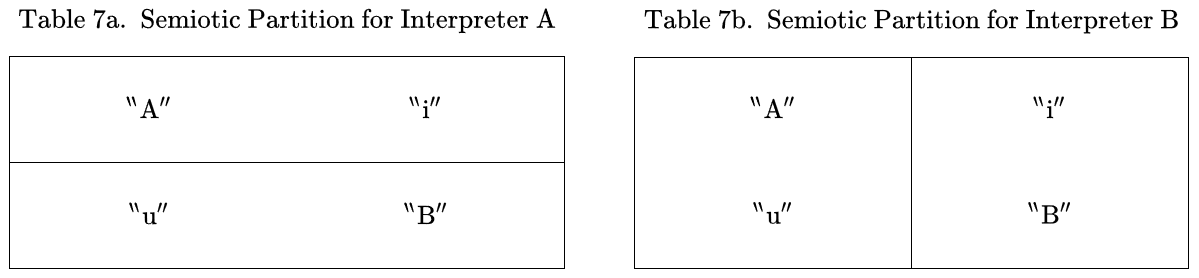
 form a pair of equivalence relations on their common syntactic domain
  This type of equivalence relation is called a semiotic equivalence relation (SER) because it equates signs having the same meaning to some interpreter.
 partitions the collection of signs into semiotic equivalence classes. This constitutes a strong form of representation in that the structure of the interpreters’ common object domain
  is reflected or reconstructed, part for part, in the structure of each one’s semiotic partition of the syntactic domain
 Information about the ennotative aspect of meaning is obtained from
  and the interpretant domain
  The ennotative component of a sign relation

 and
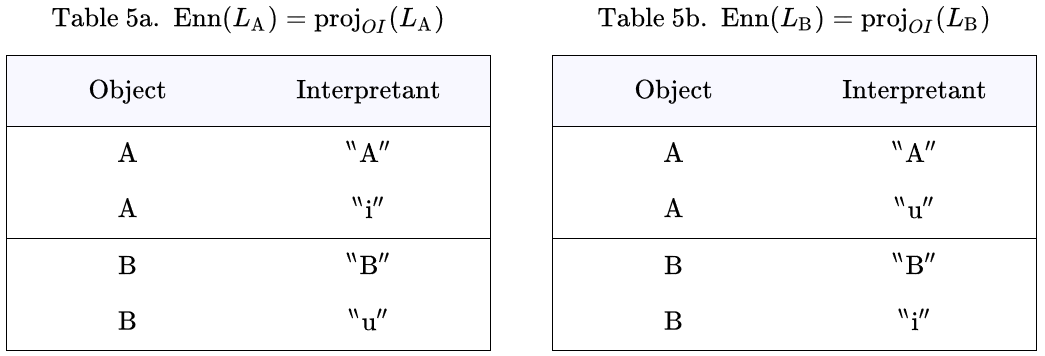
and  is defined as follows.
 is echoed unchanged in
  and all the data of
  is echoed unchanged in
 respectively. The rows of each Table list the ordered pairs
  in the corresponding projections,

 Inquiry Into Inquiry