Interpretive Duality in Logical Graphs • 8

Re: Interpretive Duality in Logical Graphs • 6

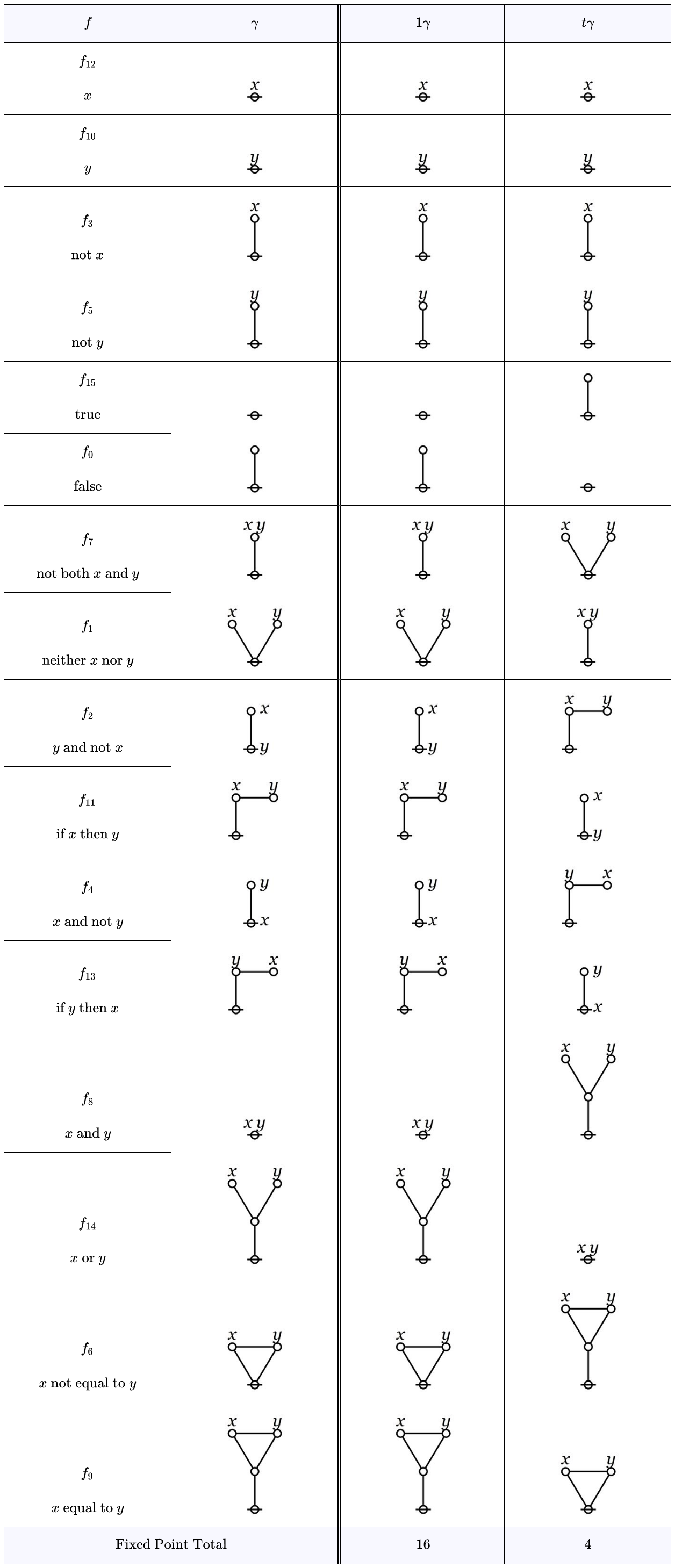
The last of our six ways of looking at interpretive duality is arrived at by taking the previous Table of Logical Graphs and Venn Diagrams and sorting it in Orbit Order.

\text{Logical Graphs} \stackrel{_\bullet}{} \text{Entitative and Existential Venn Diagrams} \stackrel{_\bullet}{} \text{Orbit Order}

Logical Graphs • Entitative and Existential Venn Diagrams • Orbit Order

Resources

cc: FB | Logical GraphsLaws of Form • Mathstodon • Academia.edu
cc: Conceptual GraphsCyberneticsStructural ModelingSystems Science

Posted in Amphecks, Animata, Boolean Algebra, Boolean Functions, C.S. Peirce, Cactus Graphs, Constraint Satisfaction Problems, Deduction, Diagrammatic Reasoning, Duality, Equational Inference, Graph Theory, Interpretive Duality, Laws of Form, Logic, Logical Graphs, Mathematics, Minimal Negation Operators, Model Theory, Painted Cacti, Proof Theory, Propositional Calculus, Propositional Equation Reasoning Systems, Spencer Brown, Visualization | Tagged , , , , , , , , , , , , , , , , , , , , , , , , | 4 Comments

Interpretive Duality in Logical Graphs • 7

Re: Interpretive Duality in Logical Graphs • 2

Dualities are symmetries of order two and symmetries bear on complexity by reducing its measure in proportion to their order.  The inverse relationship between symmetry and the usual dissymmetries from dispersion and diversity to entropy and uncertainty is governed in cybernetics by the Law of Requisite Variety, the medium of whose exchange C.S. Peirce invested in the formula Information = Comprehension × Extension.

The duality between entitative and existential interpretations of logical graphs is one example of a mathematical symmetry but it’s not unusual to find symmetries within symmetries and it’s always rewarding to find them where they exist.  To that end let’s take up our Table of Venn Diagrams and Logical Graphs on Two Variables and sort the rows to bring together diagrams and graphs having similar shapes.  What defines their similarity is the action of a mathematical group whose operations transform the elements of each class among one another but intermingle no dissimilar elements.  In the jargon of transformation groups those classes are called orbits.  We find the sixteen rows partition into seven orbits, as shown below.

\text{Venn Diagrams and Logical Graphs on Two Variables} \stackrel{_\bullet}{} \text{Orbit Order}

Venn Diagrams and Logical Graphs on Two Variables • Orbit Order

Resources

cc: FB | Logical GraphsLaws of Form • Mathstodon • Academia.edu
cc: Conceptual GraphsCyberneticsStructural ModelingSystems Science

Posted in Amphecks, Animata, Boolean Algebra, Boolean Functions, C.S. Peirce, Cactus Graphs, Constraint Satisfaction Problems, Deduction, Diagrammatic Reasoning, Duality, Equational Inference, Graph Theory, Interpretive Duality, Laws of Form, Logic, Logical Graphs, Mathematics, Minimal Negation Operators, Model Theory, Painted Cacti, Proof Theory, Propositional Calculus, Propositional Equation Reasoning Systems, Spencer Brown, Visualization | Tagged , , , , , , , , , , , , , , , , , , , , , , , , | 4 Comments

Interpretive Duality in Logical Graphs • 6

Re: Interpretive Duality in Logical Graphs • 2

A more graphic picture of interpretive duality is given by the next Table, showing how logical graphs map to venn diagrams under entitative and existential interpretations.  Column 1 shows the logical graphs for the sixteen boolean functions on two variables.  Column 2 shows the venn diagrams associated with the entitative interpretation and Column 3 shows the venn diagrams associated with the existential interpretation.

\text{Logical Graphs} \stackrel{_\bullet}{} \text{Entitative and Existential Venn Diagrams}

Logical Graphs • Entitative and Existential Venn Diagrams

Resources

cc: FB | Logical GraphsLaws of Form • Mathstodon • Academia.edu
cc: Conceptual GraphsCyberneticsStructural ModelingSystems Science

Posted in Amphecks, Animata, Boolean Algebra, Boolean Functions, C.S. Peirce, Cactus Graphs, Constraint Satisfaction Problems, Deduction, Diagrammatic Reasoning, Duality, Equational Inference, Graph Theory, Interpretive Duality, Laws of Form, Logic, Logical Graphs, Mathematics, Minimal Negation Operators, Model Theory, Painted Cacti, Proof Theory, Propositional Calculus, Propositional Equation Reasoning Systems, Spencer Brown, Visualization | Tagged , , , , , , , , , , , , , , , , , , , , , , , , | 5 Comments

Interpretive Duality in Logical Graphs • 5

Re: Interpretive Duality in Logical Graphs • 1

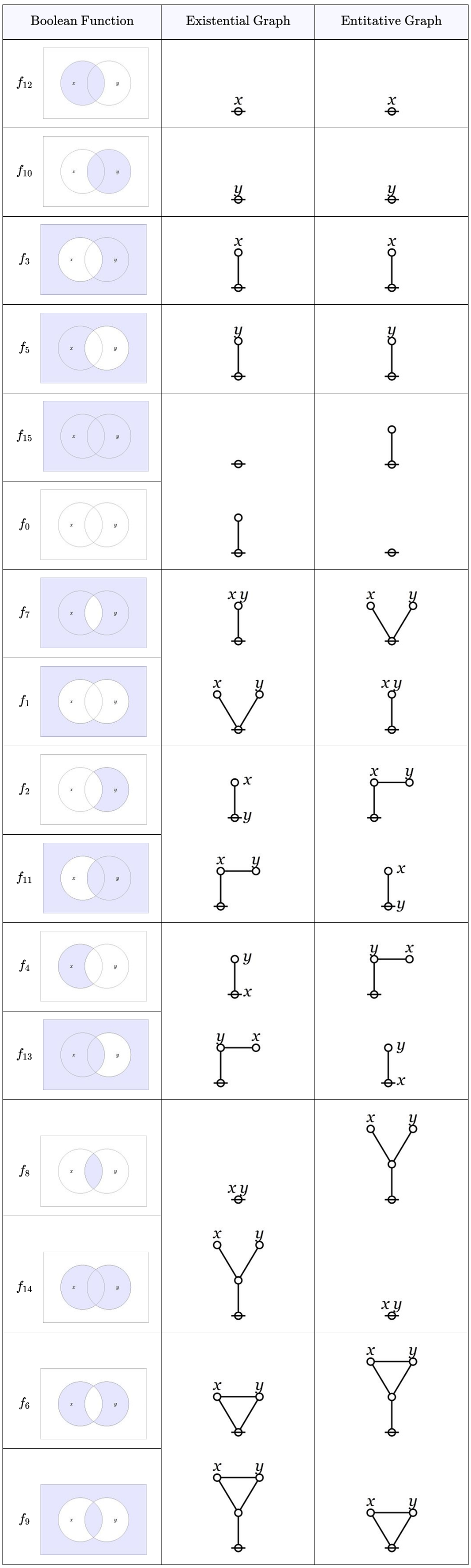
Another way of looking at interpretive duality in logical graphs is given by the following Table, showing how logical graphs denote the sixteen boolean functions on two variables under entitative and existential interpretations, respectively.

\text{Logical Graphs} \stackrel{_\bullet}{} \text{Entitative and Existential Interpretations}

Logical Graphs • Entitative and Existential Interpretations

Resources

cc: FB | Logical GraphsLaws of Form • Mathstodon • Academia.edu
cc: Conceptual GraphsCyberneticsStructural ModelingSystems Science

Posted in Amphecks, Animata, Boolean Algebra, Boolean Functions, C.S. Peirce, Cactus Graphs, Constraint Satisfaction Problems, Deduction, Diagrammatic Reasoning, Duality, Equational Inference, Graph Theory, Interpretive Duality, Laws of Form, Logic, Logical Graphs, Mathematics, Minimal Negation Operators, Model Theory, Painted Cacti, Proof Theory, Propositional Calculus, Propositional Equation Reasoning Systems, Spencer Brown, Visualization | Tagged , , , , , , , , , , , , , , , , , , , , , , , , | 4 Comments

Interpretive Duality in Logical Graphs • 4

Re: Interpretive Duality in Logical Graphs • (1)(2)(3)

Last time we took up Peirce’s law, ((p \Rightarrow q) \Rightarrow p) \Rightarrow p, and saw how it might be expressed in two different ways, under the entitative and existential interpretations, respectively.  The next thing to do is see how our choice of interpretation bears on the patterns of proof we might find.  A sense of the possibilities may be gotten by displaying the two styles of proof in parallel columns, as shown below.

\text{Peirce's Law} \stackrel{_\bullet}{} \text{Parallel Proofs}

Peirce's Law • Parallel Proofs

For convenience, the formal axioms and a few theorems of frequent use are linked below.

Resources

cc: FB | Logical GraphsLaws of Form • Mathstodon • Academia.edu
cc: Conceptual GraphsCyberneticsStructural ModelingSystems Science

Posted in Amphecks, Animata, Boolean Algebra, Boolean Functions, C.S. Peirce, Cactus Graphs, Constraint Satisfaction Problems, Deduction, Diagrammatic Reasoning, Duality, Equational Inference, Graph Theory, Interpretive Duality, Laws of Form, Logic, Logical Graphs, Mathematics, Minimal Negation Operators, Model Theory, Painted Cacti, Proof Theory, Propositional Calculus, Propositional Equation Reasoning Systems, Spencer Brown, Visualization | Tagged , , , , , , , , , , , , , , , , , , , , , , , , | 4 Comments

Interpretive Duality in Logical Graphs • 3

Re: Interpretive Duality in Logical Graphs • (1)(2)

For a sense of how the choice of interpretation bears on cases beyond the bare minimum complexity let us start with the familiar example of Peirce’s law, commonly expressed in the following form.

((p \Rightarrow q) \Rightarrow p) \Rightarrow p

The following two formal equations show how Peirce’s law may be expressed in terms of logical graphs, operating under the entitative and existential interpretations, respectively.

\text{Peirce's Law} \stackrel{_\bullet}{} \text{Dual Graphs}

Peirce's Law • Dual Graphs

Resources

cc: FB | Logical GraphsLaws of Form • Mathstodon • Academia.edu
cc: Conceptual GraphsCyberneticsStructural ModelingSystems Science

Posted in Amphecks, Animata, Boolean Algebra, Boolean Functions, C.S. Peirce, Cactus Graphs, Constraint Satisfaction Problems, Deduction, Diagrammatic Reasoning, Duality, Equational Inference, Graph Theory, Interpretive Duality, Laws of Form, Logic, Logical Graphs, Mathematics, Minimal Negation Operators, Model Theory, Painted Cacti, Proof Theory, Propositional Calculus, Propositional Equation Reasoning Systems, Spencer Brown, Visualization | Tagged , , , , , , , , , , , , , , , , , , , , , , , , | 5 Comments

Interpretive Duality in Logical Graphs • 2

Re: Interpretive Duality in Logical Graphs • 1

A logical concept represented by a boolean variable has its extension, the cases it covers in a designated universe of discourse, and its comprehension (or intension), the properties it implies in a designated hierarchy of predicates.

The formulas and graphs tabulated in the previous post are well‑adapted to articulate the syntactic and intensional aspects of propositional logic.  But their very tailoring to those tasks tends to slight the extensional and therefore empirical applications of logic.  Venn diagrams, despite their unwieldiness as the number of logical dimensions increases, are indispensable in providing the visual intuition with a solid grounding in the extensions of logical concepts.  All that makes it worthwhile to reset our table of boolean functions on two variables to include the corresponding venn diagrams.

\text{Venn Diagrams and Logical Graphs on Two Variables}

Venn Diagrams and Logical Graphs on Two Variables

cc: FB | Logical GraphsLaws of Form • Mathstodon • Academia.edu
cc: Conceptual GraphsCyberneticsStructural ModelingSystems Science

Posted in Amphecks, Animata, Boolean Algebra, Boolean Functions, C.S. Peirce, Cactus Graphs, Constraint Satisfaction Problems, Deduction, Diagrammatic Reasoning, Duality, Equational Inference, Graph Theory, Interpretive Duality, Laws of Form, Logic, Logical Graphs, Mathematics, Minimal Negation Operators, Model Theory, Painted Cacti, Proof Theory, Propositional Calculus, Propositional Equation Reasoning Systems, Spencer Brown, Visualization | Tagged , , , , , , , , , , , , , , , , , , , , , , , , | 8 Comments

Interpretive Duality in Logical Graphs • 1

The duality between Entitative and Existential interpretations of logical graphs is a good example of a mathematical symmetry, in this case a symmetry of order two.  Symmetries of this and higher orders give us conceptual handles on excess complexity in the manifold of sensuous impressions, making it well worth the effort to seek them out and grasp them where we find them.

Both Peirce and Spencer Brown understood the significance of the mathematical unity underlying the dual interpretation of logical graphs.  Peirce began with the Entitative option and later switched to the Existential choice while Spencer Brown exercised the Entitative option in his Laws of Form.

In that vein, here’s a Rosetta Stone to give us a grounding in the relationship between boolean functions and our two readings of logical graphs.

\text{Boolean Functions on Two Variables}

Boolean Functions on Two Variables

cc: FB | Logical GraphsLaws of Form • Mathstodon • Academia.edu
cc: Conceptual GraphsCyberneticsStructural ModelingSystems Science

Posted in Amphecks, Animata, Boolean Algebra, Boolean Functions, C.S. Peirce, Cactus Graphs, Constraint Satisfaction Problems, Deduction, Diagrammatic Reasoning, Duality, Equational Inference, Graph Theory, Interpretive Duality, Laws of Form, Logic, Logical Graphs, Mathematics, Minimal Negation Operators, Model Theory, Painted Cacti, Proof Theory, Propositional Calculus, Propositional Equation Reasoning Systems, Spencer Brown, Visualization | Tagged , , , , , , , , , , , , , , , , , , , , , , , , | 11 Comments

Operator Variables in Logical Graphs • 12

Re: Operator Variables in Logical Graphs • 11

The rules given in the previous post for evaluating cactus graphs were given in purely formal terms, that is, by referring to the mathematical forms of cacti without mentioning their potential for logical meaning.  As it turns out, two ways of mapping cactus graphs to logical meanings are commonly found in practice.  These two mappings of mathematical structure to logical meaning are formally dual to each other and known as the Entitative and Existential interpretations respectively.  The following Table compares the entitative and existential interpretations of the primary cactus structures, from which the rest of their semantics can be derived.

Logical Interpretations of Cactus Structures

cc: FB | Logical GraphsLaws of FormMathstodonAcademia.edu
cc: Conceptual GraphsCyberneticsStructural ModelingSystems Science

Posted in Amphecks, Animata, Boolean Algebra, Boolean Functions, C.S. Peirce, Cactus Graphs, Constraint Satisfaction Problems, Deduction, Diagrammatic Reasoning, Duality, Equational Inference, Graph Theory, Laws of Form, Logic, Logical Graphs, Mathematics, Minimal Negation Operators, Model Theory, Painted Cacti, Peirce, Proof Theory, Propositional Calculus, Propositional Equation Reasoning Systems, Spencer Brown, Theorem Proving, Visualization | Tagged , , , , , , , , , , , , , , , , , , , , , , , , , | 4 Comments

Operator Variables in Logical Graphs • 11

Re: Futures Of Logical GraphsThemes and Variations

This post and the next wrap up the Themes and Variations section of my speculation on Futures of Logical Graphs.  I made an effort to “show my work”, reviewing the steps I took to arrive at the present perspective on logical graphs, whistling past the least productive of the blind alleys, cul‑de‑sacs, detours, and forking paths I explored along the way.  It can be useful to tell the story that way, partly because others may find things I missed down those roads, but it does call for a recap of the main ideas I would like readers to take away.

Partly through my reflection on Peirce’s use of operator variables I was led to what I called a “reflective extension of logical graphs”, amounting to a graphical formal language called the “cactus language” or “cactus syntax” after its principal graph-theoretic data structure.

The abstract syntax of cactus graphs can be interpreted for logical use in a couple of ways, both of which arise from generalizing the negation operator {}^{\backprime\backprime} \texttt{(} ~ \texttt{)} {}^{\prime\prime} in a particular direction, treating {}^{\backprime\backprime} \texttt{(} ~ \texttt{)} {}^{\prime\prime} as the controlled, moderated, or reflective negation operator of order 1 and adding another operator for each integer greater than 1.  The resulting family of operators is symbolized by bracketed argument lists of the forms {}^{\backprime\backprime} \texttt{(} ~ \texttt{)} {}^{\prime\prime}, {}^{\backprime\backprime} \texttt{(} ~ \texttt{,} ~ \texttt{)} {}^{\prime\prime}, {}^{\backprime\backprime} \texttt{(} ~ \texttt{,} ~ \texttt{,} ~ \texttt{)} {}^{\prime\prime}, and so on, where the number of places is the order of the reflective negation operator in question.

Two rules suffice for evaluating cactus graphs.

  • The rule for evaluating a k-node operator, corresponding to an expression of the form {}^{\backprime\backprime} x_1 x_2 \ldots x_{k-1} x_k {}^{\prime\prime}, is as follows.

Node Evaluation Rule

  • The rule for evaluating a k-lobe operator, corresponding to an expression of the form {}^{\backprime\backprime} \texttt{(} x_1 \texttt{,} x_2 \texttt{,} \ldots \texttt{,} x_{k-1} \texttt{,} x_k \texttt{)} {}^{\prime\prime}, is as follows.

Lobe Evaluation Rule

cc: FB | Logical GraphsLaws of FormMathstodonAcademia.edu
cc: Conceptual GraphsCyberneticsStructural ModelingSystems Science

Posted in Amphecks, Animata, Boolean Algebra, Boolean Functions, C.S. Peirce, Cactus Graphs, Constraint Satisfaction Problems, Deduction, Diagrammatic Reasoning, Duality, Equational Inference, Graph Theory, Laws of Form, Logic, Logical Graphs, Mathematics, Minimal Negation Operators, Model Theory, Painted Cacti, Peirce, Proof Theory, Propositional Calculus, Propositional Equation Reasoning Systems, Spencer Brown, Theorem Proving, Visualization | Tagged , , , , , , , , , , , , , , , , , , , , , , , , , | 5 Comments