Charles Sanders Peirce, George Spencer Brown, and Me • 18

Re: Laws of FormJames Bowery

JB:
I’m interested in those who have approached the notion of self‑duality from the meta‑perspective of switching perspectives between Directed Cyclic Graphs of NiNAND and NiNOR gates (Ni for N‑Inputs à la boolean network theory).  The burgeoning interest in what might be called “The Self‑Simulation Hypothesis” founded on the notion of self‑duality rather demands this meta‑perspective.

Hi James, it’s been a while … Picking up this thread again always leads me through a maze of reminiscence — I’m used to that — but it’s taking more time than usual to sort out what bears on the topics you raise, more from the richness of the embedding matrix than any lack of content … but I will keep at it … here’s a first bit …

Parametrized families of logical operators like the ones you mention are some of the first things I remember discussing with one of my former logic professors, Herb Hendry, who told me they are called “multigrade operators”.  Herb taught in the philosophy department at Michigan State and became an early adopter of instructional technology for teaching logic, developing a software package by the name of CALL for Computer Assisted Logic Lessons.  It was only natural that I would come to have many discussions with him about my own adventures in computing for logic.

Then as now I came at everything from a Peircean direction and I had early on learned about the operators Peirce described as the ampheck \curlywedge and its dual \bar\curlywedge — McCulloch would later refer to both as amphecks for reasons we’ll get to eventually — and others of my teachers called NNOR and NAND, respectively.

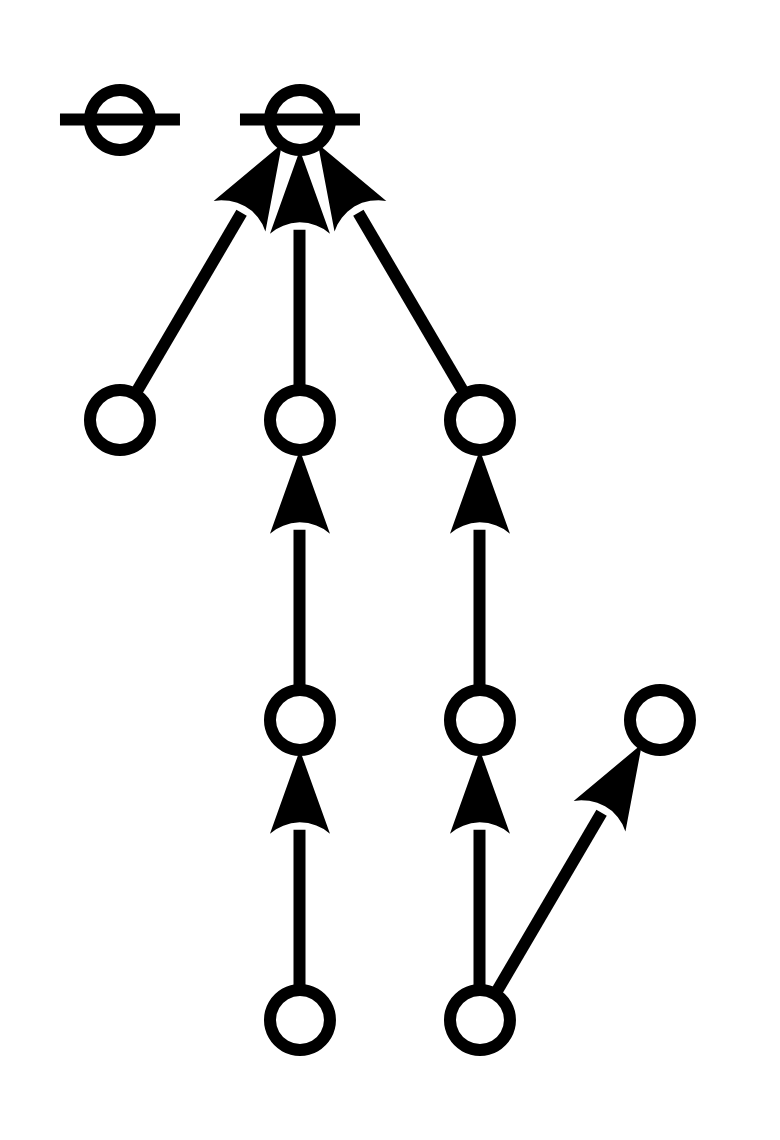
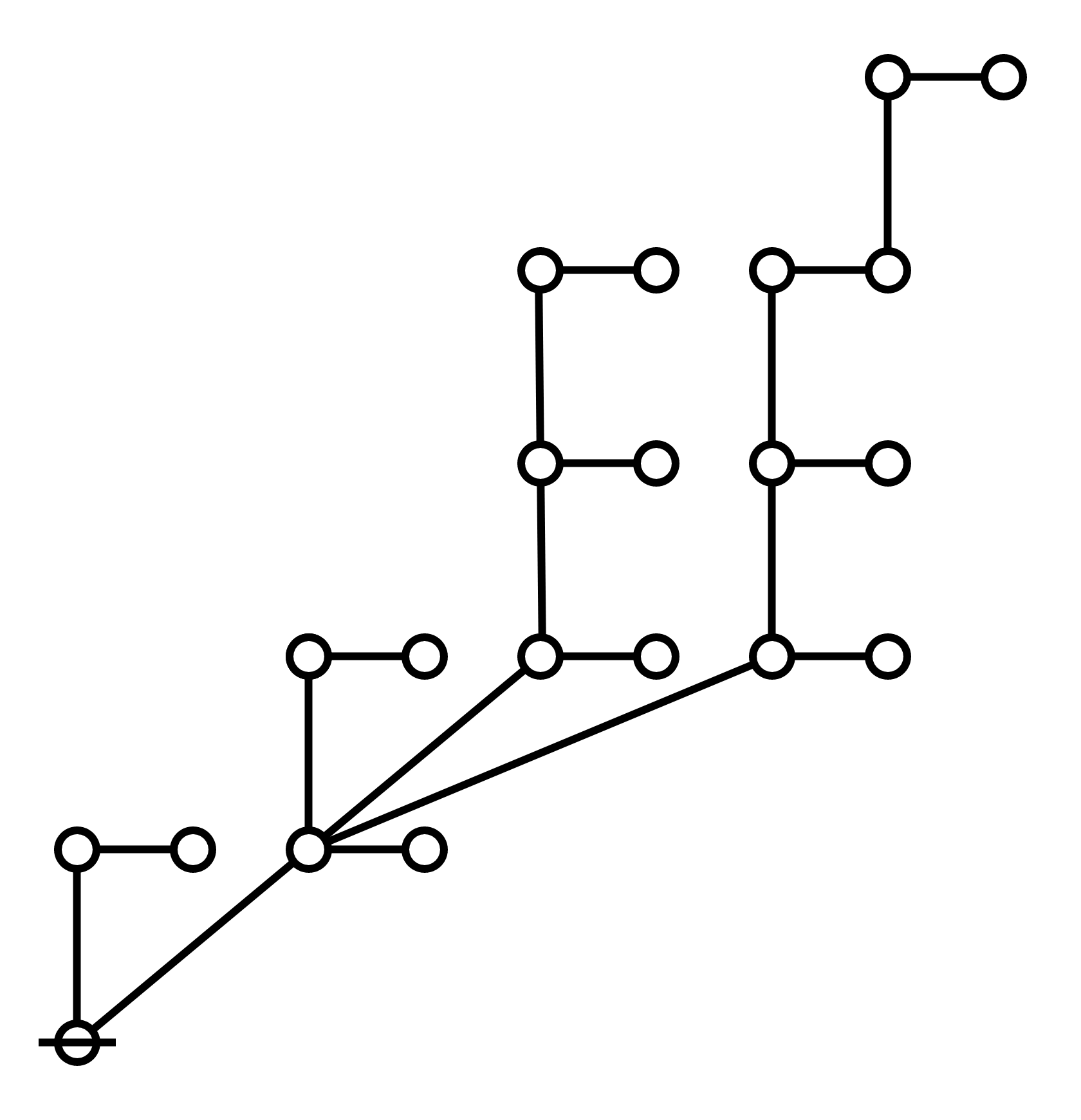
Making a long story as short as possible, the natural extensions of NAND and NNOR to finite numbers of variables are represented by logical graphs of the following forms.

Cactus Graphs for NCON and NDIS E(1‥n)

Working under what amounts to Peirce’s existential interpretation, an expression of the form \texttt{(} e_1 \ldots e_n \texttt{)} is a negation of a conjunction while an expression of the form \texttt{(} e_1 \texttt{)} \ldots \texttt{(} e_n \texttt{)} is a negation of a disjunction, which is also a conjunction of many negations.

For concreteness of orientation, the corresponding venn diagrams for the case where n = 3 are shown below.

Venn Diagrams for NCON and NDIS (p, q, r)

References

Resources

cc: Academia.edu • BlueSky • Laws of FormMathstodonResearch Gate
cc: Conceptual GraphsCyberneticsStructural ModelingSystems Science

Posted in Abstraction, Amphecks, Analogy, Animata, Boolean Algebra, Boolean Functions, C.S. Peirce, Cactus Graphs, Cybernetics, Deduction, Differential Analytic Turing Automata, Differential Logic, Duality, Form, Graph Theory, Inquiry, Inquiry Driven Systems, Laws of Form, Logic, Logical Graphs, Mathematics, Minimal Negation Operators, Model Theory, Proof Theory, Propositional Calculus, Semiotics, Sign Relational Manifolds, Sign Relations, Spencer Brown, Theorem Proving, Time, Topology | Tagged , , , , , , , , , , , , , , , , , , , , , , , , , , , , , , , | 1 Comment

Charles Sanders Peirce, George Spencer Brown, and Me • 17

Re: Laws of FormJames Bowery

JB:
I’m interested in those who have approached the notion of self‑duality from the meta‑perspective of switching perspectives between Directed Cyclic Graphs of NiNAND and NiNOR gates (Ni for N‑Inputs à la boolean network theory).  The burgeoning interest in what might be called “The Self‑Simulation Hypothesis” founded on the notion of self‑duality rather demands this meta‑perspective.

Thanks, James, I’ve been needing a break about here — the series on Cactus Language is very important but it can be rough going at times — as far as the current thread goes it’s been a long time passing so allow me a bit of anamnesis to remember why I walked into the room.

Resources

cc: Academia.edu • BlueSky • Laws of FormMathstodonResearch Gate
cc: Conceptual GraphsCyberneticsStructural ModelingSystems Science

Posted in Abstraction, Amphecks, Analogy, Animata, Boolean Algebra, Boolean Functions, C.S. Peirce, Cactus Graphs, Cybernetics, Deduction, Differential Analytic Turing Automata, Differential Logic, Duality, Form, Graph Theory, Inquiry, Inquiry Driven Systems, Laws of Form, Logic, Logical Graphs, Mathematics, Minimal Negation Operators, Model Theory, Proof Theory, Propositional Calculus, Semiotics, Sign Relational Manifolds, Sign Relations, Spencer Brown, Theorem Proving, Time, Topology | Tagged , , , , , , , , , , , , , , , , , , , , , , , , , , , , , , , | 1 Comment

Cactus Language • Pragmatics 16

Stricture, Strait, Constraint, Information, Complexity

The ways in which strictures and straits at different levels of complexity relate to one another can be given systematic treatment by introducing the following pair of definitions.

Excerpt of a Stricture
The j^\text{th} excerpt of a stricture ``S_1 \times \ldots \times S_k", regarded in a frame of discussion where the number of places is bounded by k, is a stricture of the form ``X \times \ldots \times S_j \times \ldots \times X".

The j^\text{th} excerpt can be written more briefly in context as the stricture ``(S_j)_{[j]}", an assertion which places the j^\text{th} set in the j^\text{th} place of the product.

Extract of a Strait
The j^\text{th} extract of a strait S_1 \times \ldots \times S_k, regarded in a frame of discussion where the number of places is bounded by k, is a strait of the form X \times \ldots \times S_j \times \ldots \times X.

The j^\text{th} extract can be denoted more briefly in context by the stricture ``(S_j)_{[j]}", an assertion which places the j^\text{th} set in the j^\text{th} place of the product.

Using the above definitions, a stricture of the form ``S_1 \times \ldots \times S_k" can be expressed in terms of simpler strictures, namely, as the following conjunction of its individual excerpts.

\begin{array}{lll}  ``S_1 \times \ldots \times S_k" & = & ``(S_1)_{[1]}" \land \ldots \land ``(S_k)_{[k]}"  \end{array}

In a similar vein, a strait of the form S_1 \times \ldots \times S_k can be expressed in terms of simpler straits, namely, as the following intersection of its individual extracts.

\begin{array}{lll}  S_1 \times \ldots \times S_k & = & (S_1)_{[1]} \cap \ldots \cap (S_k)_{[k]}  \end{array}

Resources

cc: Academia.edu • BlueSky • Laws of FormMathstodonResearch Gate
cc: Conceptual GraphsCyberneticsStructural ModelingSystems Science

Posted in Automata, Boolean Algebra, Boolean Functions, C.S. Peirce, Cactus Graphs, Differential Logic, Equational Inference, Formal Grammars, Formal Languages, Graph Theory, Logic, Logical Graphs, Mathematics, Minimal Negation Operators, Painted Cacti, Propositional Calculus, Visualization | Tagged , , , , , , , , , , , , , , , , | 2 Comments

Cactus Language • Pragmatics 15

Stricture, Strait, Constraint, Information, Complexity

From here it is easy to see how the concatenation of languages is related to the intersection of sets and thus to the conjunction of logical propositions.  In the upshot a cartesian product P \times Q is described by a logical proposition P_{[1]} \land Q_{[2]} subject to the following interpretation.

  • P_{[1]} says there is an element from the set P in the 1st place of the product P \times Q.
  • Q_{[2]} says there is an element from the set Q in the 2nd place of the product P \times Q.

The integration of those two pieces of information can be taken to specify a yet to be fully determined relation.

In a corresponding fashion at the level of elements, the ordered pair (p, q) is described by a conjunction of propositions, namely p_{[1]} \land q_{[2]}, subject to the following interpretation.

  • p_{[1]} says that p occupies the 1st place of the product element under construction.
  • q_{[2]} says that q occupies the 2nd place of the product element under construction.

Taking the cartesian product of P and Q or the concatenation of \mathfrak{L}_1 and \mathfrak{L}_2 in the above manner shifts the level of active construction from the tupling of elements in P and Q or the concatenation of strings in \mathfrak{L}_1 and \mathfrak{L}_2 to the concatenation of external signs describing those sets or languages.

Thus we pass to a conjunction of indexed propositions P_{[1]} and Q_{[2]} or a conjunction of assertions (\mathfrak{L}_1)_{[1]} and (\mathfrak{L}_2)_{[2]} which mark the indicated sets or languages for insertion in the indicated places of a product set or product language, respectively.  On closer examination, we can recognize the subscripting by the indices ``[1]" and ``[2]" as a type of concatenation, in this case accomplished through the posting of editorial remarks from an external mark‑up language.

Resources

cc: Academia.edu • BlueSky • Laws of FormMathstodonResearch Gate
cc: Conceptual GraphsCyberneticsStructural ModelingSystems Science

Posted in Automata, Boolean Algebra, Boolean Functions, C.S. Peirce, Cactus Graphs, Differential Logic, Equational Inference, Formal Grammars, Formal Languages, Graph Theory, Logic, Logical Graphs, Mathematics, Minimal Negation Operators, Painted Cacti, Propositional Calculus, Visualization | Tagged , , , , , , , , , , , , , , , , | 2 Comments

Cactus Language • Pragmatics 14

Stricture, Strait, Constraint, Information, Complexity

To give a concrete example of strictures and straits in action, let us institute a frame of discussion where the number of places in a relation is bounded at two and the variety of sets under active consideration is limited to the subsets P and Q of a universe X.  Under those conditions one may use the following sorts of expression as schematic strictures.

\begin{matrix}  ``X" & ``P" & ``Q"  \\[4pt]  ``X \times X" & ``X \times P" & ``X \times Q"  \\[4pt]  ``P \times X" & ``P \times P" & ``P \times Q"  \\[4pt]  ``Q \times X" & ``Q \times P" & ``Q \times Q"  \end{matrix}

The above strictures and their corresponding straits are stratified according to the amounts of information they contain, or the levels of constraint they impose, as shown in the following table.

\begin{array}{lcccc}  \text{High:} & ``P \times P" & ``P \times Q" & ``Q \times P" & ``Q \times Q"  \\[4pt]  \text{Med:} & ``P" & ``X \times P" & ``P \times X"  \\[4pt]  \text{Med:} & ``Q" & ``X \times Q" & ``Q \times X"  \\[4pt]  \text{Low:} & ``X" & ``X \times X"  \end{array}

In that framework, the complex strait P \times Q can be defined in terms of the simpler straits P \times X and X \times Q as the following set‑theoretic intersection.

\begin{array}{lllll}  P \times Q & = & P \times X & \cap & X \times Q  \end{array}

Resources

cc: Academia.edu • BlueSky • Laws of FormMathstodonResearch Gate
cc: Conceptual GraphsCyberneticsStructural ModelingSystems Science

Posted in Automata, Boolean Algebra, Boolean Functions, C.S. Peirce, Cactus Graphs, Differential Logic, Equational Inference, Formal Grammars, Formal Languages, Graph Theory, Logic, Logical Graphs, Mathematics, Minimal Negation Operators, Painted Cacti, Propositional Calculus, Visualization | Tagged , , , , , , , , , , , , , , , , | 2 Comments

Cactus Language • Pragmatics 13

Stricture, Strait, Constraint, Information, Complexity

Within the framework of a particular discussion, it is customary to set a bound on the number of places and to limit the variety of sets regarded as being under active consideration and it is further convenient to index the places of the indicated relations and their encompassing cartesian products in some fixed way.

But the whole idea of a stricture is to specify a strait capable of extending through and beyond fixed frames of discussion.  In other words, a stricture is conceived to constrain a strait at a certain point and then to leave it literally embedded, if tacitly expressed, in a yet to be fully specified relation, one involving an unspecified number of unspecified domains.

A quantity of information is a measure of constraint.  In that respect, a set of comparable strictures is ordered on account of the information each one conveys and a system of comparable straits is ordered in accord with the amount of information it takes to pin each one down.

Strictures which are more constraining and straits which are more constrained are placed at higher levels of information than those which are less so and entities involving more information are said to have greater complexity than entities involving less information, which are said to have greater simplicity.

Resources

cc: Academia.edu • BlueSky • Laws of FormMathstodonResearch Gate
cc: Conceptual GraphsCyberneticsStructural ModelingSystems Science

Posted in Automata, Boolean Algebra, Boolean Functions, C.S. Peirce, Cactus Graphs, Differential Logic, Equational Inference, Formal Grammars, Formal Languages, Graph Theory, Logic, Logical Graphs, Mathematics, Minimal Negation Operators, Painted Cacti, Propositional Calculus, Visualization | Tagged , , , , , , , , , , , , , , , , | 2 Comments

Cactus Language • Pragmatics 12

The concatenation \mathfrak{L}_1 \cdot \mathfrak{L}_2 of the formal languages \mathfrak{L}_1 and \mathfrak{L}_2 is just a cartesian product \mathfrak{L}_1 \times \mathfrak{L}_2 of the sets \mathfrak{L}_1 and \mathfrak{L}_2 but the relation of cartesian products to set‑theoretic intersections and thus to logical conjunctions is not immediately clear.  One way of seeing a type of relation is to focus on the information needed to specify each construction and thus to reflect on the signs used to bear the information.  As a first approach to the topic of information I introduce the following set of ideas, intended to be taken in a very provisional way.

A stricture is a specification of a certain set in a certain place, relative to a number of other sets yet to be specified.  It is assumed one knows enough to tell if two strictures are equivalent as pieces of information but any more determinate indications, for instance, names for the places mentioned in the stricture or bounds on the number of places involved, are regarded as extraneous impositions, outside the proper concern of the definition, no matter how convenient they happen to be for a particular discussion.  As a schematic form of illustration, a stricture can be pictured in the following shape.

``\ldots \times X \times Q \times X \times \ldots"

A strait is the object specified by a stricture, in other words, a certain set in a certain place of an otherwise yet to be specified relation.  Somewhat sketchily, the strait corresponding to the stricture just given can be pictured in the following shape.

\ldots \times X \times Q \times X \times \ldots

In that picture Q is a certain set and X is the universe of discourse relevant to a given discussion.  As a stricture does not contain a sufficient amount of information to specify the number of sets it intends to set in place, or even to pin down the absolute location of the set it does set in place, it appears to place an unspecified number of unspecified sets in a vague and uncertain state of affairs.  Taken out of its interpretive context the residual information a stricture is able to bear makes all of the following potentially equivalent as strictures.

\begin{array}{ccccccc}  ``Q" & , & ``X \times Q \times X" & , & ``X \times X \times Q \times X \times X" & , & \ldots  \end{array}

With respect to what those strictures specify, that leaves all of the following equivalent as straits.

\begin{array}{ccccccc}  Q & = & X \times Q \times X & = & X \times X \times Q \times X \times X & = & \ldots  \end{array}

Resources

cc: Academia.edu • BlueSky • Laws of FormMathstodonResearch Gate
cc: Conceptual GraphsCyberneticsStructural ModelingSystems Science

Posted in Automata, Boolean Algebra, Boolean Functions, C.S. Peirce, Cactus Graphs, Differential Logic, Equational Inference, Formal Grammars, Formal Languages, Graph Theory, Logic, Logical Graphs, Mathematics, Minimal Negation Operators, Painted Cacti, Propositional Calculus, Visualization | Tagged , , , , , , , , , , , , , , , , | 2 Comments

Cactus Language • Pragmatics 11

I am throwing together a wide variety of different operations into the bins labeled additive and multiplicative but it’s easy to observe a natural organization and even some relations approaching isomorphisms among and between the members of each class.

The relation between logical disjunction and the union of sets and the relation between logical conjunction and the intersection of sets ought to be clear enough for present purposes.  But the relation of set‑theoretic union to category‑theoretic co‑product and the relation of set‑theoretic intersection to syntactic concatenation deserve a closer look at this point.

The effect of a co‑product as a disjointed union, in other words, that creates an object tantamount to a disjoint union of sets in the resulting co‑product even if some of those sets intersect non‑trivially and even if some of them are identical in reality, can be achieved in several ways.

The usual conception is that of making a separate copy, for each part of the intended co‑product, of the set assigned to that part.  One imagines the set assigned to a particular part of the co‑product as being distinguished by a particular color, in other words, by the attachment of a distinct index, label, or tag, any sort of marker inherited by and passed on to every element of the set in that part.  A concrete image of the construction can be achieved by imagining each set and each element of each set is placed in an ordered pair with the sign of its color, index, label, or tag.  One describes that as the injection of each set into the corresponding part of the co‑product.

For example, given the sets P and Q, overlapping or not, one defines the indexed or marked sets P_{[1]} and Q_{[2]}, amounting to the copy of P into the first part of the co‑product and the copy of Q into the second part of the co‑product, in the following manner.

\begin{array}{lllll}  P_{[1]} & = & (P, 1) & = & \{ (x, 1) : x \in P \},  \\  Q_{[2]} & = & (Q, 2) & = & \{ (x, 2) : x \in Q \}.  \end{array}

Using the co‑product operator (\textstyle\coprod) for the construction, the sum, the co‑product, or the disjointed union of P and Q in that order can be represented as the ordinary union of P_{[1]} and Q_{[2]}.

\begin{array}{lll}  P \coprod Q & = & P_{[1]} \cup Q_{[2]}.  \end{array}

Resources

cc: Academia.edu • BlueSky • Laws of FormMathstodonResearch Gate
cc: Conceptual GraphsCyberneticsStructural ModelingSystems Science

Posted in Automata, Boolean Algebra, Boolean Functions, C.S. Peirce, Cactus Graphs, Differential Logic, Equational Inference, Formal Grammars, Formal Languages, Graph Theory, Logic, Logical Graphs, Mathematics, Minimal Negation Operators, Painted Cacti, Propositional Calculus, Visualization | Tagged , , , , , , , , , , , , , , , , | 2 Comments

Cactus Language • Pragmatics 10

One insight arising from Peirce’s work on the mathematics underlying logic is that the operations on sets known as complementation, intersection, and union, along with the corresponding logical operations of negation, conjunction, and disjunction, are not as fundamental as they first appear.  That is because all of them can be constructed or derived from a smaller set of operations, in fact, taking the logical side of things, from either one of two sole sufficient operators called amphecks by Peirce, strokes by those who re‑discovered them later, and known in computer science as the operators nand and nnor.  Thus by virtue of their precedence in the orders of construction and derivation, the sole sufficient operators have to be regarded as the simplest and most primitive in principle, even if they are scarcely recognized as lying among the more familiar elements of logic.

Resources

cc: Academia.edu • BlueSky • Laws of FormMathstodonResearch Gate
cc: Conceptual GraphsCyberneticsStructural ModelingSystems Science

Posted in Automata, Boolean Algebra, Boolean Functions, C.S. Peirce, Cactus Graphs, Differential Logic, Equational Inference, Formal Grammars, Formal Languages, Graph Theory, Logic, Logical Graphs, Mathematics, Minimal Negation Operators, Painted Cacti, Propositional Calculus, Visualization | Tagged , , , , , , , , , , , , , , , , | 2 Comments

Cactus Language • Pragmatics 9

A moment’s reflection on the issue of style, giving due consideration to the received array of stylistic choices, ought to inspire at least the question:  “Are those the only choices there are?”

There are abundant indications that other options, more differentiated varieties of description and more integrated ways of approaching individual languages, are likely to be conceivable, feasible, and even more ultimately viable.  If a suitably generic style, one that incorporates the full scope of logical combinations and operations, is broadly available, then it would no longer be necessary, or even apt, to argue in universal terms about which style is best, but more useful to investigate how we might adapt the local styles to the local requirements.  The medium of a fully generic style would yield a viable compromise between additive and multiplicative canons and render the choice between parallel and serial a false alternative, at least, when expressed in the globally exclusive terms which are currently and most commonly adopted to pose it.

One set of indications comes from the study of machines, languages, and computation, including theories of their structures and relations.  The forms of composition and decomposition known as parallel and serial are merely the limiting special cases in two directions of specialization of a more generic form, commonly known as the cascade form of combination.  That is a well‑known fact in the theories dealing with automata and their associated formal languages but its implications do not seem to be widely appreciated outside those fields.  In particular, the availability of that option dispells the need to choose one extreme or the other, since most of the natural cases are likely to exist somewhere in between.

Another set of indications appears in algebra and category theory, where forms of composition and decomposition related to the cascade combination, namely, the semi‑direct product and its special case, the wreath product, are encountered at higher levels of generality than the cartesian products of sets or the direct products of spaces.

In those domains of operation, one finds it necessary to consider also the co‑product of sets and spaces, a construction which artificially creates a disjoint union of sets, that is, a union of spaces which are being treated as independent.  It does that, in effect, by indexing, coloring, or preparing the otherwise possibly overlapping domains which are being combined.  What renders that a chimera or a hybrid form of combination is the fact that the indexing is tantamount to a cartesian product of a singleton set, namely, the conventional index, color, or affix in question, with the individual domain which is entering as a factor, a term, or a participant in the final result.

Resources

cc: Academia.edu • BlueSky • Laws of FormMathstodonResearch Gate
cc: Conceptual GraphsCyberneticsStructural ModelingSystems Science

Posted in Automata, Boolean Algebra, Boolean Functions, C.S. Peirce, Cactus Graphs, Differential Logic, Equational Inference, Formal Grammars, Formal Languages, Graph Theory, Logic, Logical Graphs, Mathematics, Minimal Negation Operators, Painted Cacti, Propositional Calculus, Visualization | Tagged , , , , , , , , , , , , , , , , | 2 Comments