Casual Introduction (cont.)
Figure 3 returns to the situation in Figure 1, but this time interpolates a new quality specifically tailored to account for the relation between Figure 1 and Figure 2.
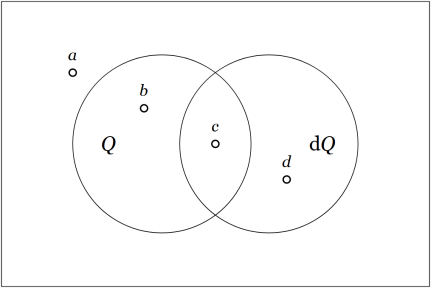

The new quality,  is marked as a differential quality on account of its absence or presence qualifying the absence or presence of change occurring in another quality. As with any quality, it is represented in the venn diagram by means of a “circle” distinguishing two halves of the universe of discourse, in this case, the portions of
  outside and inside the region
Figure 1 represents a universe of discourse  together with a basis of discussion
  for expressing propositions about the contents of that universe. Once the quality
  is given a name, say, the symbol
  we have the basis for a formal language specifically cut out for discussing in terms of
  That language is more formally known as the propositional calculus with alphabet
In the context marked by and  there are just four distinct pieces of information which can be expressed in the corresponding propositional calculus, namely, the constant proposition
  the negative proposition
  the positive proposition
  and the constant proposition
For example, referring to the points in Figure 1, the constant proposition  holds of no points, the negative proposition
  holds of
  and
and  the positive proposition holds of
  and
and  and the constant proposition
  holds of all points in the sample.
Figure 3 preserves the same universe of discourse and extends the basis of discussion to a set of two qualities,  In corresponding fashion, the initial propositional calculus is extended by means of the enlarged alphabet,
Resources
cc: Academia.edu • Cybernetics • Structural Modeling • Systems Science
cc: Conceptual Graphs • Laws of Form • Mathstodon • Research Gate




 is outside the region
  while the object
  is inside the region
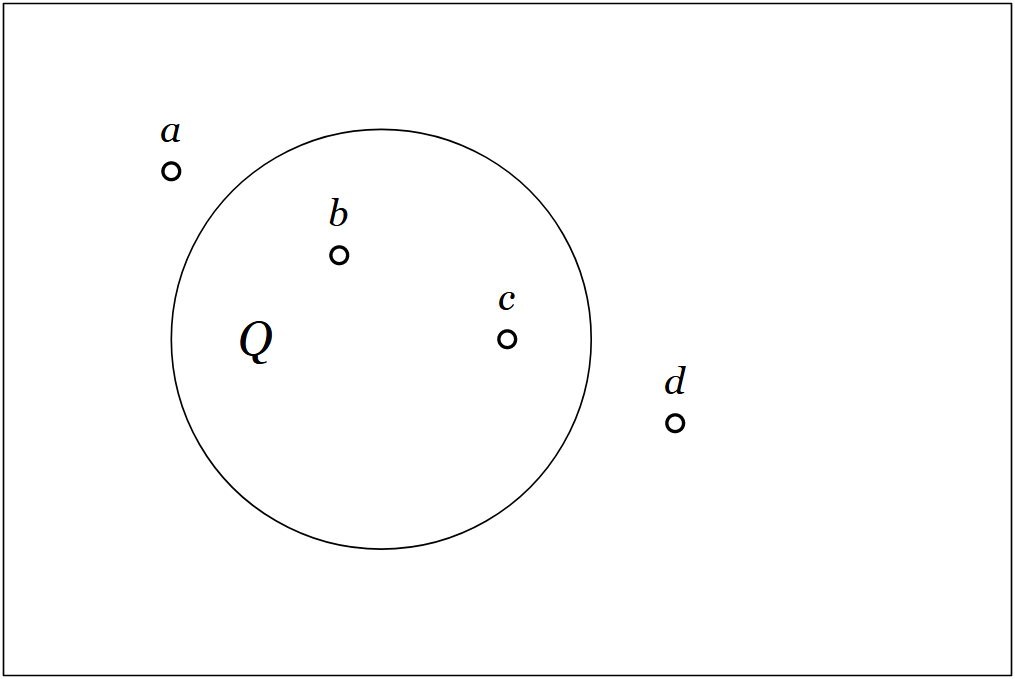

 The universe under discussion may be a population of individuals having various additional properties or it may be a collection of locations occupied by various individuals. The area of the “circle” represents the individuals with the property
  are singled out by name. As it happens,
  in the following way.
 we get by extracting the linear approximation to the difference map
  at each cell or point of the universe
  but since the adjective differential is being attached to just about everything in sight the alternative name tangent map is commonly used for
  whenever it’s necessary to single it out.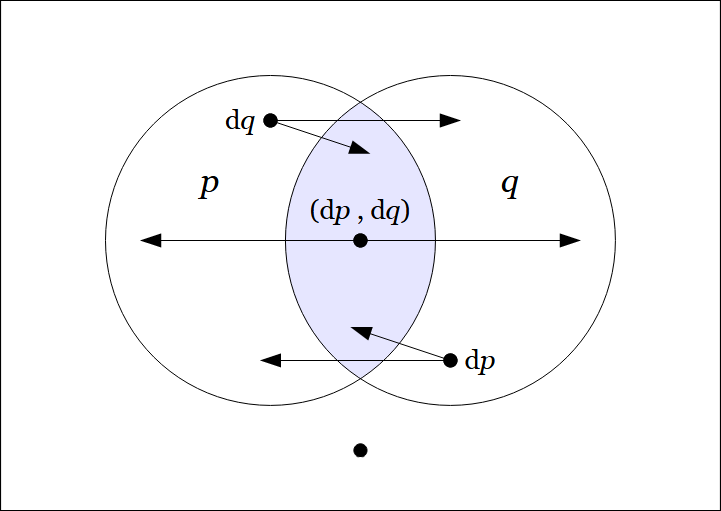

![\begin{array}{rcccccc} \mathrm{d}(pq) & = & p & \cdot & q & \cdot & \texttt{(} \mathrm{d}p \texttt{,} \mathrm{d}q \texttt{)} \\[4pt] & + & p & \cdot & \texttt{(} q \texttt{)} & \cdot & \mathrm{d}q \\[4pt] & + & \texttt{(} p \texttt{)} & \cdot & q & \cdot & \mathrm{d}p \\[4pt] & + & \texttt{(} p \texttt{)} & \cdot & \texttt{(} q \texttt{)} & \cdot & 0 \end{array}](https://s0.wp.com/latex.php?latex=%5Cbegin%7Barray%7D%7Brcccccc%7D++%5Cmathrm%7Bd%7D%28pq%29++%26+%3D+%26++p+%26+%5Ccdot+%26+q+%26+%5Ccdot+%26++%5Ctexttt%7B%28%7D+%5Cmathrm%7Bd%7Dp+%5Ctexttt%7B%2C%7D+%5Cmathrm%7Bd%7Dq+%5Ctexttt%7B%29%7D++%5C%5C%5B4pt%5D++%26+%2B+%26++p+%26+%5Ccdot+%26+%5Ctexttt%7B%28%7D+q+%5Ctexttt%7B%29%7D+%26+%5Ccdot+%26++%5Cmathrm%7Bd%7Dq++%5C%5C%5B4pt%5D++%26+%2B+%26++%5Ctexttt%7B%28%7D+p+%5Ctexttt%7B%29%7D+%26+%5Ccdot+%26+q+%26+%5Ccdot+%26++%5Cmathrm%7Bd%7Dp++%5C%5C%5B4pt%5D++%26+%2B+%26++%5Ctexttt%7B%28%7D+p+%5Ctexttt%7B%29%7D+%26+%5Ccdot+%26+%5Ctexttt%7B%28%7D+q+%5Ctexttt%7B%29%7D+%26+%5Ccdot+%26+0++%5Cend%7Barray%7D&bg=ffffff&fg=000000&s=0&c=20201002)
![\begin{matrix} \texttt{(} \mathrm{d}p \texttt{,} \mathrm{d}q \texttt{)} & = & \texttt{~} \mathrm{d}p \texttt{~} \texttt{(} \mathrm{d}q \texttt{)} & + & \texttt{(} \mathrm{d}p \texttt{)} \texttt{~} \mathrm{d}q \texttt{~} \\[4pt] dp & = & \texttt{~} \mathrm{d}p \texttt{~} \texttt{~} \mathrm{d}q \texttt{~} & + & \texttt{~} \mathrm{d}p \texttt{~} \texttt{(} \mathrm{d}q \texttt{)} \\[4pt] \mathrm{d}q & = & \texttt{~} \mathrm{d}p \texttt{~} \texttt{~} \mathrm{d}q \texttt{~} & + & \texttt{(} \mathrm{d}p \texttt{)} \texttt{~} \mathrm{d}q \texttt{~} \end{matrix}](https://s0.wp.com/latex.php?latex=%5Cbegin%7Bmatrix%7D++%5Ctexttt%7B%28%7D+%5Cmathrm%7Bd%7Dp+%5Ctexttt%7B%2C%7D+%5Cmathrm%7Bd%7Dq+%5Ctexttt%7B%29%7D++%26+%3D+%26++%5Ctexttt%7B%7E%7D+%5Cmathrm%7Bd%7Dp+%5Ctexttt%7B%7E%7D+%5Ctexttt%7B%28%7D+%5Cmathrm%7Bd%7Dq+%5Ctexttt%7B%29%7D++%26+%2B+%26++%5Ctexttt%7B%28%7D+%5Cmathrm%7Bd%7Dp+%5Ctexttt%7B%29%7D+%5Ctexttt%7B%7E%7D+%5Cmathrm%7Bd%7Dq+%5Ctexttt%7B%7E%7D++%5C%5C%5B4pt%5D++dp++%26+%3D+%26++%5Ctexttt%7B%7E%7D+%5Cmathrm%7Bd%7Dp+%5Ctexttt%7B%7E%7D+%5Ctexttt%7B%7E%7D+%5Cmathrm%7Bd%7Dq+%5Ctexttt%7B%7E%7D++%26+%2B+%26++%5Ctexttt%7B%7E%7D+%5Cmathrm%7Bd%7Dp+%5Ctexttt%7B%7E%7D+%5Ctexttt%7B%28%7D+%5Cmathrm%7Bd%7Dq+%5Ctexttt%7B%29%7D++%5C%5C%5B4pt%5D++%5Cmathrm%7Bd%7Dq++%26+%3D+%26++%5Ctexttt%7B%7E%7D+%5Cmathrm%7Bd%7Dp+%5Ctexttt%7B%7E%7D+%5Ctexttt%7B%7E%7D+%5Cmathrm%7Bd%7Dq+%5Ctexttt%7B%7E%7D++%26+%2B+%26++%5Ctexttt%7B%28%7D+%5Cmathrm%7Bd%7Dp+%5Ctexttt%7B%29%7D+%5Ctexttt%7B%7E%7D+%5Cmathrm%7Bd%7Dq+%5Ctexttt%7B%7E%7D++%5Cend%7Bmatrix%7D&bg=ffffff&fg=000000&s=0&c=20201002)
 which happens to be linear in pairs of variables.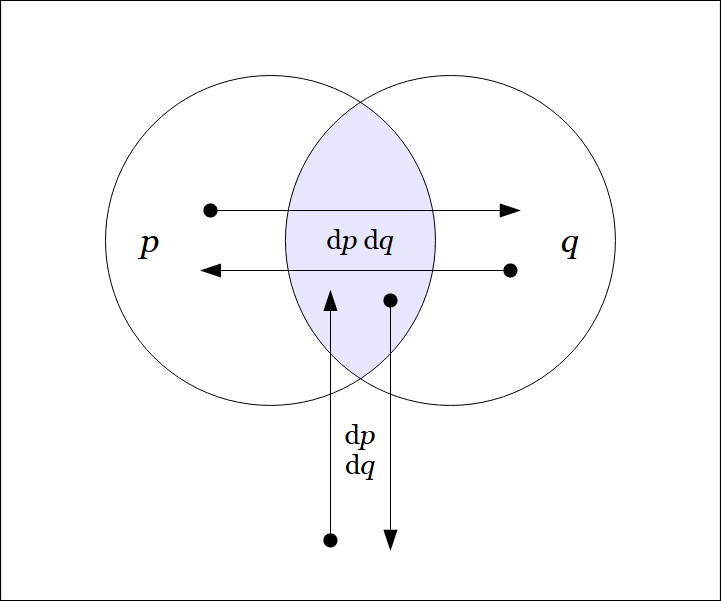

![\begin{array}{rcccccc} \mathrm{r}(pq) & = & p & \cdot & q & \cdot & \mathrm{d}p ~ \mathrm{d}q \\[4pt] & + & p & \cdot & \texttt{(} q \texttt{)} & \cdot & \mathrm{d}p ~ \mathrm{d}q \\[4pt] & + & \texttt{(} p \texttt{)} & \cdot & q & \cdot & \mathrm{d}p ~ \mathrm{d}q \\[4pt] & + & \texttt{(} p \texttt{)} & \cdot & \texttt{(} q \texttt{)} & \cdot & \mathrm{d}p ~ \mathrm{d}q \end{array}](https://s0.wp.com/latex.php?latex=%5Cbegin%7Barray%7D%7Brcccccc%7D++%5Cmathrm%7Br%7D%28pq%29++%26+%3D+%26+p+%26+%5Ccdot+%26+q+%26+%5Ccdot+%26+%5Cmathrm%7Bd%7Dp+%7E+%5Cmathrm%7Bd%7Dq++%5C%5C%5B4pt%5D++%26+%2B+%26+p+%26+%5Ccdot+%26+%5Ctexttt%7B%28%7D+q+%5Ctexttt%7B%29%7D+%26+%5Ccdot+%26+%5Cmathrm%7Bd%7Dp+%7E+%5Cmathrm%7Bd%7Dq++%5C%5C%5B4pt%5D++%26+%2B+%26+%5Ctexttt%7B%28%7D+p+%5Ctexttt%7B%29%7D+%26+%5Ccdot+%26+q+%26+%5Ccdot+%26+%5Cmathrm%7Bd%7Dp+%7E+%5Cmathrm%7Bd%7Dq++%5C%5C%5B4pt%5D++%26+%2B+%26+%5Ctexttt%7B%28%7D+p+%5Ctexttt%7B%29%7D+%26+%5Ccdot+%26+%5Ctexttt%7B%28%7D+q+%5Ctexttt%7B%29%7D+%26+%5Ccdot+%26+%5Cmathrm%7Bd%7Dp+%7E+%5Cmathrm%7Bd%7Dq++%5Cend%7Barray%7D&bg=ffffff&fg=000000&s=0&c=20201002)
 is a constant field, having the value
  at each cell.
 the following venn diagram shows the enlargement or shift map
  in the same style of field picture we drew for the tacit extension
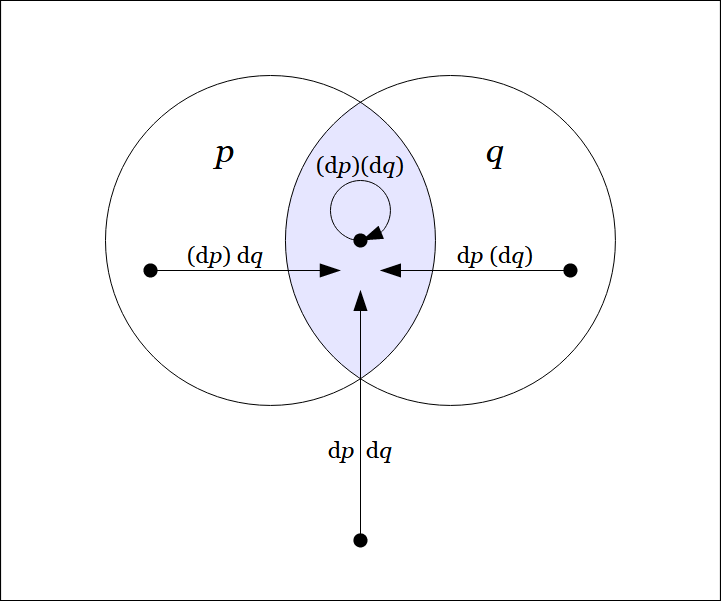

![\begin{array}{rcccccc} \mathrm{E}(pq) & = & p & \cdot & q & \cdot & \texttt{(} \mathrm{d}p \texttt{)(} \mathrm{d}q \texttt{)} \\[4pt] & + & p & \cdot & \texttt{(} q \texttt{)} & \cdot & \texttt{(} \mathrm{d}p \texttt{)~} \mathrm{d}q \texttt{~} \\[4pt] & + & \texttt{(} p \texttt{)} & \cdot & q & \cdot & \texttt{~} \mathrm{d}p \texttt{~(} \mathrm{d}q \texttt{)} \\[4pt] & + & \texttt{(} p \texttt{)} & \cdot & \texttt{(} q \texttt{)} & \cdot & \texttt{~} \mathrm{d}p \texttt{~~} \mathrm{d}q \texttt{~} \end{array}](https://s0.wp.com/latex.php?latex=%5Cbegin%7Barray%7D%7Brcccccc%7D++%5Cmathrm%7BE%7D%28pq%29+++%26+%3D+%26+p+%26+%5Ccdot+%26+q+%26+%5Ccdot+%26++%5Ctexttt%7B%28%7D+%5Cmathrm%7Bd%7Dp+%5Ctexttt%7B%29%28%7D+%5Cmathrm%7Bd%7Dq+%5Ctexttt%7B%29%7D++%5C%5C%5B4pt%5D++%26+%2B+%26+p+%26+%5Ccdot+%26+%5Ctexttt%7B%28%7D+q+%5Ctexttt%7B%29%7D+%26+%5Ccdot+%26++%5Ctexttt%7B%28%7D+%5Cmathrm%7Bd%7Dp+%5Ctexttt%7B%29%7E%7D+%5Cmathrm%7Bd%7Dq+%5Ctexttt%7B%7E%7D++%5C%5C%5B4pt%5D++%26+%2B+%26+%5Ctexttt%7B%28%7D+p+%5Ctexttt%7B%29%7D+%26+%5Ccdot+%26+q+%26+%5Ccdot+%26++%5Ctexttt%7B%7E%7D+%5Cmathrm%7Bd%7Dp+%5Ctexttt%7B%7E%28%7D+%5Cmathrm%7Bd%7Dq+%5Ctexttt%7B%29%7D++%5C%5C%5B4pt%5D++%26+%2B+%26+%5Ctexttt%7B%28%7D+p+%5Ctexttt%7B%29%7D+%26+%5Ccdot+%26+%5Ctexttt%7B%28%7D+q+%5Ctexttt%7B%29%7D+%26+%5Ccdot+%26++%5Ctexttt%7B%7E%7D+%5Cmathrm%7Bd%7Dp+%5Ctexttt%7B%7E%7E%7D+%5Cmathrm%7Bd%7Dq+%5Ctexttt%7B%7E%7D++%5Cend%7Barray%7D&bg=ffffff&fg=000000&s=0&c=20201002)
 and
and  both of the type
  is very useful, because it allows us to consider those fields as integral mathematical objects which can be operated on and combined in the ways we usually associate with algebras.
 are in a sense dual to each other. The tacit extension
  is true and the enlargement
  at
at  If we add the two sets of arcs in mod 2 fashion then the loop of multiplicity 2 zeroes out, leaving the 6 arrows of
  shown in the following venn diagram.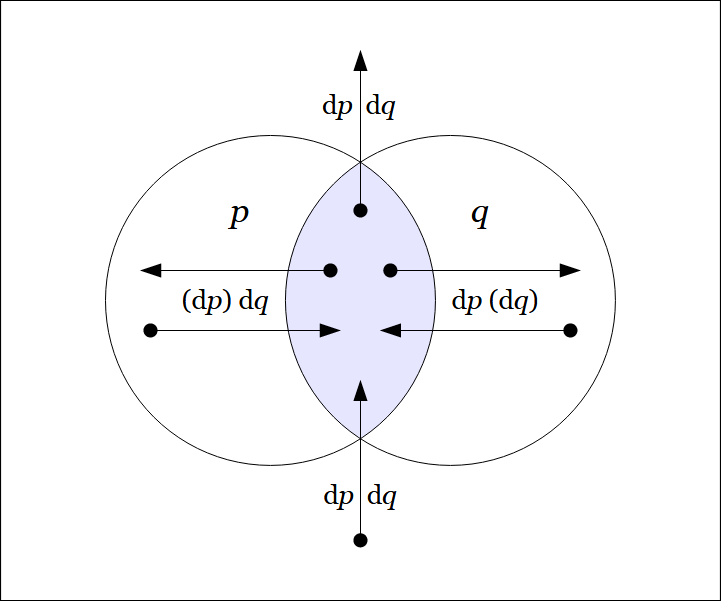

![\begin{array}{rcccccc} \mathrm{D}(pq) & = & p & \cdot & q & \cdot & \texttt{((} \mathrm{d}p \texttt{)(} \mathrm{d}q \texttt{))} \\[4pt] & + & p & \cdot & \texttt{(} q \texttt{)} & \cdot & \texttt{~(} \mathrm{d}p \texttt{)~} \mathrm{d}q \texttt{~~} \\[4pt] & + & \texttt{(} p \texttt{)} & \cdot & q & \cdot & \texttt{~~} \mathrm{d}p \texttt{~(} \mathrm{d}q \texttt{)~} \\[4pt] & + & \texttt{(} p \texttt{)} & \cdot & \texttt{(}q \texttt{)} & \cdot & \texttt{~~} \mathrm{d}p \texttt{~~} \mathrm{d}q \texttt{~~} \end{array}](https://s0.wp.com/latex.php?latex=%5Cbegin%7Barray%7D%7Brcccccc%7D++%5Cmathrm%7BD%7D%28pq%29+++%26+%3D+%26+p+%26+%5Ccdot+%26+q+%26+%5Ccdot+%26++%5Ctexttt%7B%28%28%7D+%5Cmathrm%7Bd%7Dp+%5Ctexttt%7B%29%28%7D+%5Cmathrm%7Bd%7Dq+%5Ctexttt%7B%29%29%7D++%5C%5C%5B4pt%5D++%26+%2B+%26+p+%26+%5Ccdot+%26+%5Ctexttt%7B%28%7D+q+%5Ctexttt%7B%29%7D+%26+%5Ccdot+%26++%5Ctexttt%7B%7E%28%7D+%5Cmathrm%7Bd%7Dp+%5Ctexttt%7B%29%7E%7D+%5Cmathrm%7Bd%7Dq+%5Ctexttt%7B%7E%7E%7D++%5C%5C%5B4pt%5D++%26+%2B+%26+%5Ctexttt%7B%28%7D+p+%5Ctexttt%7B%29%7D+%26+%5Ccdot+%26+q+%26+%5Ccdot+%26++%5Ctexttt%7B%7E%7E%7D+%5Cmathrm%7Bd%7Dp+%5Ctexttt%7B%7E%28%7D+%5Cmathrm%7Bd%7Dq+%5Ctexttt%7B%29%7E%7D++%5C%5C%5B4pt%5D++%26+%2B+%26+%5Ctexttt%7B%28%7D+p+%5Ctexttt%7B%29%7D+%26+%5Ccdot+%26+%5Ctexttt%7B%28%7Dq+%5Ctexttt%7B%29%7D+%26+%5Ccdot+%26++%5Ctexttt%7B%7E%7E%7D+%5Cmathrm%7Bd%7Dp+%5Ctexttt%7B%7E%7E%7D+%5Cmathrm%7Bd%7Dq+%5Ctexttt%7B%7E%7E%7D++%5Cend%7Barray%7D&bg=ffffff&fg=000000&s=0&c=20201002)
 to its enlargement or shift map
  and its difference map
  can now be drawn.
 and give its development a slightly different twist at the appropriate point.
 is shown again in the venn diagram below. In the field picture it may be seen as a scalar field — analogous to a potential hill in physics but in logic amounting to a potential plateau — where the shaded region indicates an elevation of 1 and the unshaded region indicates an elevation of 0.

 the tacit extension of
  is denoted
  and defined by the equation
  so it’s really just the same proposition residing in a bigger universe. Tacit extensions formalize the intuitive idea that a function on a given set of variables can be extended to a function on a superset of those variables in such a way that the new function obeys the same constraints on the old variables, with a “don’t care” condition on the new variables.
 is shown in the following venn diagram.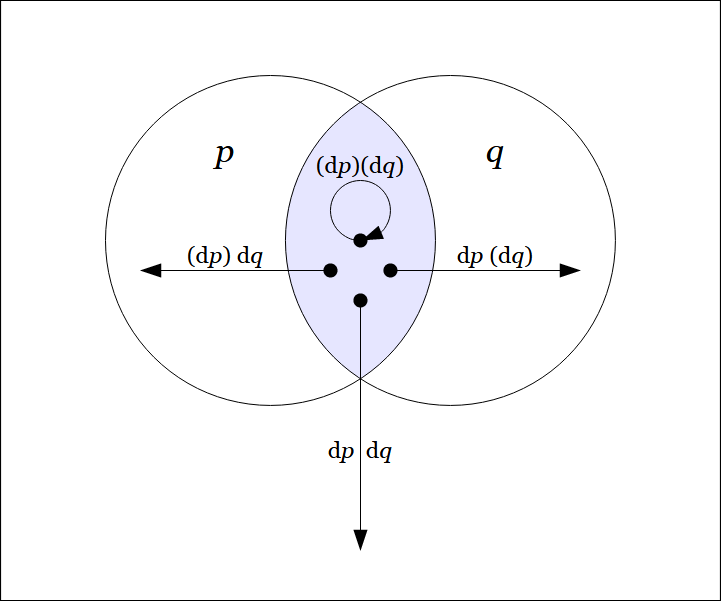

![\begin{array}{rcccccc} \boldsymbol\varepsilon (pq) & = & p & \cdot & q & \cdot & \texttt{(} \mathrm{d}p \texttt{)} \texttt{(} \mathrm{d}q \texttt{)} \\[4pt] & + & p & \cdot & q & \cdot & \texttt{(} \mathrm{d}p \texttt{)} \texttt{~} \mathrm{d}q \texttt{~} \\[4pt] & + & p & \cdot & q & \cdot & \texttt{~} \mathrm{d}p \texttt{~} \texttt{(} \mathrm{d}q \texttt{)} \\[4pt] & + & p & \cdot & q & \cdot & \texttt{~} \mathrm{d}p \texttt{~} \texttt{~} \mathrm{d}q \texttt{~} \end{array}](https://s0.wp.com/latex.php?latex=%5Cbegin%7Barray%7D%7Brcccccc%7D++%5Cboldsymbol%5Cvarepsilon+%28pq%29++%26+%3D+%26++p+%26+%5Ccdot+%26+q+%26+%5Ccdot+%26++%5Ctexttt%7B%28%7D+%5Cmathrm%7Bd%7Dp+%5Ctexttt%7B%29%7D++%5Ctexttt%7B%28%7D+%5Cmathrm%7Bd%7Dq+%5Ctexttt%7B%29%7D++%5C%5C%5B4pt%5D++%26+%2B+%26++p+%26+%5Ccdot+%26+q+%26+%5Ccdot+%26++%5Ctexttt%7B%28%7D+%5Cmathrm%7Bd%7Dp+%5Ctexttt%7B%29%7D++%5Ctexttt%7B%7E%7D+%5Cmathrm%7Bd%7Dq+%5Ctexttt%7B%7E%7D++%5C%5C%5B4pt%5D++%26+%2B+%26++p+%26+%5Ccdot+%26+q+%26+%5Ccdot+%26++%5Ctexttt%7B%7E%7D+%5Cmathrm%7Bd%7Dp+%5Ctexttt%7B%7E%7D++%5Ctexttt%7B%28%7D+%5Cmathrm%7Bd%7Dq+%5Ctexttt%7B%29%7D++%5C%5C%5B4pt%5D++%26+%2B+%26++p+%26+%5Ccdot+%26+q+%26+%5Ccdot+%26++%5Ctexttt%7B%7E%7D+%5Cmathrm%7Bd%7Dp+%5Ctexttt%7B%7E%7D++%5Ctexttt%7B%7E%7D+%5Cmathrm%7Bd%7Dq+%5Ctexttt%7B%7E%7D++%5Cend%7Barray%7D&bg=ffffff&fg=000000&s=0&c=20201002)
 that is, a proposition
  In that frame of reference, if
  is the universe generated by the set of coordinate propositions
  then
then  is the differential universe generated by the set of differential propositions
  The differential propositions
  and
and  may thus be interpreted as indicating
  and
and  respectively.
 of the first order type we are currently considering, takes a proposition
  In the field view of the scene, we see the proposition
  as a vector field, specifically, a field of propositions about contemplated changes in
  on
on  specifies the changes which need to be made from each point of
  that is, in order to satisfy the proposition
  on
on  specifies the changes which need to be made from each point of
  to considering a larger universe of discourse
  An operator
  of that general type, namely,
  acts on each proposition
  and the difference operator
  The operators
  that is, propositions of the form
  which amount to propositions about specified collections of changes conceivably occurring in
  over
over  If that sounds like the same thing as a function from

 takes us from considering propositions
 Inquiry Into Inquiry