
What Makes An Object? • 2

Re: Peirce List Discussison • (1)(2)

Visual metaphors and perceptual analogies can be instructive — they make for most of my personal favorites — but in logic, mathematics, and science our interest extends through the abductive spectrum, from percept formation to where it shades off to concept formation to where it takes off in theory formation.

Objects in logic and semiotics are any objects of discussion or thought — atoms and atomic clocks, bubbles and bubble chambers, clouds and cohorts, determinants and deuterium, electrons and ellipses, galaxies and ganglia, photons and positrons, quarks and question marks, …, you get the picture.

If we take care that our signs make sense, and by this “sense” mean to say they have objects that are logically consistent, then we pass from the realm of mere semiotics, where literary clutches will dilletate till the twelfth of never on the Madness Of Prince Hamlet (MOPH1) or the Method Of Prince Hamlet (MOPH0), or the taste of Organic Martian Potatoes (OMPs), and leaving all that till the twelfth of never we enter the realm of formal or normative semiotics that we know as logic.

Posted in C.S. Peirce, Interpretation, Interpretive Frameworks, Intuition, Logic, Logic of Relatives, Manifolds, Mathematics, Objective Frameworks, Peirce, Peirce List, Physics, Pragmata, Pragmatism, Process, Process Thinking, Relation Theory, Semiosis, Semiotics, Sign Relational Manifolds, Sign Relations, Triadic Relations | Tagged , , , , , , , , , , , , , , , , , , , , , | 1 Comment

What Makes An Object? • 1

Re: Gary FuhrmanSeeing Things

What makes an object is a perennial question.

I can remember my physics professors bringing it up in a really big way when I was still just a freshman in college.  They always cautioned us then about extrapolating our everyday intuitions about everyday objects beyond their native realms.

Anyone who has been graced or grazed by a modicum of process thinking, say Whitehead or Bucky Fuller, is aware of the trade-off between process thinking and product thinking that rules our descriptions of every domain of phenomena, but in a retrograde time like the one we are currently experiencing it takes a mighty effort to recollect the way that hidebound objects are precipitated from more primal processes.

Here’s an old post I happened on that may apply here:

Posted in C.S. Peirce, Interpretation, Interpretive Frameworks, Intuition, Logic, Logic of Relatives, Manifolds, Mathematics, Objective Frameworks, Peirce, Peirce List, Physics, Pragmata, Pragmatism, Process, Process Thinking, Relation Theory, Semiosis, Semiotics, Sign Relational Manifolds, Sign Relations, Triadic Relations | Tagged , , , , , , , , , , , , , , , , , , , , , | Leave a comment

Forgetfulness Of Purpose • 8

Re: Peirce List Discussion • (1)(2)

Just to review, we were looking at Ashby’s example of a regulation game as given below.

\begin{array}{cc|ccc}  \multicolumn{5}{c}{\text{Table 11/3/1}} \\[4pt]  & & & R & \\  & & \alpha & \beta & \gamma \\  \hline  & 1 & b & a & c \\  D & 2 & a & c & b \\  & 3 & c & b & a  \end{array}

I observed that this gives us a triadic relation G_1 \subseteq D \times R \times O whose triples are listed next.

\begin{matrix}  D & R & O \\  \hline  1 & \alpha & b \\  1 & \beta & a \\  1 & \gamma & c \\  2 & \alpha & a \\  2 & \beta & c \\  2 & \gamma & b \\  3 & \alpha & c \\  3 & \beta & b \\  3 & \gamma & a  \end{matrix}

Sungchul Ji raised a question about the irreducibility of G_1 as a triadic relation, suggesting that it would imply a degree of “communication” or “transfer of information” between D and R as constrained by the relation G_1.

For the moment I remain puzzled how we ought to measure various orders and quantities of information that affect the play of regulation games.  That question evidently depends on the kinds of structures that are key to the regulation task.  The quickest way to gain information on those scores is probably to read a little further in Ashby’s text, so I will set a goal of doing that.

On the other hand, the irreducibility of G_1 as a triadic relation can be investigated more directly, without considering the information question, so I will try that tack first.

Reference

  • Ashby, W.R. (1956), An Introduction to Cybernetics, Chapman and Hall, London, UK.  Republished by Methuen and Company, London, UK, 1964.  Online.
Posted in Anamnesis, Ashby, C.S. Peirce, Cybernetics, Memory, Peirce, Pragmata, Purpose, Systems Theory | Tagged , , , , , , , , | 1 Comment

Forgetfulness Of Purpose • 7

Re: Peirce List DiscussionSungchul Ji

I invited readers to consider Ashby’s example of a regulation game as a triadic relation G_1 \subseteq D \times R \times O whose triples (d, r, o) are given by either one of the following tables.

\begin{array}{cc|ccc}  \multicolumn{5}{c}{\text{Table 11/3/1}} \\[4pt]  & & & R & \\  & & \alpha & \beta & \gamma \\  \hline  & 1 & b & a & c \\  D & 2 & a & c & b \\  & 3 & c & b & a  \end{array}

\begin{matrix}  D & R & O \\  \hline  1 & \alpha & b \\  1 & \beta & a \\  1 & \gamma & c \\  2 & \alpha & a \\  2 & \beta & c \\  2 & \gamma & b \\  3 & \alpha & c \\  3 & \beta & b \\  3 & \gamma & a  \end{matrix}

Sungchul Ji asked a rather good question about the degree of “communication” or “transfer of information” between D and R within G_1 and its bearing on the irreducibility of G_1 as a triadic relation.  Given the light that concrete examples can throw on abstract questions, I thought it worth the effort to work through a detailed answer and I began as follows:

Ashby cast this example at a high level of abstraction in order to isolate the “bare bones” structure of the situation but we know the intended interpretation makes D the source of disturbances arising from the environment and R the regulator who has to counteract the disturbances in order to maintain the goal.

With regard to the question of communication or transfer of information between D and R, it is clear that R has to make different choices depending on what D does, so there is a degree of information transmission between D and R to that extent.  In effect, R is trying to cancel the variety that D creates.

Careful discussions of irreducibility will require us to work from explicit definitions and here it turns out there are several different notions of irreducibility that are often confounded in common use.

Looking to the case at hand, G_1 \subseteq D \times R \times O is a triadic relation consisting of 9 triples in the larger set D \times R \times O that consists of 3 \times 3 \times 3 = 27 triples.

We could reasonably use the ratio 3/9 = 1/3 as one measure of constraint, determination, information, selection, or “law” involved in carving G_1 from the uncarved block D \times R \times O.

If we prefer an additive measure, we could extract the exponents from the ratio 3^1/3^3 and use their difference as a measure of the information it takes to select G_1 from D \times R \times O.  Peirce pulled this very trick in some manuscripts I saw one time, getting a simple version of our modern day logarithmic measure of information.

To be continued …

Reference

  • Ashby, W.R. (1956), An Introduction to Cybernetics, Chapman and Hall, London, UK.  Republished by Methuen and Company, London, UK, 1964.  Online.
Posted in Anamnesis, Ashby, C.S. Peirce, Cybernetics, Memory, Peirce, Pragmata, Purpose, Systems Theory | Tagged , , , , , , , , | 3 Comments

Forgetfulness Of Purpose • 6

Just enough time for an incidental observation.

Consider the table Ashby uses to describe his first example of a regulation game.

\begin{array}{cc|ccc}  \multicolumn{5}{c}{\text{Table 11/3/1}} \\[4pt]  & & & R & \\  & & \alpha & \beta & \gamma \\  \hline  & 1 & b & a & c \\  D & 2 & a & c & b \\  & 3 & c & b & a  \end{array}

A table like that is a compact way of describing a triadic relation, in this case a relation L \subseteq D \times R \times O whose triples are displayed in the following relational data table.
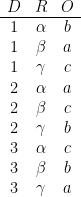
\begin{matrix}  D & R & O \\  \hline  1 & \alpha & b \\  1 & \beta  & a \\  1 & \gamma & c \\  2 & \alpha & a \\  2 & \beta  & c \\  2 & \gamma & b \\  3 & \alpha & c \\  3 & \beta  & b \\  3 & \gamma & a  \end{matrix}

May you find food for thought, a late night snack on those tables.

Reference

  • Ashby, W.R. (1956), An Introduction to Cybernetics, Chapman and Hall, London, UK.  Republished by Methuen and Company, London, UK, 1964.  Online.
Posted in Anamnesis, Ashby, C.S. Peirce, Cybernetics, Memory, Peirce, Pragmata, Purpose, Systems Theory | Tagged , , , , , , , , | 1 Comment

Forgetfulness Of Purpose • 5

Recall the game between R and D determined by the following data.

\begin{array}{cc|ccc}  \multicolumn{5}{c}{\text{Table 11/3/1}} \\[4pt]  & & & R & \\  & & \alpha & \beta & \gamma \\  \hline    & 1 & b & a & c \\  D & 2 & a & c & b \\    & 3 & c & b & a  \end{array}

Here is Ashby’s analysis of how it plays out.

Examination of the table soon shows that with this particular table R can win always.  Whatever value D selects first, R can always select a Greek letter that will give the desired outcome.  Thus if D selects 1, R selects β;  if D selects 2, R selects α;  and so on.  In fact, if R acts according to the transformation

\begin{array}{cccc}  & 1 & 2 & 3 \\  \downarrow & & & \\  & \beta & \alpha & \gamma  \end{array}

then he can always force the outcome to be a.

R‘s position, with this particular table, is peculiarly favourable, for not only can R always force a as the outcome, but he can as readily force, if desired, b or c as the outcome.  R has, in fact, complete control of the outcome.

Reference

  • Ashby, W.R. (1956), An Introduction to Cybernetics, Chapman and Hall, London, UK.  Republished by Methuen and Company, London, UK, 1964.  Online.
Posted in Anamnesis, Ashby, C.S. Peirce, Cybernetics, Memory, Peirce, Pragmata, Purpose, Systems Theory | Tagged , , , , , , , , | 2 Comments

Forgetfulness Of Purpose • 4

Ashby now invites us to consider a series of games, beginning as follows.

11/3.   Play and outcome.  Let us therefore forget all about regulation and simply suppose that we are watching two players, R and D, who are engaged in a game.  We shall follow the fortunes of R, who is attempting to score an a.  The rules are as follows.  They have before them Table 11/3/1, which can be seen by both:

\begin{array}{cc|ccc}  \multicolumn{5}{c}{\text{Table 11/3/1}} \\[4pt]  & & & R & \\  & & \alpha & \beta & \gamma \\  \hline    & 1 & b & a & c \\  D & 2 & a & c & b \\    & 3 & c & b & a  \end{array}

D must play first, by selecting a number, and thus a particular row.  R, knowing this number, then selects a Greek letter, and thus a particular column.  The italic letter specified by the intersection of the row and column is the outcome.  If it is an a, R wins;  if not, R loses.

I’ll pause the play here and give readers a chance to contemplate strategies.

Reference

  • Ashby, W.R. (1956), An Introduction to Cybernetics, Chapman and Hall, London, UK.  Republished by Methuen and Company, London, UK, 1964.  Online.
Posted in Anamnesis, Ashby, C.S. Peirce, Cybernetics, Memory, Peirce, Pragmata, Purpose, Systems Theory | Tagged , , , , , , , , | 2 Comments

Forgetfulness Of Purpose • 3

Here is the first part of Ashby’s setup for the schematic example I had in mind.

Requisite Variety

11/1.   In the previous chapter we considered regulation from the biological point of view, taking it as something sufficiently well understood.  In this chapter we shall examine the process of regulation itself, with the aim of finding out exactly what is involved and implied.  In particular we shall develop ways of measuring the amount or degree of regulation achieved, and we shall show that this amount has an upper limit.

11/2.   The subject of regulation is very wide in its applications, covering as it does most of the activities in physiology, sociology, ecology, economics, and much of the activities in almost every branch of science and life.  Further, the types of regulator that exist are almost bewildering in their variety.  One way of treating the subject would be to deal seriatim with the various types;  and chapter 12 will, in fact, indicate them.  In this chapter, however, we shall be attempting to get at the core of the subject — to find what is common to all.

What is common to all regulators, however, is not, at first sight, much like any particular form.  We will therefore start anew in the next section, making no explicit reference to what has gone before.  Only after the new subject has been sufficiently developed will we begin to consider any relation it may have to regulation.

Reference

  • Ashby, W.R. (1956), An Introduction to Cybernetics, Chapman and Hall, London, UK.  Republished by Methuen and Company, London, UK, 1964.  Online.
Posted in Anamnesis, Ashby, C.S. Peirce, Cybernetics, Memory, Peirce, Pragmata, Purpose, Systems Theory | Tagged , , , , , , , , | 1 Comment

Forgetfulness Of Purpose • 2

I had planned to get down to brass tacks as quickly as possible, with an object example from Ashby’s Cybernetics that made an impression on me at an early stage in my thinking about intelligent systems.  But while I was looking for that my eye fell on on another passage that so well articulates one of the deepest roots of scientific reasoning that I could not resist reciting it here.

Quantity of Variety

7/1.   In Part I we considered the main properties of the machine, usually with the assumption that we had before us the actual thing, about which we would make some definite statement, with reference to what it is doing here and now.  To progress in cybernetics, however, we shall have to extend our range of consideration.  The fundamental questions in regulation and control can be answered only when we are able to consider the broader set of what it might do, when “might” is given some exact specification.

Throughout Part II, therefore, we shall be considering always a set of possibilities.  The study will lead us into the subjects of information and communication, and how they are coded in their passages through mechanism.  This study is essential for the thorough understanding of regulation and control.  We shall start from the most elementary or basic considerations possible.

7/2.   A second reason for considering a set of possibilities is that science is little interested in some fact that is valid only for a single experiment, conducted on a single day;  it seeks always for generalisations, statements that shall be true for all of a set of experiments, conducted in a variety of laboratories and on a variety of occasions.  Galileo’s discovery of the law of the pendulum would have been of little interest had it been valid only for that pendulum on that afternoon.  Its great importance is due precisely to the fact that it is true over a great range of space and time and materials.  Science looks for the repetitive.

7/3.   This fact, that it is the set that science refers to, is often obscured by a manner of speech.  “The chloride ion …”, says the lecturer, when clearly he means his statement to apply to all chloride ions.  So we get references to the petrol engine, the growing child, the chronic drunkard, and to other objects in the singular, when the reference is in fact to the set of all such objects.

Reference

  • Ashby, W.R. (1956), An Introduction to Cybernetics, Chapman and Hall, London, UK.  Republished by Methuen and Company, London, UK, 1964.  Online.
Posted in Anamnesis, Ashby, C.S. Peirce, Cybernetics, Memory, Peirce, Pragmata, Purpose, Systems Theory | Tagged , , , , , , , , | 1 Comment

Forgetfulness Of Purpose • 1

Naturally I had purposes and reflected on my purposes for as long as I can remember but I don’t think I thought about the concept of purpose in a systematic way until I began taking courses on cybernetics and systems theory in college.  So I’ll try beginning this anamnesis with the readings that stick in my memory from those times.

Posted in Anamnesis, Ashby, C.S. Peirce, Cybernetics, Memory, Peirce, Pragmata, Purpose, Systems Theory | Tagged , , , , , , , , | 3 Comments