
Grammar 4 (concl.)
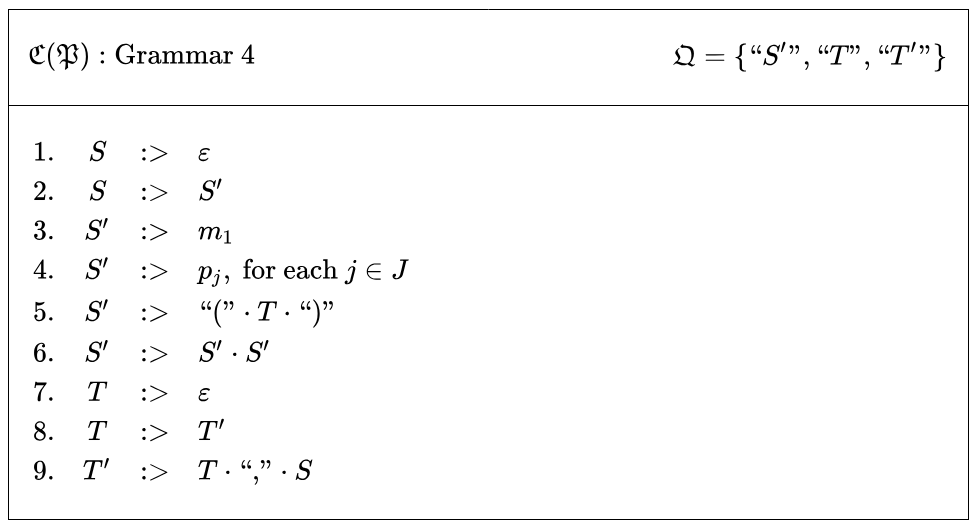
As we have seen, Grammar 4 partitions the intermediate type 


There does not appear to be anything radically wrong with trying the above approach to types. It is reasonable and consistent in its underlying principle and it provides a rational and uniform strategy toward all parts of speech. But it does require an extra amount of conceptual overhead in that every non‑trivial type has to be split into two parts and comprehended in two stages. Consequently, in view of the largely practical difficulties of making the required distinctions for every intermediate symbol, it is a common convention, whenever possible, to restrict intermediate types to covering exclusively non‑empty strings.
It is convenient to refer to the above restriction on intermediate symbols as the intermediate significance constraint. It may be given compact form as a condition on the relations between non‑terminal symbols 

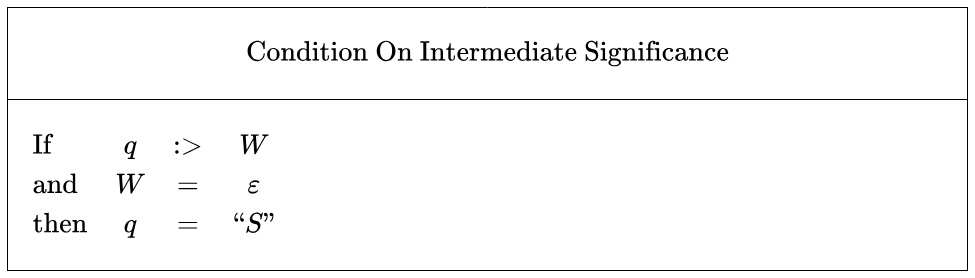
If that begins to sound like a monotone condition then it is not absurd to sharpen the resemblance and render the likeness more acute. That is achieved by declaring a couple of ordering relations, denoting them under variant interpretations by the same sign,

- The ordering
on the collection of non‑terminal symbols
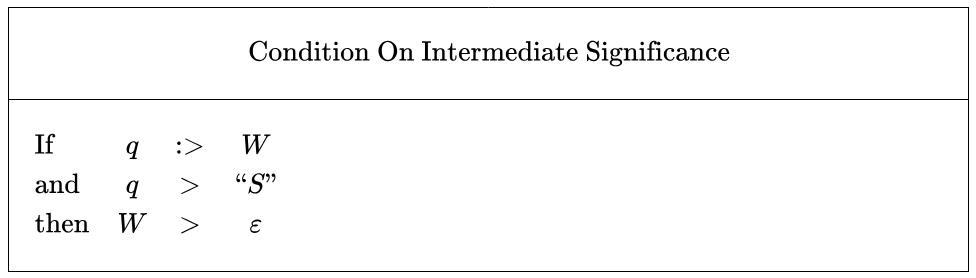
to be strictly prior to every intermediate symbol. That amounts to an axiom of the form
for all
- The ordering
ordains the empty string to be strictly less than every other sentential form. That amounts to an axiom of the form
for every non‑empty sentential form


Given the above orderings, the constraint on intermediate significance may be stated as follows.
A grammar respecting intermediate significance will normally require a more detailed account of the initial setting of each type, both with regard to the type of context inciting its appearance and also with respect to the minimal strings arising under the type in question. In order to find covering productions satisfying the intermediate significance condition, one must be prepared to consider a wider variety of calling contexts or inciting situations observed to surround each recognized type and also to enumerate a larger number of minimal cases observed to fall under the significant types.
Resources
cc: Academia.edu • BlueSky • Laws of Form • Mathstodon • Research Gate
cc: Conceptual Graphs • Cybernetics • Structural Modeling • Systems Science


 Inquiry Into Inquiry
Pingback: Survey of Animated Logical Graphs • 8 | Inquiry Into Inquiry
Pingback: Survey of Animated Logical Graphs • 8 | Systems Community of Inquiry