Cactus Language • Syntax 9

Grammar 4

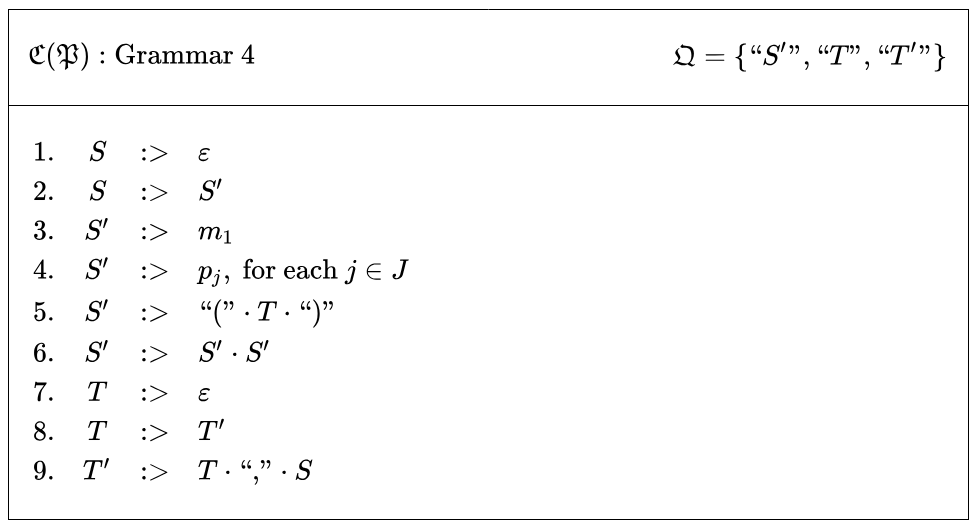
If one imposes the distinction between empty and significant types on each non‑terminal symbol in Grammar 2 then the symbols ``S" and ``T" give rise to the expanded set of non‑terminal symbols ``S", ``S'", ``T", ``T'", leaving the last three to form a new intermediate alphabet.

Grammar 4 has the intermediate alphabet \mathfrak{Q} = \{ ``S'", ``T", ``T'" \} with the set \mathfrak{K} of covering rules listed in the next display.

Cactus Language Grammar 4

Grammar 4 partitions the intermediate type T as T = \underline\varepsilon + T' in parallel fashion with the division of its overlying type as S = \underline\varepsilon + S'.  That is an option we will close off for now but leave open to consider at a later point.  It suffices to give a brief discussion of the considerations involved in choosing between grammars at this point, and then move on to the next alternative.

Resources

cc: Academia.edu • BlueSky • Laws of FormMathstodonResearch Gate
cc: Conceptual GraphsCyberneticsStructural ModelingSystems Science

This entry was posted in Automata, Boolean Algebra, Boolean Functions, C.S. Peirce, Cactus Graphs, Differential Logic, Equational Inference, Formal Grammars, Formal Languages, Graph Theory, Logic, Logical Graphs, Mathematics, Minimal Negation Operators, Painted Cacti, Propositional Calculus, Visualization and tagged , , , , , , , , , , , , , , , , . Bookmark the permalink.

2 Responses to Cactus Language • Syntax 9

  1. Pingback: Survey of Animated Logical Graphs • 8 | Inquiry Into Inquiry

  2. Pingback: Survey of Animated Logical Graphs • 8 | Systems Community of Inquiry

Leave a comment

This site uses Akismet to reduce spam. Learn how your comment data is processed.