Grammar 2
One way to analyze the surcatenation of any number of sentences is to introduce an auxiliary type of string, not itself a sentence but a proper component of any sentence formed by surcatenation. Doing that brings one to the following definition.
A tract is a concatenation of a finite sequence of sentences, with a literal comma  interpolated between each pair of adjacent sentences. Thus, a typical tract
  takes the following form.

A tract of that type must be distinguished from the abstract sequence of sentences,  where the commas coming to mind, as if being called up to separate the successive sentences of the sequence, remain as partially abstract conceptions, or as signs retaining a disengaged status on the borderline between text and mind. The kinds of commas appearing in the abstract sequence continue to exist as conceptual abstractions and fail to be cognized in a wholly explicit fashion, either as concrete tokens in the object language or as marks in the text engaging one’s parsing attention.
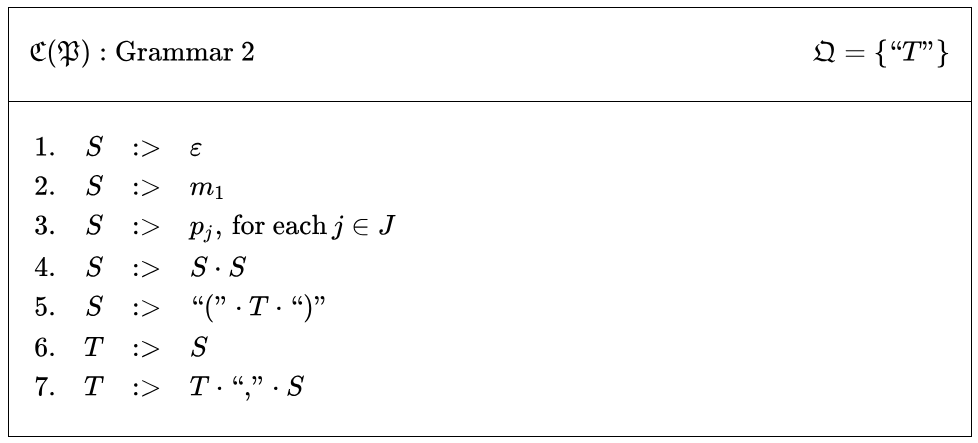
Returning to the painted cactus language  it is possible to put the assembled pieces of grammar together in the light of the adopted canons of style to refine our analysis of the fact that the concept of a sentence covers any concatenation of sentences and any surcatenation of sentences, and so arrive at the following form of grammar.
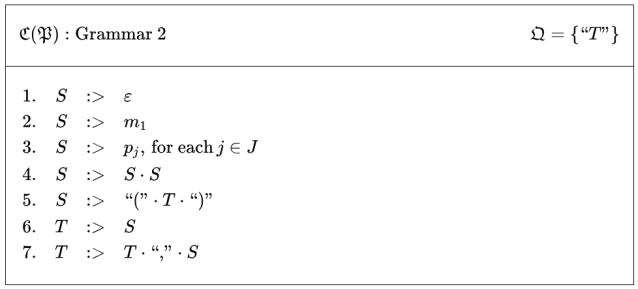
In that rendition, a string of type is not in general a sentence itself but a proper part of speech, that is, a strictly lesser component of a sentence in any suitable ordering of sentences and their components. In order to see how the grammatical category gets off the ground, that is, to detect its minimal strings and to discover how its ensuing generations take their start from those, it is useful to observe that the covering rule  means that inherits all the initial conditions of
  namely,
  In accord with those simple beginnings it comes to pass that the rule
  with the substitutions
  and
and  , bears the germinal implication that
Grammar 2 achieves a portion of its success through a higher degree of intermediate organization. The level of organization is reflected in the size of the intermediate alphabet  but the number of symbols alone does not give a full account, as intermediate symbols are taken to serve a purpose, a purpose which is easy to recognize but not so easy to pin down and specify exactly. Nevertheless, it is worth the trouble to explore the intermediate level of organization and its development a little further.
Resources
cc: Academia.edu • BlueSky • Laws of Form • Mathstodon • Research Gate
cc: Conceptual Graphs • Cybernetics • Structural Modeling • Systems Science


 Inquiry Into Inquiry
Pingback: Survey of Animated Logical Graphs • 8 | Inquiry Into Inquiry
Pingback: Survey of Animated Logical Graphs • 8 | Systems Community of Inquiry