Grammar 1
Grammar 1 is something of a misnomer. It is nowhere near exemplifying any kind of a standard form and it’s put forth only as a starting point for the initiation of more respectable grammars. Such as it is, it uses the terminal alphabet 


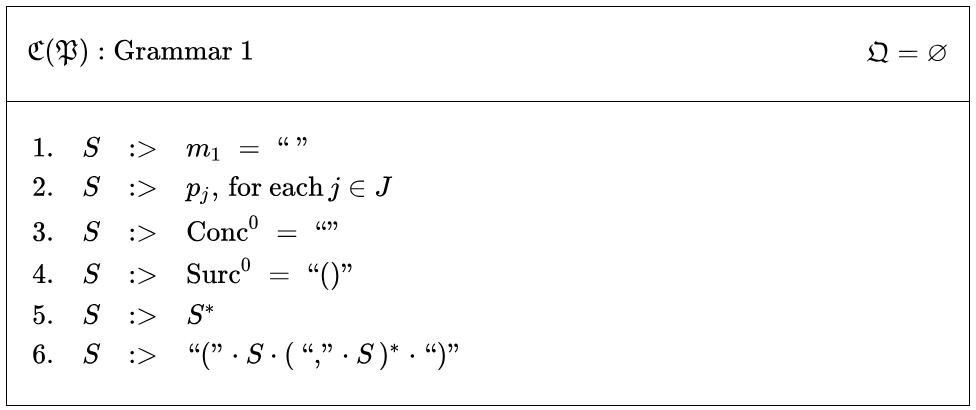
The last two rules of Grammar 1 dictate the following typings.
- The concept of a sentence in
covers any concatenation of sentences in
that is, any finite number of freely chosen sentences available to be concatenated one after another.
- The concept of a sentence in
continuing with a sentence, possibly empty, following with a finite number of phrases of the form
and closing with a

The above appears to be just about the most concise description of the cactus language 
- The invocation of the kleene star operation is not reduced to a manifestly finitary form.
- The type
indicative of a sentence is allowed to cover not only itself but also the empty string.
We’ll discuss those issues at first in general, and especially in regard to how the two features interact with one another, and then we’ll return to address in further detail the questions they engender on their individual bases.
Resources
cc: Academia.edu • BlueSky • Laws of Form • Mathstodon • Research Gate
cc: Conceptual Graphs • Cybernetics • Structural Modeling • Systems Science


 Inquiry Into Inquiry
Pingback: Survey of Animated Logical Graphs • 8 | Inquiry Into Inquiry
Pingback: Survey of Animated Logical Graphs • 8 | Systems Community of Inquiry