
Enlargement and Difference Maps
Continuing with the example 


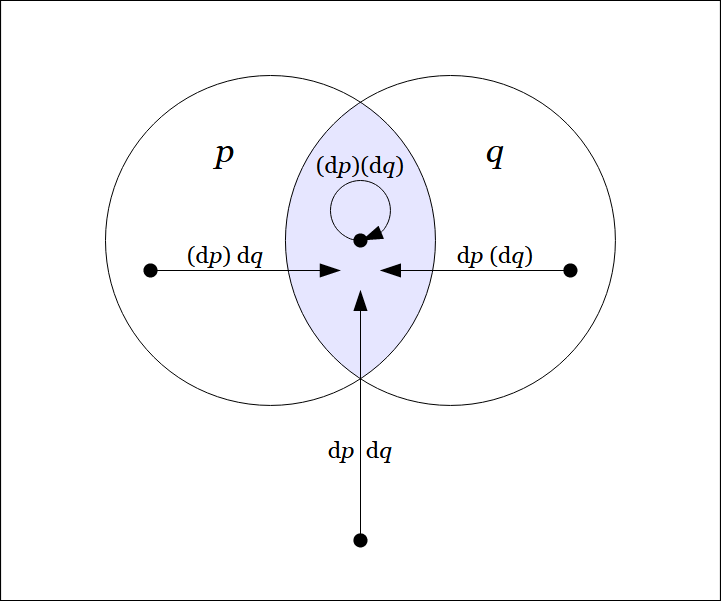

![\begin{array}{rcccccc} \mathrm{E}(pq) & = & p & \cdot & q & \cdot & \texttt{(} \mathrm{d}p \texttt{)(} \mathrm{d}q \texttt{)} \\[4pt] & + & p & \cdot & \texttt{(} q \texttt{)} & \cdot & \texttt{(} \mathrm{d}p \texttt{)~} \mathrm{d}q \texttt{~} \\[4pt] & + & \texttt{(} p \texttt{)} & \cdot & q & \cdot & \texttt{~} \mathrm{d}p \texttt{~(} \mathrm{d}q \texttt{)} \\[4pt] & + & \texttt{(} p \texttt{)} & \cdot & \texttt{(} q \texttt{)} & \cdot & \texttt{~} \mathrm{d}p \texttt{~~} \mathrm{d}q \texttt{~} \end{array}](https://s0.wp.com/latex.php?latex=%5Cbegin%7Barray%7D%7Brcccccc%7D++%5Cmathrm%7BE%7D%28pq%29+++%26+%3D+%26+p+%26+%5Ccdot+%26+q+%26+%5Ccdot+%26++%5Ctexttt%7B%28%7D+%5Cmathrm%7Bd%7Dp+%5Ctexttt%7B%29%28%7D+%5Cmathrm%7Bd%7Dq+%5Ctexttt%7B%29%7D++%5C%5C%5B4pt%5D++%26+%2B+%26+p+%26+%5Ccdot+%26+%5Ctexttt%7B%28%7D+q+%5Ctexttt%7B%29%7D+%26+%5Ccdot+%26++%5Ctexttt%7B%28%7D+%5Cmathrm%7Bd%7Dp+%5Ctexttt%7B%29%7E%7D+%5Cmathrm%7Bd%7Dq+%5Ctexttt%7B%7E%7D++%5C%5C%5B4pt%5D++%26+%2B+%26+%5Ctexttt%7B%28%7D+p+%5Ctexttt%7B%29%7D+%26+%5Ccdot+%26+q+%26+%5Ccdot+%26++%5Ctexttt%7B%7E%7D+%5Cmathrm%7Bd%7Dp+%5Ctexttt%7B%7E%28%7D+%5Cmathrm%7Bd%7Dq+%5Ctexttt%7B%29%7D++%5C%5C%5B4pt%5D++%26+%2B+%26+%5Ctexttt%7B%28%7D+p+%5Ctexttt%7B%29%7D+%26+%5Ccdot+%26+%5Ctexttt%7B%28%7D+q+%5Ctexttt%7B%29%7D+%26+%5Ccdot+%26++%5Ctexttt%7B%7E%7D+%5Cmathrm%7Bd%7Dp+%5Ctexttt%7B%7E%7E%7D+%5Cmathrm%7Bd%7Dq+%5Ctexttt%7B%7E%7D++%5Cend%7Barray%7D&bg=ffffff&fg=000000&s=0&c=20201002)
A very important conceptual transition has just occurred here, almost tacitly, as it were. Generally speaking, having a set of mathematical objects of compatible types, in this case the two differential fields 


In the present case one notices the tacit extension 


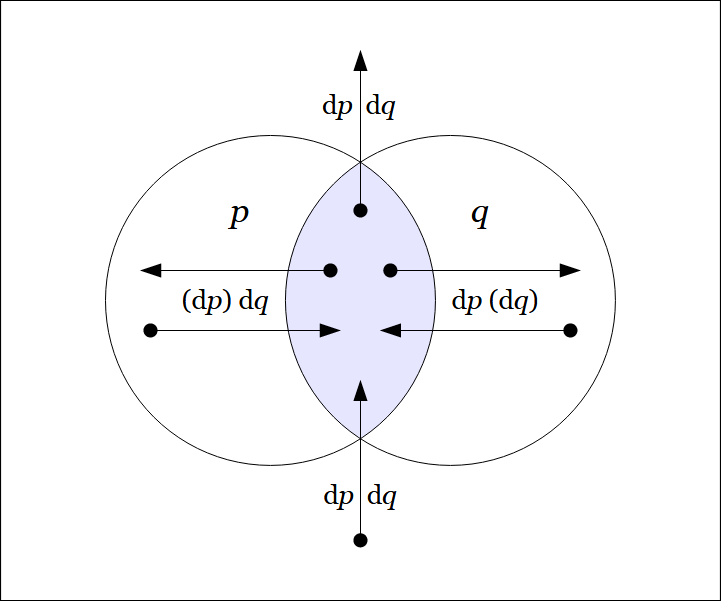

![\begin{array}{rcccccc} \mathrm{D}(pq) & = & p & \cdot & q & \cdot & \texttt{((} \mathrm{d}p \texttt{)(} \mathrm{d}q \texttt{))} \\[4pt] & + & p & \cdot & \texttt{(} q \texttt{)} & \cdot & \texttt{~(} \mathrm{d}p \texttt{)~} \mathrm{d}q \texttt{~~} \\[4pt] & + & \texttt{(} p \texttt{)} & \cdot & q & \cdot & \texttt{~~} \mathrm{d}p \texttt{~(} \mathrm{d}q \texttt{)~} \\[4pt] & + & \texttt{(} p \texttt{)} & \cdot & \texttt{(}q \texttt{)} & \cdot & \texttt{~~} \mathrm{d}p \texttt{~~} \mathrm{d}q \texttt{~~} \end{array}](https://s0.wp.com/latex.php?latex=%5Cbegin%7Barray%7D%7Brcccccc%7D++%5Cmathrm%7BD%7D%28pq%29+++%26+%3D+%26+p+%26+%5Ccdot+%26+q+%26+%5Ccdot+%26++%5Ctexttt%7B%28%28%7D+%5Cmathrm%7Bd%7Dp+%5Ctexttt%7B%29%28%7D+%5Cmathrm%7Bd%7Dq+%5Ctexttt%7B%29%29%7D++%5C%5C%5B4pt%5D++%26+%2B+%26+p+%26+%5Ccdot+%26+%5Ctexttt%7B%28%7D+q+%5Ctexttt%7B%29%7D+%26+%5Ccdot+%26++%5Ctexttt%7B%7E%28%7D+%5Cmathrm%7Bd%7Dp+%5Ctexttt%7B%29%7E%7D+%5Cmathrm%7Bd%7Dq+%5Ctexttt%7B%7E%7E%7D++%5C%5C%5B4pt%5D++%26+%2B+%26+%5Ctexttt%7B%28%7D+p+%5Ctexttt%7B%29%7D+%26+%5Ccdot+%26+q+%26+%5Ccdot+%26++%5Ctexttt%7B%7E%7E%7D+%5Cmathrm%7Bd%7Dp+%5Ctexttt%7B%7E%28%7D+%5Cmathrm%7Bd%7Dq+%5Ctexttt%7B%29%7E%7D++%5C%5C%5B4pt%5D++%26+%2B+%26+%5Ctexttt%7B%28%7D+p+%5Ctexttt%7B%29%7D+%26+%5Ccdot+%26+%5Ctexttt%7B%28%7Dq+%5Ctexttt%7B%29%7D+%26+%5Ccdot+%26++%5Ctexttt%7B%7E%7E%7D+%5Cmathrm%7Bd%7Dp+%5Ctexttt%7B%7E%7E%7D+%5Cmathrm%7Bd%7Dq+%5Ctexttt%7B%7E%7E%7D++%5Cend%7Barray%7D&bg=ffffff&fg=000000&s=0&c=20201002)
Resources
cc: Academia.edu • Cybernetics • Structural Modeling • Systems Science
cc: Conceptual Graphs • Laws of Form • Mathstodon • Research Gate


 Inquiry Into Inquiry
Pingback: Survey of Differential Logic • 7 | Inquiry Into Inquiry
Pingback: Survey of Differential Logic • 7 | Inquiry Into Inquiry
Pingback: Survey of Differential Logic • 8 | Inquiry Into Inquiry
Pingback: Survey of Differential Logic • 8 | Systems Community of Inquiry