In the previous post we computed what is variously described as the difference map, the difference proposition, or the local proposition  of the proposition
  at the point
  where
where  and
and 
In the universe of discourse  the four propositions
  can be taken to indicate the so‑called “cells” or smallest distinguished regions of the universe, otherwise indicated by their coordinates as the “points”
  respectively. In that regard the four propositions are called singular propositions because they serve to single out the minimal regions of the universe of discourse.
Thus we can write  so long as we know the frame of reference in force.
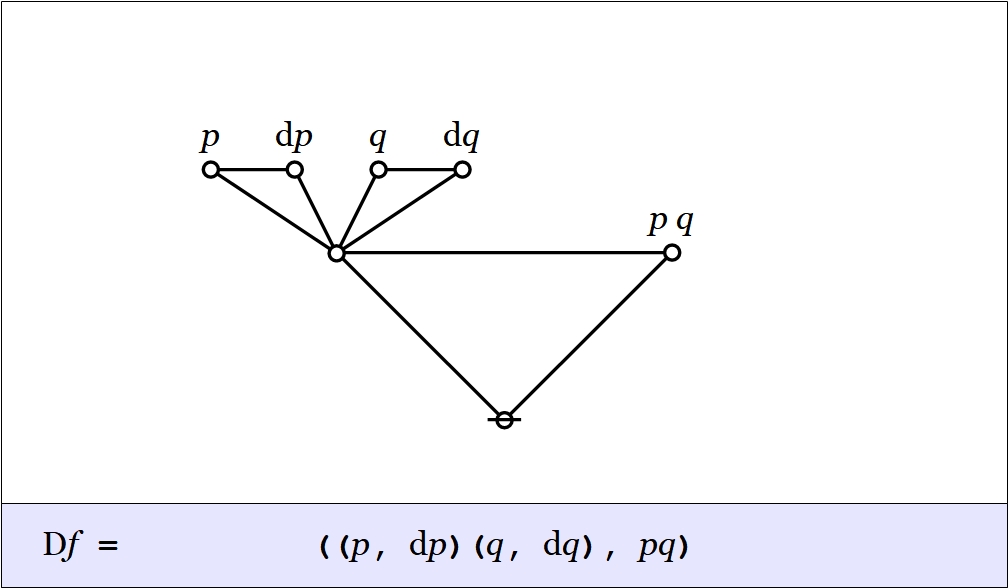
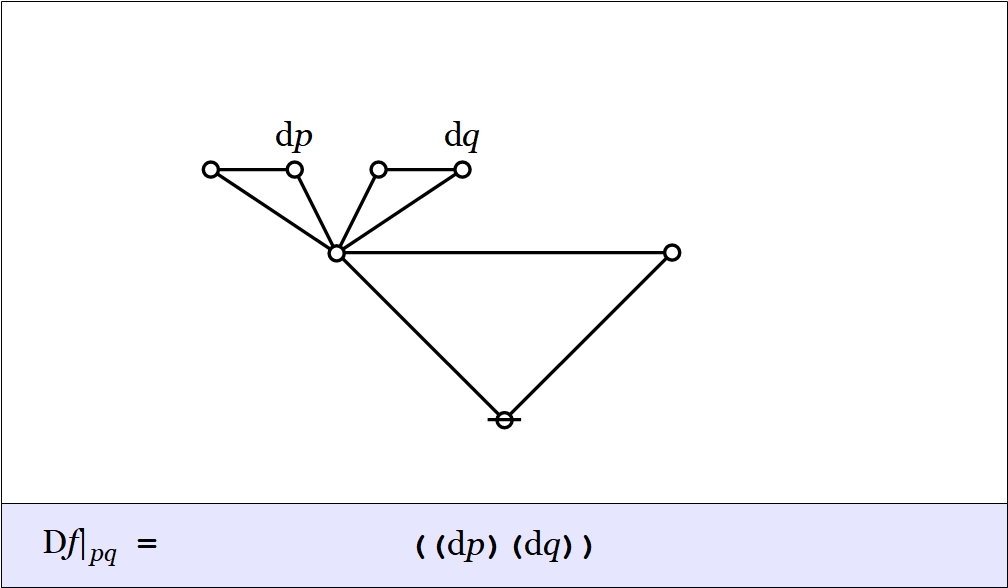
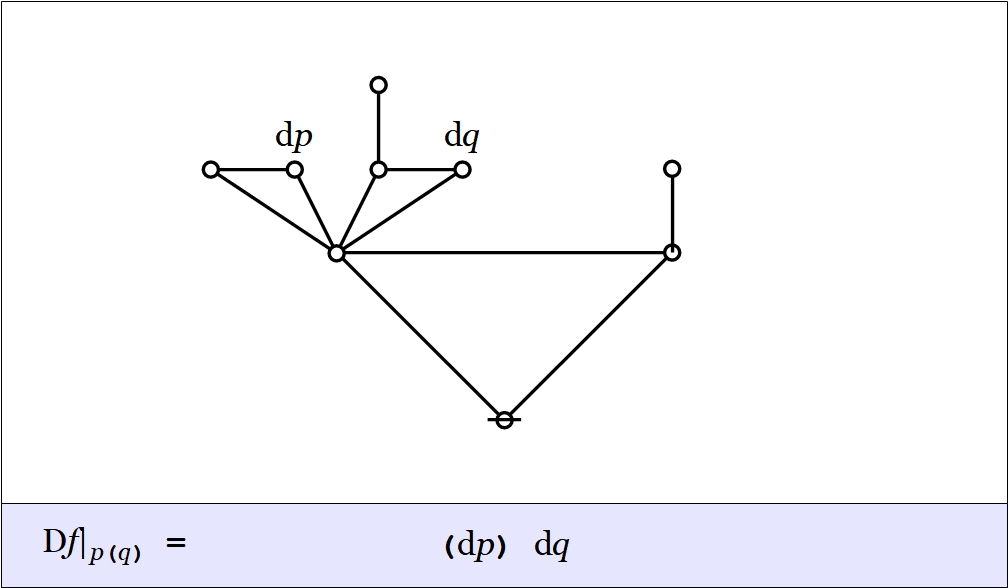
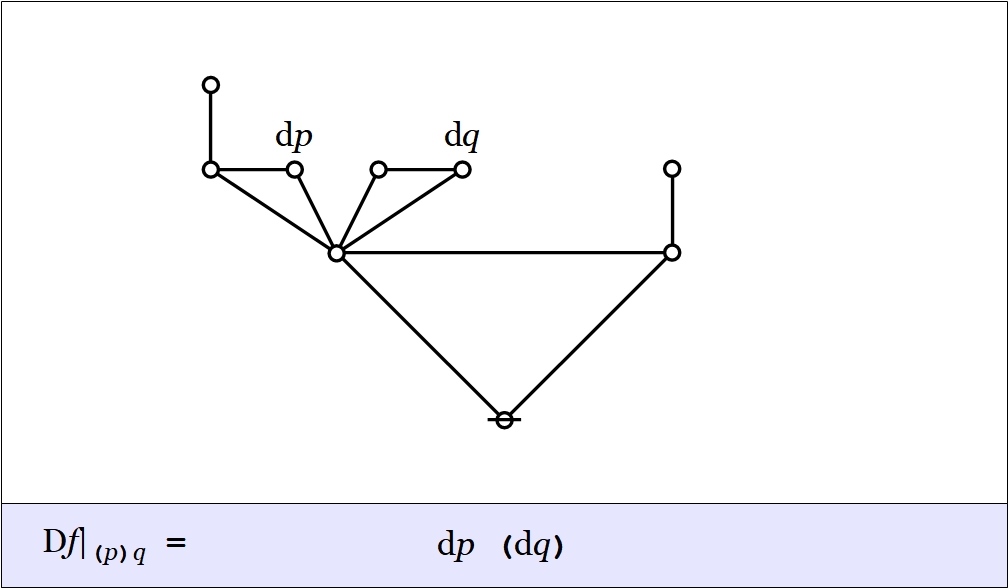
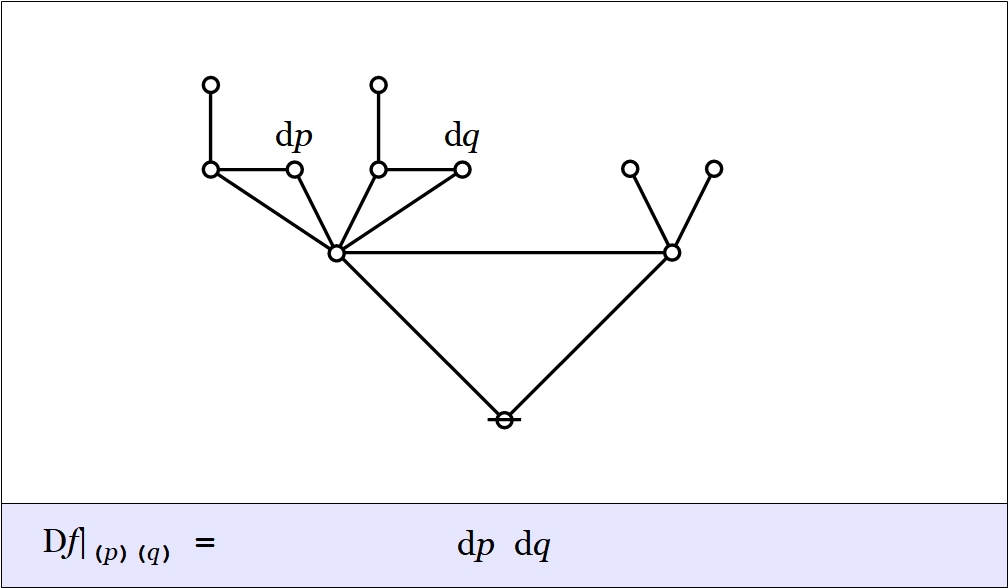
In the example  the value of the difference proposition at each of the four points
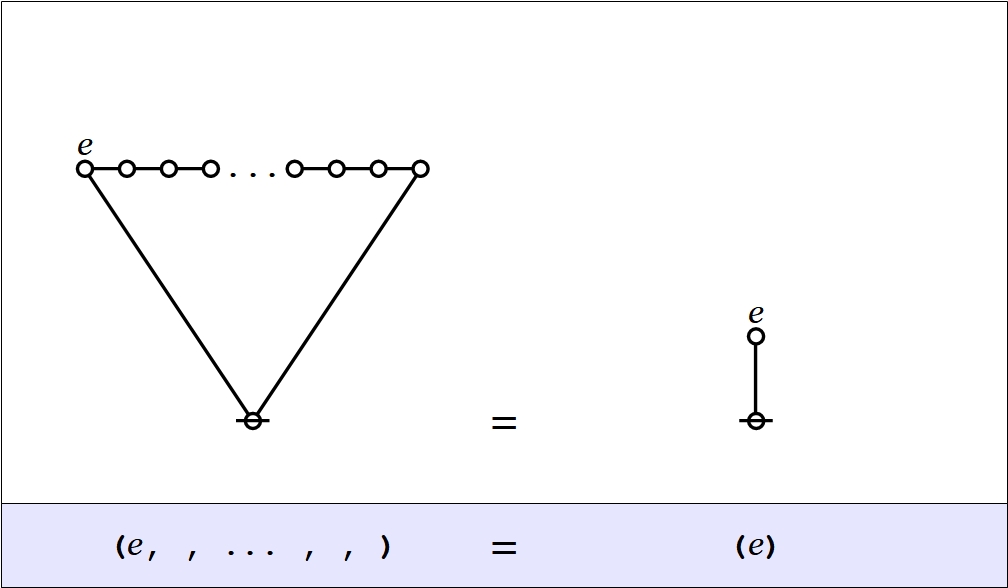
  may be computed in graphical fashion as shown below.
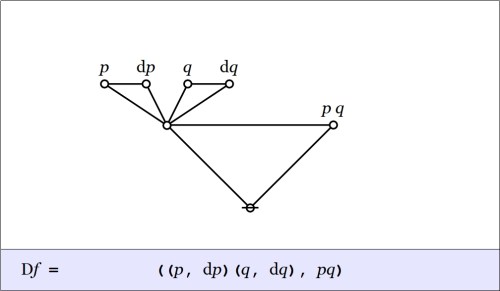

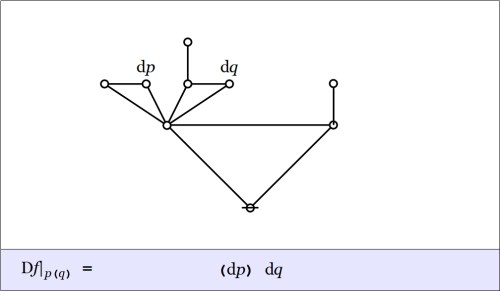


The easy way to visualize the values of the above graphical expressions is just to notice the following graphical equations.


Adding the arrows to the venn diagram gives us the picture of a differential vector field.

The Figure shows the points of the extended universe  indicated by the difference map
  namely, the following six points or singular propositions.

The information borne by  should be clear enough from a survey of these six points — they tell you what you have to do from each point of
  in order to change the value borne by
  that is, the move you have to make in order to reach a point where the value of the proposition
  is different from what it is where you started.
We have been studying the action of the difference operator  on propositions of the form
  as illustrated by the example which is known in logic as the conjunction of
  and
and  The resulting difference map is a (first order) differential proposition, that is, a proposition of the form
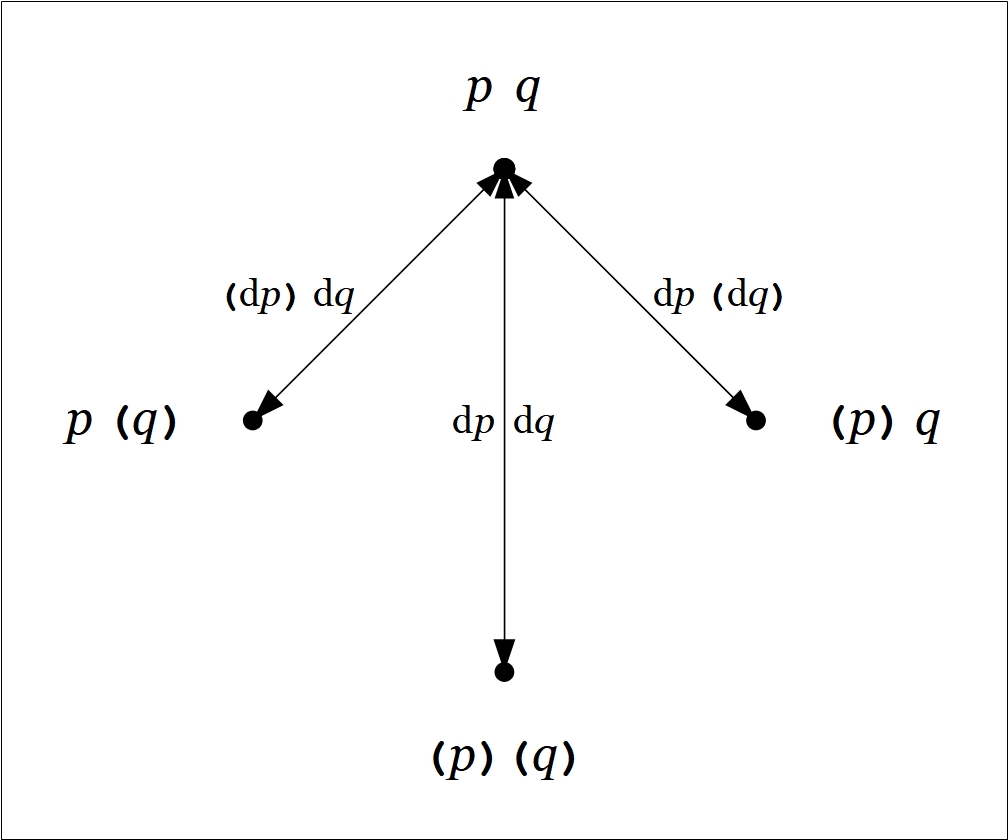
The augmented venn diagram shows how the models or satisfying interpretations of distribute over the extended universe of discourse  Abstracting from that picture, the difference map can be represented in the form of a digraph or directed graph, one whose points are labeled with the elements of
  and whose arrows are labeled with the elements of
  as shown in the following Figure.

![\begin{array}{rcccccc} f & = & p & \cdot & q \\[4pt] \mathrm{D}f & = & p & \cdot & q & \cdot & \texttt{((} \mathrm{d}p \texttt{)(} \mathrm{d}q \texttt{))} \\[4pt] & + & p & \cdot & \texttt{(} q \texttt{)} & \cdot & \texttt{~(} \mathrm{d}p \texttt{)~} \mathrm{d}q \texttt{~~} \\[4pt] & + & \texttt{(} p \texttt{)} & \cdot & q & \cdot & \texttt{~~} \mathrm{d}p \texttt{~(} \mathrm{d}q \texttt{)~} \\[4pt] & + & \texttt{(} p \texttt{)} & \cdot & \texttt{(} q \texttt{)} & \cdot & \texttt{~~} \mathrm{d}p \texttt{~~} \mathrm{d}q \texttt{~~} \end{array}](https://s0.wp.com/latex.php?latex=%5Cbegin%7Barray%7D%7Brcccccc%7D++f+%26+%3D+%26+p+%26+%5Ccdot+%26+q++%5C%5C%5B4pt%5D++%5Cmathrm%7BD%7Df+%26+%3D+%26++p+%26+%5Ccdot+%26+q+%26+%5Ccdot+%26++%5Ctexttt%7B%28%28%7D+%5Cmathrm%7Bd%7Dp+%5Ctexttt%7B%29%28%7D+%5Cmathrm%7Bd%7Dq+%5Ctexttt%7B%29%29%7D++%5C%5C%5B4pt%5D++%26+%2B+%26++p+%26+%5Ccdot+%26+%5Ctexttt%7B%28%7D+q+%5Ctexttt%7B%29%7D+%26+%5Ccdot+%26++%5Ctexttt%7B%7E%28%7D+%5Cmathrm%7Bd%7Dp+%5Ctexttt%7B%29%7E%7D+%5Cmathrm%7Bd%7Dq+%5Ctexttt%7B%7E%7E%7D++%5C%5C%5B4pt%5D++%26+%2B+%26++%5Ctexttt%7B%28%7D+p+%5Ctexttt%7B%29%7D+%26+%5Ccdot+%26+q+%26+%5Ccdot+%26++%5Ctexttt%7B%7E%7E%7D+%5Cmathrm%7Bd%7Dp+%5Ctexttt%7B%7E%28%7D+%5Cmathrm%7Bd%7Dq+%5Ctexttt%7B%29%7E%7D++%5C%5C%5B4pt%5D++%26+%2B+%26++%5Ctexttt%7B%28%7D+p+%5Ctexttt%7B%29%7D+%26+%5Ccdot+%26+%5Ctexttt%7B%28%7D+q+%5Ctexttt%7B%29%7D+%26+%5Ccdot+%26++%5Ctexttt%7B%7E%7E%7D+%5Cmathrm%7Bd%7Dp+%5Ctexttt%7B%7E%7E%7D+%5Cmathrm%7Bd%7Dq+%5Ctexttt%7B%7E%7E%7D++%5Cend%7Barray%7D&bg=ffffff&fg=000000&s=0&c=20201002)
Any proposition worth its salt can be analyzed from many different points of view, any one of which has the potential to reveal previously unsuspected aspects of the proposition’s meaning. We will encounter more and more such alternative readings as we go.
Resources
cc: Academia.edu • Cybernetics • Structural Modeling • Systems Science
cc: Conceptual Graphs • Laws of Form • Mathstodon • Research Gate




 Inquiry Into Inquiry
Pingback: Survey of Differential Logic • 7 | Inquiry Into Inquiry
Pingback: Survey of Differential Logic • 7 | Inquiry Into Inquiry
Pingback: Survey of Differential Logic • 8 | Inquiry Into Inquiry
Pingback: Survey of Differential Logic • 8 | Systems Community of Inquiry