
Primary Algebra as Pattern Calculus
Experience teaches that complex objects are best approached in a gradual, laminar, modular fashion, one step, one layer, one piece at a time, especially when that complexity is irreducible, when all our articulations and all our representations will be cloven at joints disjoint from the structure of the object itself, with some assembly required in the synthetic integrity of the intuition.
That’s one good reason for spending so much time on the first half of zeroth order logic, instanced here by the primary arithmetic, a level of formal structure Peirce verged on intuiting at numerous points and times in his work on logical graphs but Spencer Brown named and brought more completely to life.
Another reason for lingering a while longer in these primitive forests is that an acquaintance with “bare trees”, those unadorned with literal or numerical labels, will provide a basis for understanding what’s really at issue in oft‑debated questions about the “ontological status of variables”.
It is probably best to illustrate the theme in the setting of a concrete case. To do that let’s look again at the previous example of reductive evaluation taking place in the primary arithmetic.
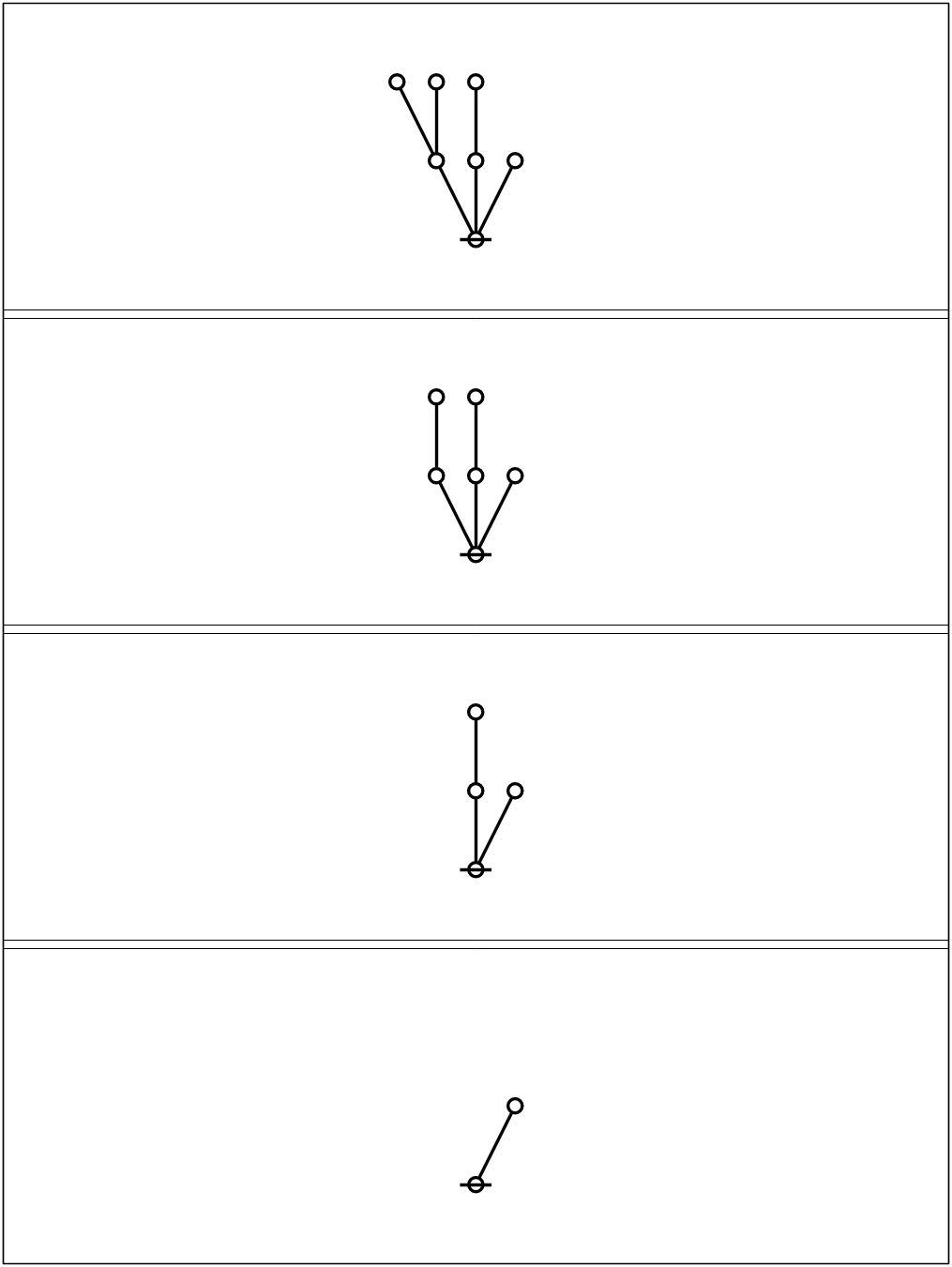 |
(16) |
After we’ve seen a few sign-transformations of roughly that shape we’ll most likely notice it doesn’t really matter what other branches are rooted next to the lone edge off to the side — the end result will always be the same. Eventually it will occur to us to summarize the results of many such observations by introducing a label or variable to signify any shape of branch whatever, writing something like the following.
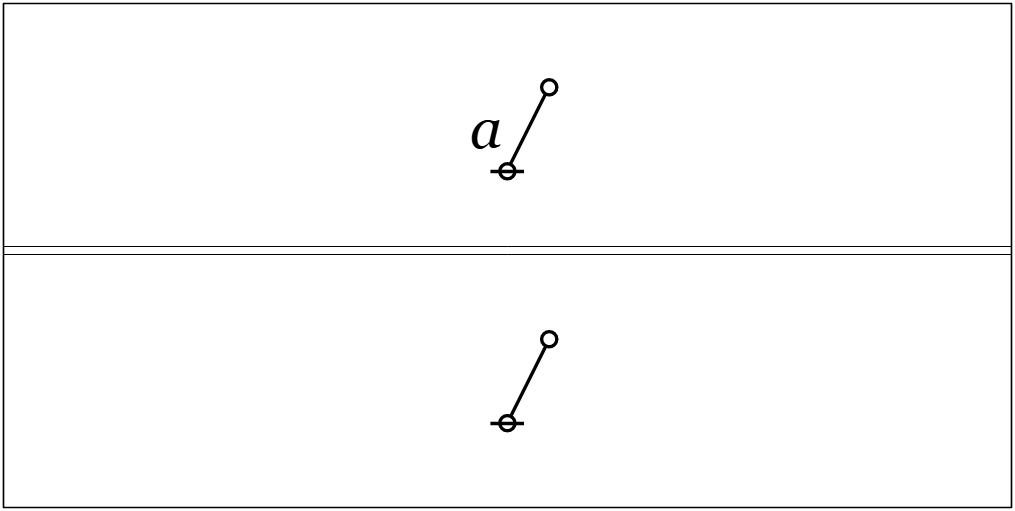 |
(17) |
Observations like that, made about an arithmetic of any variety and germinated by their summarizations, are the root of all algebra.
Resources
cc: FB | Logical Graphs • Laws of Form • Mathstodon • Academia.edu
cc: Conceptual Graphs • Cybernetics • Structural Modeling • Systems Science


 Inquiry Into Inquiry
Pingback: Survey of Animated Logical Graphs • 7 | Inquiry Into Inquiry
Pingback: Survey of Animated Logical Graphs • 7 | Inquiry Into Inquiry
Pingback: Survey of Animated Logical Graphs • 8 | Inquiry Into Inquiry
Pingback: Survey of Animated Logical Graphs • 8 | Systems Community of Inquiry