Computational Representation (concl.)
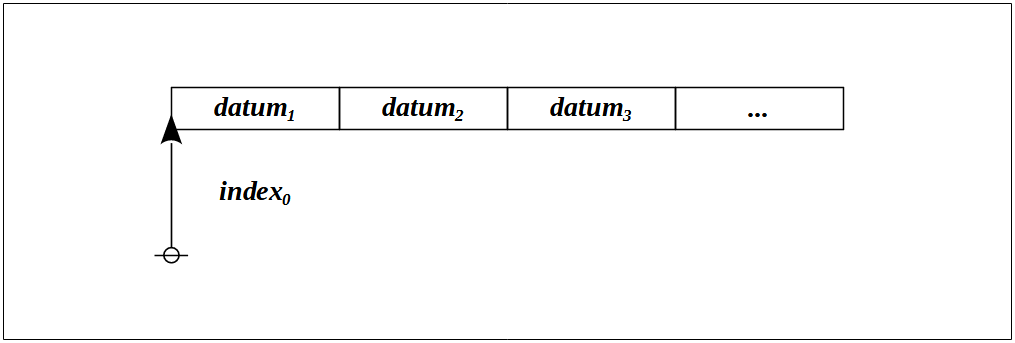
At the next level of concreteness, a pointer‑record data structure can be represented as follows.
 |
(11) |
This portrays index0 as the address of a record which contains the following data.
datum1, datum2, datum3, …, and so on.
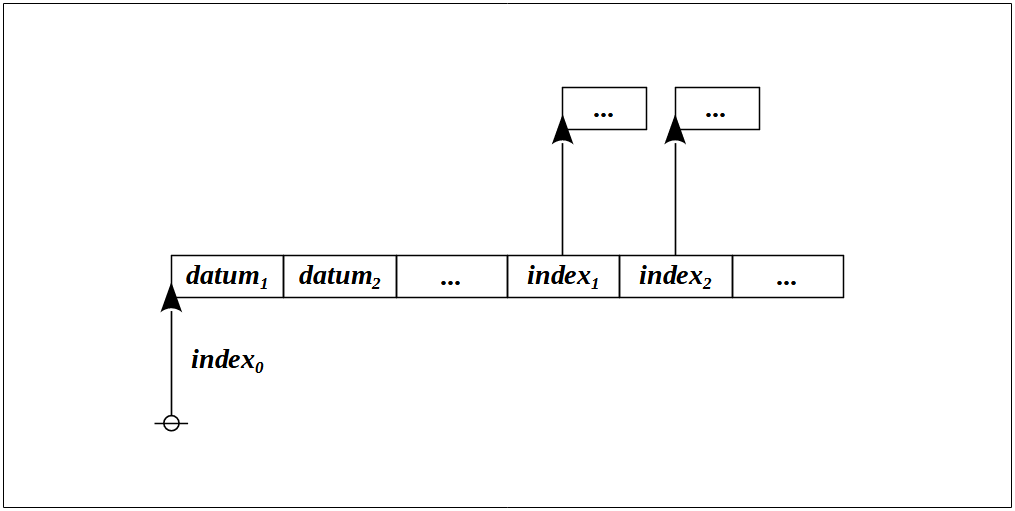
What makes it possible to represent graph‑theoretic forms as dynamic data structures is the fact that an address is just another datum to be stored on a record, and so we may have a state of affairs like the following.
 |
(12) |
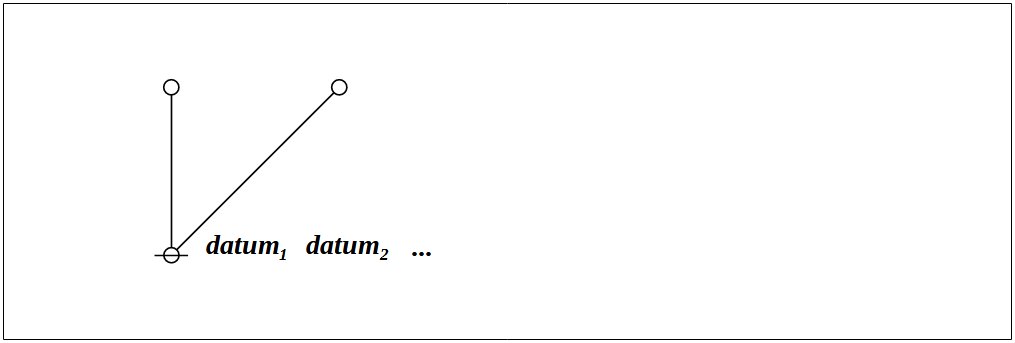
Returning to the abstract level, it takes three nodes to represent the three data records illustrated above: one root node connected to a couple of adjacent nodes. Items of data not pointing any further up the tree are treated as labels on the record‑nodes where they reside, as shown below.
 |
(13) |
Notice that drawing the arrows is optional with rooted trees like these, since singling out a unique node as the root induces a unique orientation on all the edges of the tree, with up being the direction away from the root.
Resources
cc: FB | Logical Graphs • Laws of Form • Mathstodon • Academia.edu
cc: Conceptual Graphs • Cybernetics • Structural Modeling • Systems Science


 Inquiry Into Inquiry
Pingback: Survey of Animated Logical Graphs • 7 | Inquiry Into Inquiry
Pingback: Survey of Animated Logical Graphs • 7 | Inquiry Into Inquiry
Pingback: Survey of Animated Logical Graphs • 8 | Inquiry Into Inquiry
Pingback: Survey of Animated Logical Graphs • 8 | Systems Community of Inquiry