Duality : Logical and Topological (concl.)
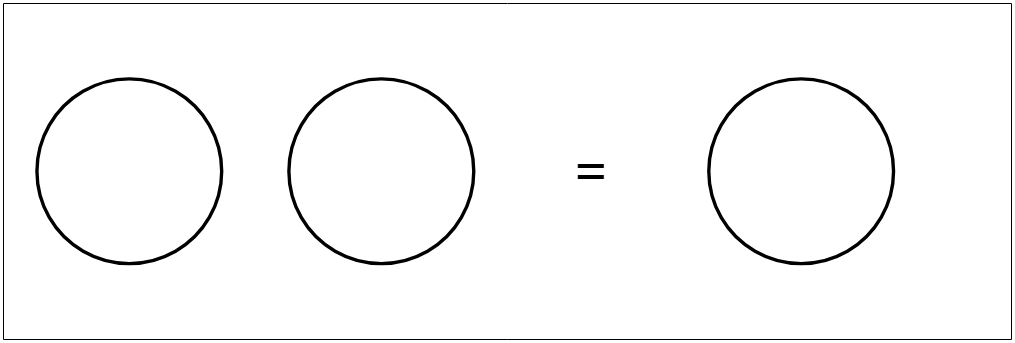
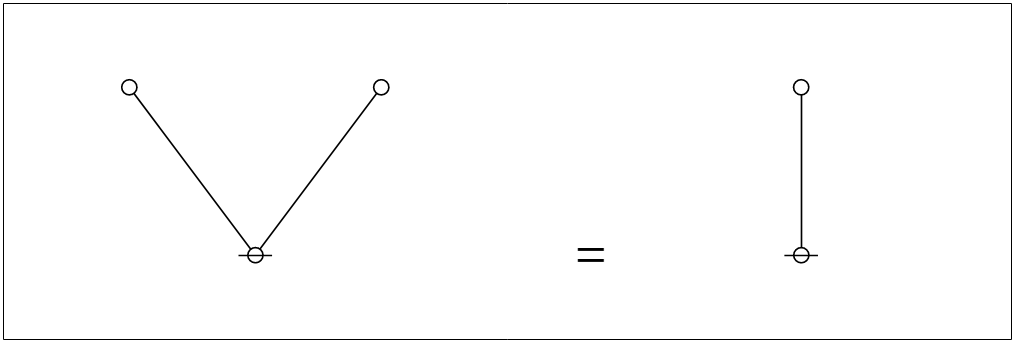
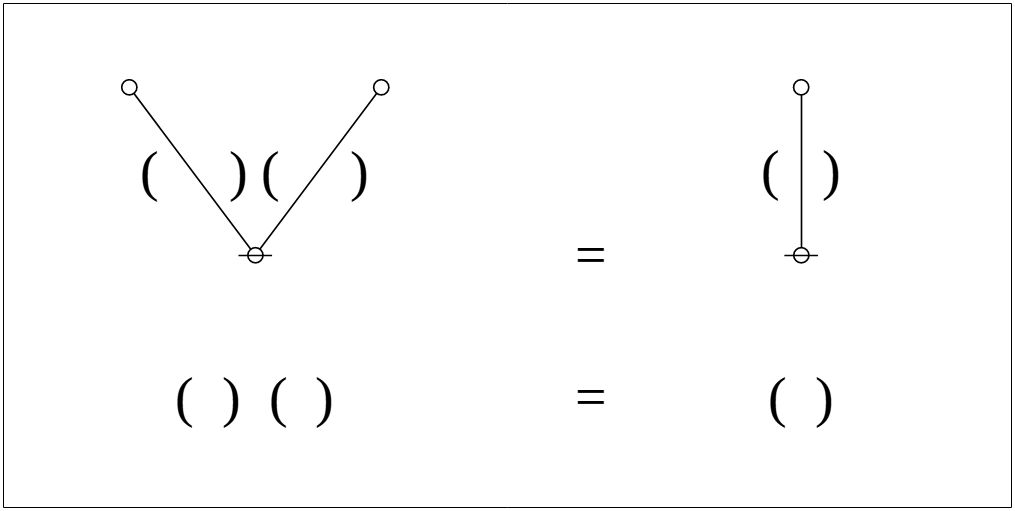
We have now treated in some detail various forms of the axiom or initial equation which is formulated in string form as “( ( ) ) = ”. For the sake of comparison, let’s record the planar and dual forms of the axiom which is formulated in string form as “( )( ) = ( )”.
First the plane-embedded maps:
 |
(7) |
Next the plane maps and their dual trees superimposed:
 |
(8) |
Finally the rooted trees by themselves:
 |
(9) |
And here are the parse trees with their traversal strings indicated:
 |
(10) |
We have at this point enough material to begin thinking about the forms of analogy, iconicity, metaphor, morphism, whatever we may call them, which bear on the use of logical graphs in their various incarnations, for example, those Peirce described as entitative graphs and existential graphs.
Resources
cc: FB | Logical Graphs • Laws of Form • Mathstodon • Academia.edu
cc: Conceptual Graphs • Cybernetics • Structural Modeling • Systems Science


 Inquiry Into Inquiry
Pingback: Survey of Animated Logical Graphs • 7 | Inquiry Into Inquiry
Pingback: Survey of Animated Logical Graphs • 7 | Inquiry Into Inquiry
Pingback: Survey of Animated Logical Graphs • 8 | Inquiry Into Inquiry
Pingback: Survey of Animated Logical Graphs • 8 | Systems Community of Inquiry