
Duality : Logical and Topological (cont.)
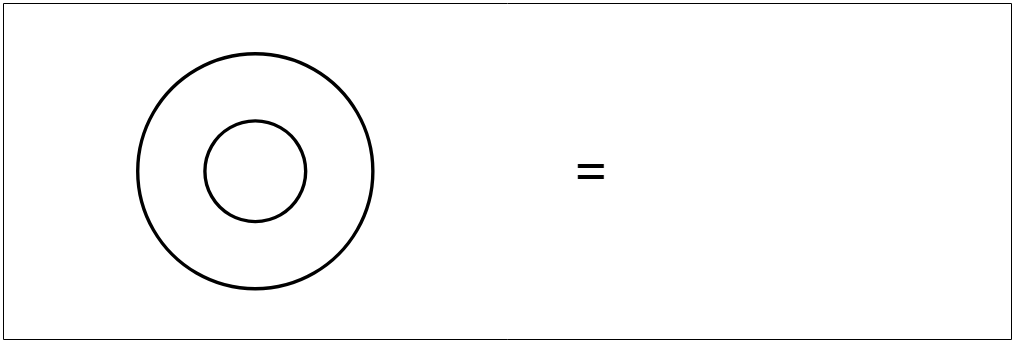
Last time we took up the axiom or initial equation shown below.
 |
(3) |
We noted it could be written inline as “( ( ) ) = ” or set off in the following text display.
( ( ) ) =
When we turn to representing the corresponding expressions in computer memory, where they can be manipulated with the greatest of ease, we begin by transforming the planar graphs into their topological duals. Planar regions of the original graph become nodes or points of the dual graph and boundaries between planar regions of the original graph become edges or lines between nodes of the dual graph.
For example, overlaying the corresponding dual graphs on the plane‑embedded graphs shown above, we get the following composite picture.
 |
(4) |
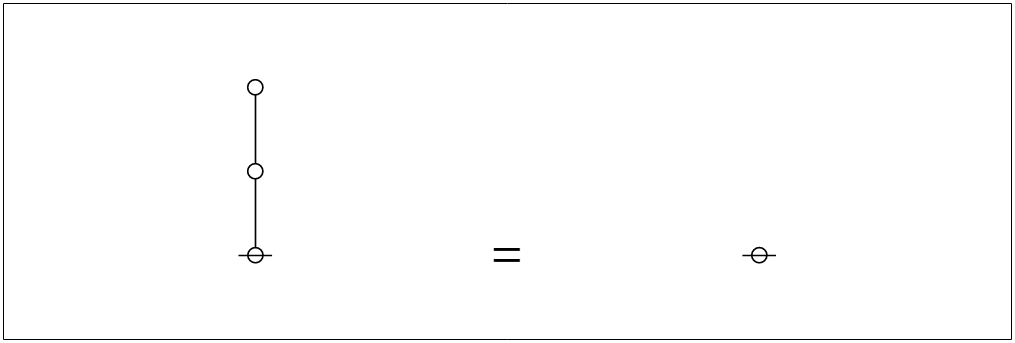
Though it’s not really there in the most abstract topology of the matter, for all sorts of pragmatic reasons we find ourselves compelled to single out the outermost region of the plane in a distinctive way and to mark it as the root node of the corresponding dual graph. In the present style of Figure the root nodes are marked by horizontal strike‑throughs.
Extracting the dual graphs from their composite matrix, we get the following equation.
 |
(5) |
Resources
cc: FB | Logical Graphs • Laws of Form • Mathstodon • Academia.edu
cc: Conceptual Graphs • Cybernetics • Structural Modeling • Systems Science


 Inquiry Into Inquiry
Pingback: Survey of Animated Logical Graphs • 7 | Inquiry Into Inquiry
Pingback: Survey of Animated Logical Graphs • 7 | Inquiry Into Inquiry
Pingback: Survey of Animated Logical Graphs • 8 | Inquiry Into Inquiry
Pingback: Survey of Animated Logical Graphs • 8 | Systems Community of Inquiry