
Here are two ways of looking at the divisibility relation, a dyadic relation of fundamental importance in number theory.
Table 1 shows the first few ordered pairs of the relation on positive integers corresponding to the relative term, “divisor of”. Thus, the ordered pair 


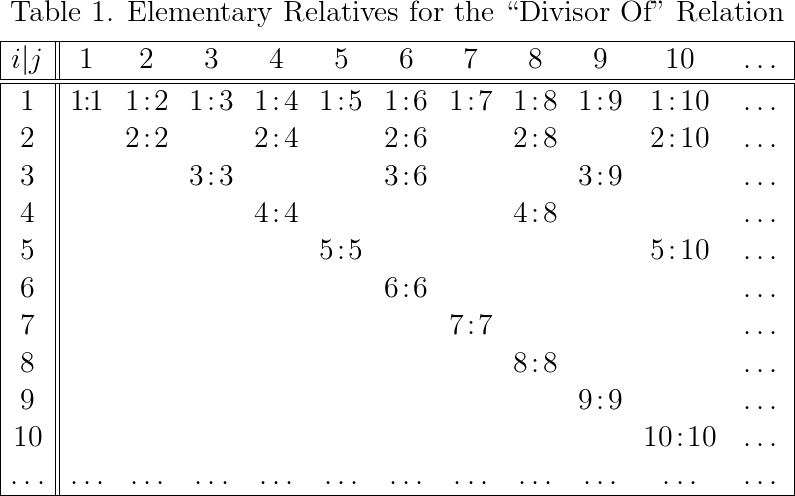
Table 2 shows the same information in the form of a logical matrix. This has a coefficient of 


Just as matrices in linear algebra represent linear transformations, logical arrays and matrices represent logical transformations.
Resources
- Relation Theory
- Triadic Relations
- Sign Relations
- Survey of Relation Theory
- Peirce’s 1870 Logic Of Relatives
cc: FB | Relation Theory • Laws of Form • Mathstodon • Academia.edu
cc: Conceptual Graphs • Cybernetics • Structural Modeling • Systems Science


 Inquiry Into Inquiry
Pingback: Survey of Relation Theory • 8 | Inquiry Into Inquiry
Pingback: Survey of Relation Theory • 9 | Inquiry Into Inquiry
Pingback: Survey of Relation Theory • 9 | Systems Community of Inquiry