
Logical Cacti
Up till now we’ve been working to hammer out a two‑edged sword of syntax, honing the syntax of cactus graphs and cactus expressions and turning it to use in taming the syntax of two‑level formal languages.
But the purpose of a logical syntax is to support a logical semantics, which means, for starters, to bear interpretation as sentential signs capable of denoting objective propositions about a universe of objects.
One of the difficulties we face is that the words interpretation, meaning, semantics, and their ilk take on so many different meanings from one moment to the next of their use. A dedicated neologician might be able to think up distinctive names for all the aspects of meaning and all the approaches to them that concern us, but I will do the best I can with the common lot of ambiguous terms, leaving it to context and intelligent interpreters to sort it out as much as possible.
The formal language of cacti is formed at such a high level of abstraction that its graphs bear at least two distinct interpretations as logical propositions. The two interpretations concerning us here are descended from the ones C.S. Peirce called the entitative and the existential interpretations of his systems of graphical logics.
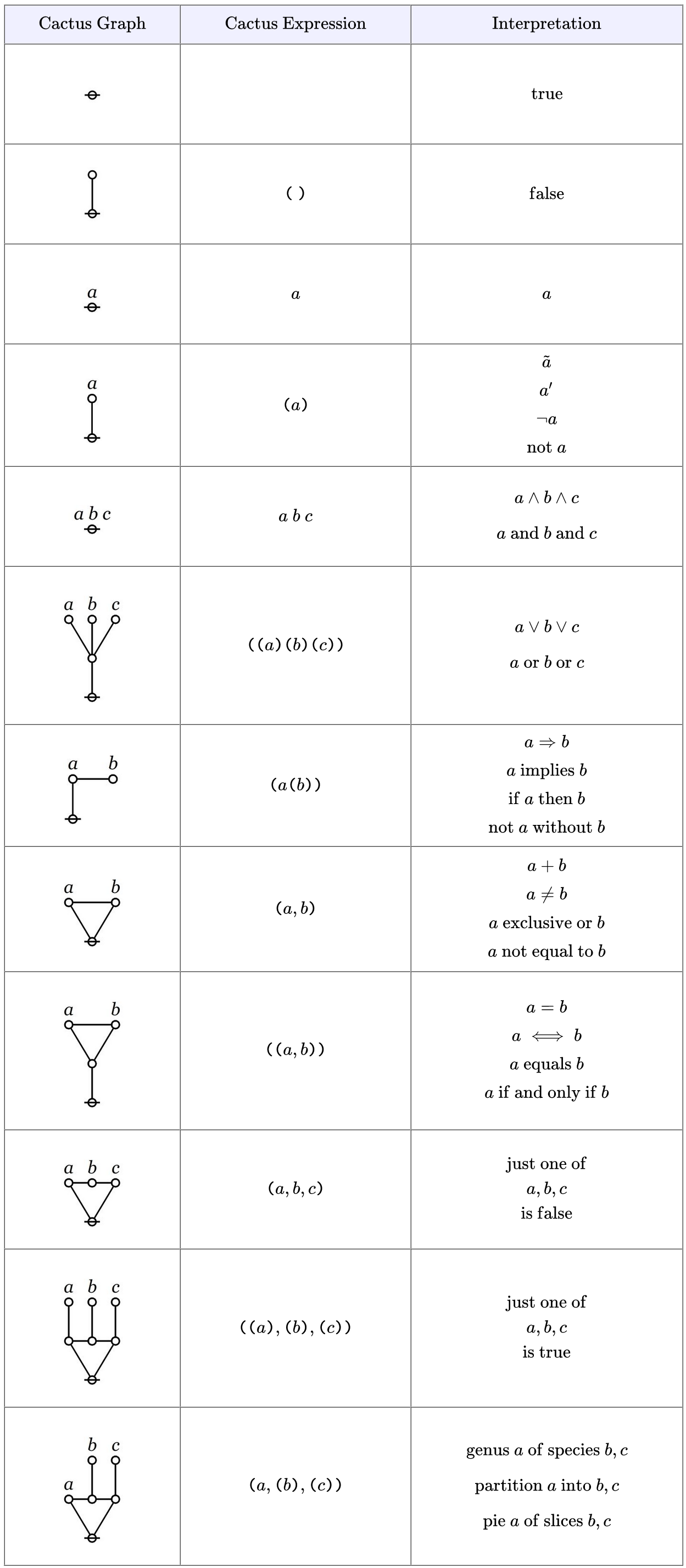
Existential Interpretation
Table 1 illustrates the existential interpretation of cactus graphs and cactus expressions by providing English translations for a few of the most basic and commonly occurring forms.

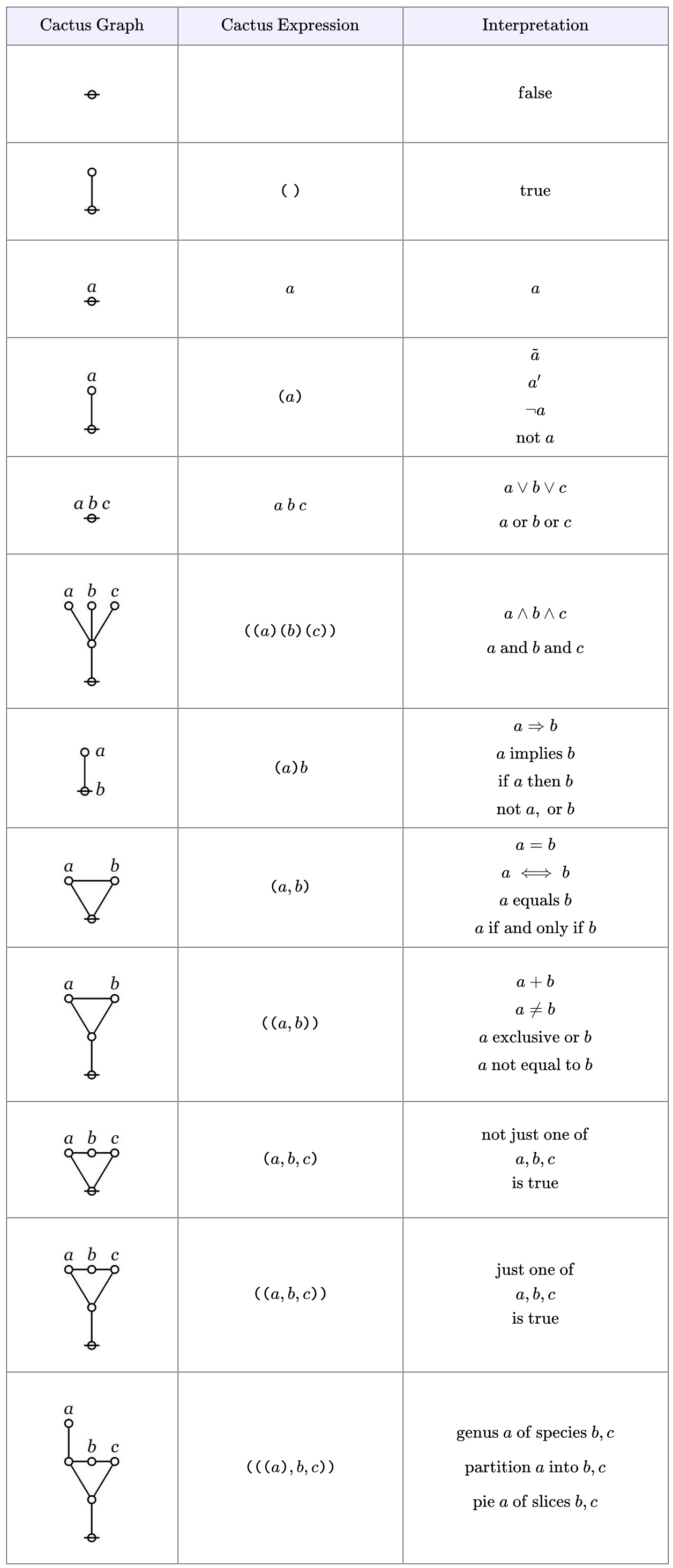
Entitative Interpretation
Table 2 illustrates the entitative interpretation of cactus graphs and cactus expressions by providing English translations for a few of the most basic and commonly occurring forms.

Resources
- Theme One Program • Overview
- Theme One Program • Exposition
- Theme One Program • User Guide
- Survey of Theme One Program
cc: FB | Theme One Program • Laws of Form • Mathstodon • Academia.edu
cc: Conceptual Graphs • Cybernetics • Structural Modeling • Systems Science

 Inquiry Into Inquiry
Pingback: Survey of Theme One Program • 6 | Inquiry Into Inquiry
Pingback: Theme One Program • Exposition 8 | Inquiry Into Inquiry
Pingback: Survey of Theme One Program • 7 | Inquiry Into Inquiry
Pingback: Survey of Theme One Program • 7 | Systems Community of Inquiry