Semiotic Transformations
Re: Transformations of Logical Graphs • (4) • (5) • (6) • (7) • (8)
Last time we took up the four singleton orbits in the action of  on
on  and saw each consists of a single logical graph which fixes, preserves, or transforms into itself. On that account those four logical graphs are said to be self‑dual or ‑invariant.
In general terms, it is useful to think of the entitative and existential interpretations as two formal languages which happen to use the same set of signs, each in its own way, to denote the same set of formal objects. Then defines the translation between languages and the self‑dual logical graphs are the points where the languages coincide, where the same signs denote the same objects in both. Such constellations of “fixed stars” are indispensable to navigation between languages, as every argot‑naut discovers in time.
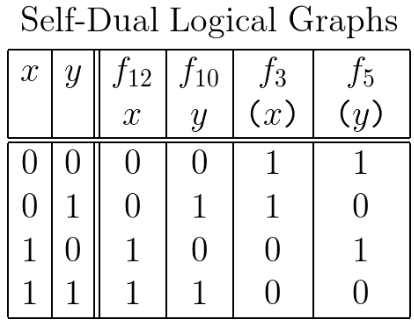
Returning to the case at hand, where acts on a selection of 16 logical graphs for the 16 boolean functions on two variables, the following Table shows the values of the denoted boolean function  for each of the self‑dual logical graphs.
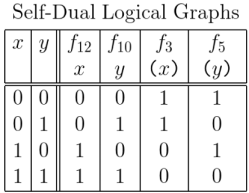
The functions indexed here as  and
and  are known as the coordinate projections
  and
and  on the first and second coordinates, respectively, and the functions indexed as
  and
and  are the negations
  and
and  of those projections, respectively.
Resources
cc: FB | Logical Graphs • Laws of Form • Mathstodon • Academia.edu
cc: Conceptual Graphs • Cybernetics • Structural Modeling • Systems Science



 Inquiry Into Inquiry
Pingback: Survey of Animated Logical Graphs • 7 | Inquiry Into Inquiry
Pingback: Transformations of Logical Graphs • 10 | Inquiry Into Inquiry
Pingback: Transformations of Logical Graphs • 11 | Inquiry Into Inquiry
Pingback: Transformations of Logical Graphs • 12 | Inquiry Into Inquiry
Pingback: Transformations of Logical Graphs • 13 | Inquiry Into Inquiry
Pingback: Transformations of Logical Graphs • 14 | Inquiry Into Inquiry
Pingback: Survey of Animated Logical Graphs • 8 | Inquiry Into Inquiry
Pingback: Charles Sanders Peirce, George Spencer Brown, and Me • 18 | Inquiry Into Inquiry