
Re: Transformations of Logical Graphs • (1) • (2)
We’ve been using the duality between entitative and existential interpretations of logical graphs to get a handle on the mathematical forms pervading logical laws. A few posts ago we took up the tools of groups and symmetries and transformations to study the duality and we looked to the space of 2-variable boolean functions as a basic training grounds. On those grounds the translation between interpretations presents as a group 

Last time we arrived at a Table showing how the group

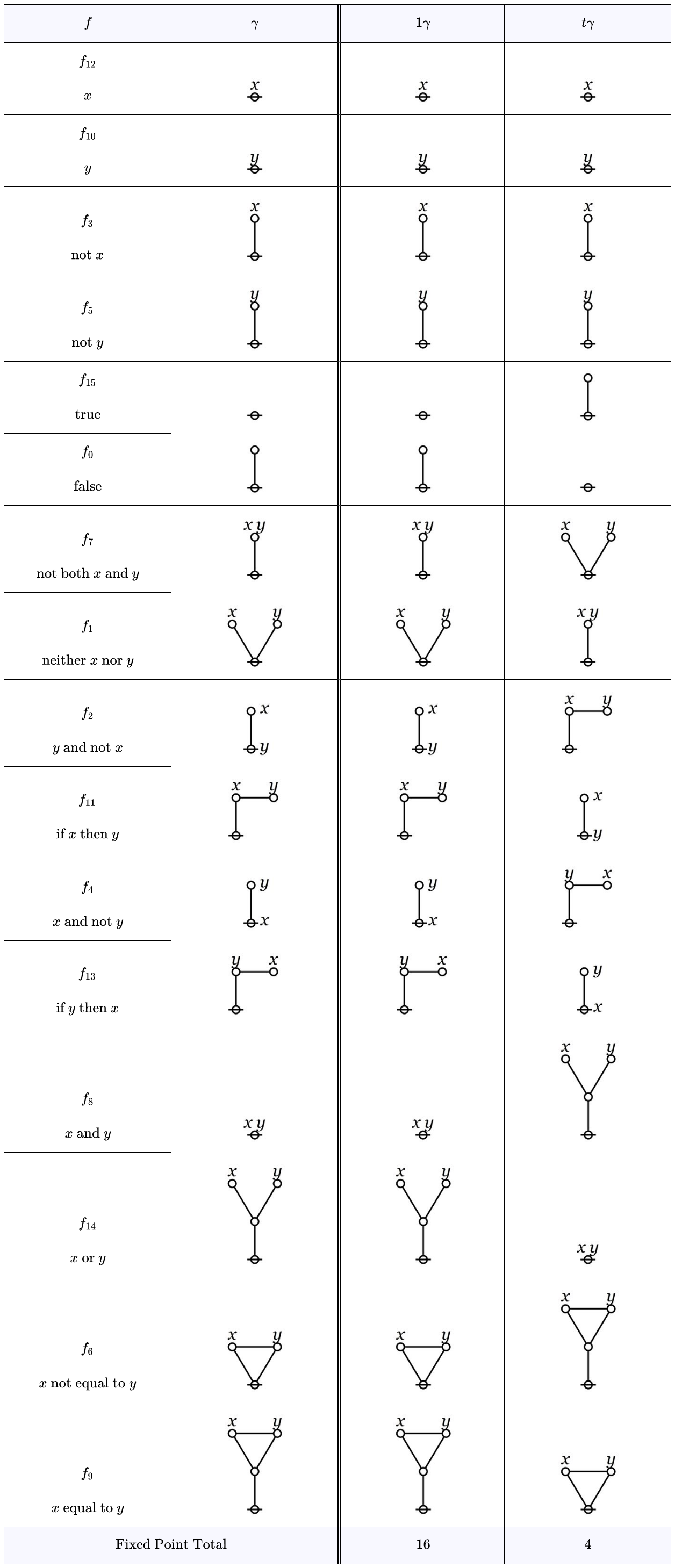
I invited the reader to investigate the relationship between the group order 


We can make a beginning toward answering those questions by inspecting the incidence relation of fixed points and orbits in the Table above. Each singleton orbit accumulates two hits, one from the group identity and one from the other group operation. But each doubleton orbit also accumulates two hits, since the group identity fixes both of its two points. Thus all the orbits are double-counted by counting the incidence of fixed points and orbits. In sum, dividing the total number of fixed points by the order of the group brings us back to the exact number of orbits.
Resources
cc: FB | Logical Graphs • Laws of Form • Mathstodon • Academia.edu
cc: Conceptual Graphs • Cybernetics • Structural Modeling • Systems Science


 Inquiry Into Inquiry
Pingback: Survey of Animated Logical Graphs • 7 | Inquiry Into Inquiry
Pingback: Survey of Animated Logical Graphs • 7 | Inquiry Into Inquiry
Pingback: Survey of Animated Logical Graphs • 8 | Inquiry Into Inquiry
Pingback: Survey of Animated Logical Graphs • 8 | Systems Community of Inquiry