
Re: Interpretive Duality in Logical Graphs • 1
A logical concept represented by a boolean variable has its extension, the cases it covers in a designated universe of discourse, and its comprehension (or intension), the properties it implies in a designated hierarchy of predicates.
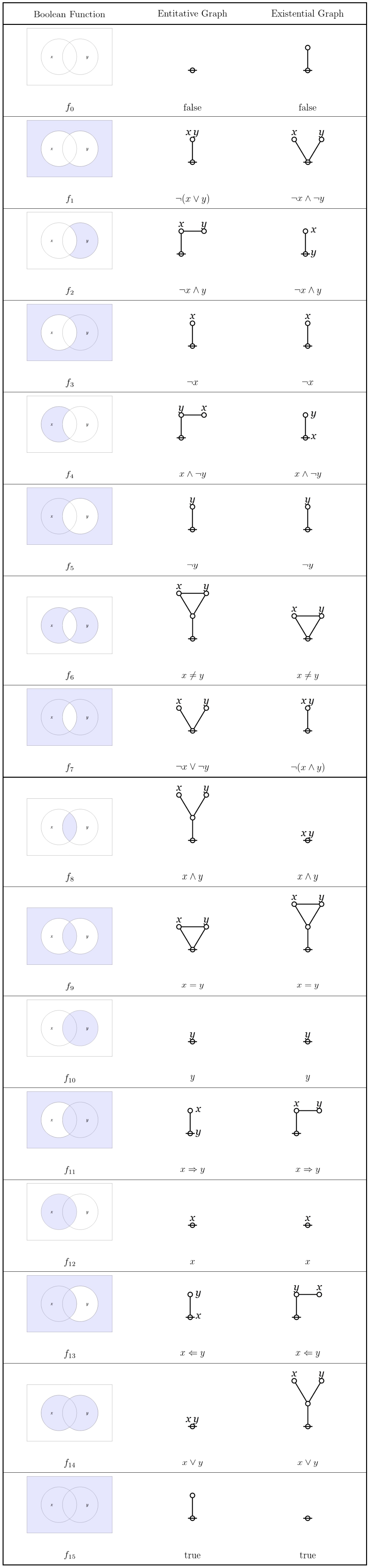
The formulas and graphs tabulated in the previous post are well‑adapted to articulate the syntactic and intensional aspects of propositional logic. But their very tailoring to those tasks tends to slight the extensional and therefore empirical applications of logic. Venn diagrams, despite their unwieldiness as the number of logical dimensions increases, are indispensable in providing the visual intuition with a solid grounding in the extensions of logical concepts. All that makes it worthwhile to reset our table of boolean functions on two variables to include the corresponding venn diagrams.

cc: FB | Logical Graphs • Laws of Form • Mathstodon • Academia.edu
cc: Conceptual Graphs • Cybernetics • Structural Modeling • Systems Science


 Inquiry Into Inquiry
Pingback: Survey of Animated Logical Graphs • 7 | Inquiry Into Inquiry
Pingback: Interpretive Duality in Logical Graphs • 3 | Inquiry Into Inquiry
Pingback: Interpretive Duality in Logical Graphs • 4 | Inquiry Into Inquiry
Pingback: Interpretive Duality in Logical Graphs • 6 | Inquiry Into Inquiry
Pingback: Interpretive Duality in Logical Graphs • 7 | Inquiry Into Inquiry
Pingback: Survey of Animated Logical Graphs • 7 | Inquiry Into Inquiry
Pingback: Survey of Animated Logical Graphs • 8 | Inquiry Into Inquiry
Pingback: Survey of Animated Logical Graphs • 8 | Systems Community of Inquiry