
Re: Interpreter and Interpretant • Selection 1

Re: Laws of Form • Lyle Anderson
- LA:
- You can not find “ground” in Aristotle. If the past three years have shown us anything it is that his assertion:
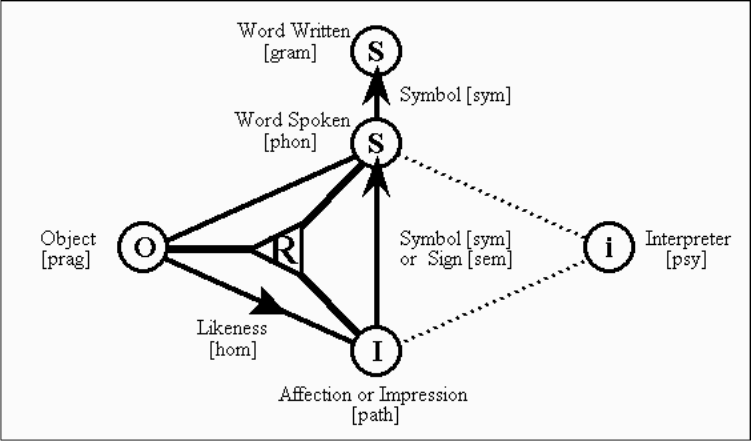
But the mental affections themselves, of which these words are primarily signs (semeia), are the same for the whole of mankind, as are also the objects (pragmata) of which those affections are representations or likenesses, images, copies (homoiomata).
Is just plain wrong. The whole of mankind does not have the same “mental affectations”, some are sane and some are insane.
Lyle,
What prompted the present review of basic issues in semiotics was a couple of recent instances where one of the most nagging questions in the whole field reared its shaggy head again. This time around I posed it as follows.
In a theory of three‑place relations among objects, signs, and interpretant signs, where indeed is there any place for the interpretive agent?
It’s best to take the Selections I gathered not as Scripture but as case studies in the conduct of inquiry where the inquirers in question managed to capture significant features of the way triadic sign relations structure the phenomena of cognition, communication, and computation. No one in science gets everything right all the time, much less at first, but first approximations taken for what they’re worth prime the pump of stepwise refinement in semiotics as in computer science.
In that spirit, Susan Awbrey and I summed up our estimation of Aristotle’s Approximation to the Sign Relation in the following way.
Aristotle’s description contains two claims of constancy, that ideas and objects are the same for all interpreters. This view does not allow for the plurality and mutability of interpreters, two features that we must be concerned with in hermeneutics and education. John Dewey expresses this point well:
Thinking is specific, in that different things suggest their own appropriate meanings, tell their own unique stories, and in that they do this in very different ways with different persons. (Dewey 1910/1991, 39).
However, this account of Aristotle’s may be considered in part a reasonable approximation and in part a suggestive metaphor, suitable as a first approach to a complex subject. (Awbrey and Awbrey, 1995).
References
- Aristotle, “On Interpretation” (De Interp.), Harold P. Cooke (trans.), pp. 111–179 in Aristotle, Volume 1, Loeb Classical Library, William Heinemann, London, UK, 1938.
- Awbrey, J.L., and Awbrey, S.M. (1995), “Interpretation as Action : The Risk of Inquiry”, Inquiry : Critical Thinking Across the Disciplines 15(1), 40–52. Archive. Journal. Online (doc) (pdf).
cc: FB | Semeiotics • Laws of Form • Mathstodon • Academia.edu
cc: Conceptual Graphs • Cybernetics • Structural Modeling • Systems Science


 Inquiry Into Inquiry
Pingback: Survey of Semiotics, Semiosis, Sign Relations • 5 | Inquiry Into Inquiry
Pingback: Survey of Semiotics, Semiosis, Sign Relations • 5 | Inquiry Into Inquiry
Pingback: Survey of Semiotics, Semiosis, Sign Relations • 6 | Inquiry Into Inquiry
Pingback: Survey of Semiotics, Semiosis, Sign Relations • 6 | Systems Community of Inquiry