
I guess it must be the flag of my disposition, out of hopeful
green stuff woven.
— Walt Whitman • Leaves of Grass
Back to the Feature
Let’s assume the sense intended for differential features is well enough established in the intuition for now that we may continue outlining the structure of the differential extension ![[\mathrm{E}\mathcal{X}] = [A, \mathrm{d}A].](https://s0.wp.com/latex.php?latex=%5B%5Cmathrm%7BE%7D%5Cmathcal%7BX%7D%5D+%3D+%5BA%2C+%5Cmathrm%7Bd%7DA%5D.&bg=ffffff&fg=000000&s=0&c=20201002)


![\begin{array}{lll} \mathrm{E}X & = & \langle A, \mathrm{d}A \rangle \\[4pt] & = & \{ \texttt{(} A \texttt{)}, A \} ~\times~ \{ \texttt{(} \mathrm{d}A \texttt{)}, \mathrm{d}A \} \\[4pt] & = & \{ \texttt{(} A \texttt{)(} \mathrm{d}A \texttt{)},~ \texttt{(} A \texttt{)} \mathrm{d}A,~ A \texttt{(} \mathrm{d}A \texttt{)},~ A ~ \mathrm{d}A \}. \end{array}](https://s0.wp.com/latex.php?latex=%5Cbegin%7Barray%7D%7Blll%7D++%5Cmathrm%7BE%7DX+%26+%3D+%26+%5Clangle+A%2C+%5Cmathrm%7Bd%7DA+%5Crangle++%5C%5C%5B4pt%5D++%26+%3D+%26+%5C%7B+%5Ctexttt%7B%28%7D+A+%5Ctexttt%7B%29%7D%2C+A+%5C%7D+%7E%5Ctimes%7E+%5C%7B+%5Ctexttt%7B%28%7D+%5Cmathrm%7Bd%7DA+%5Ctexttt%7B%29%7D%2C+%5Cmathrm%7Bd%7DA+%5C%7D++%5C%5C%5B4pt%5D++%26+%3D+%26+%5C%7B+%5Ctexttt%7B%28%7D+A+%5Ctexttt%7B%29%28%7D+%5Cmathrm%7Bd%7DA+%5Ctexttt%7B%29%7D%2C%7E++%5Ctexttt%7B%28%7D+A+%5Ctexttt%7B%29%7D+%5Cmathrm%7Bd%7DA%2C%7E++A+%5Ctexttt%7B%28%7D+%5Cmathrm%7Bd%7DA+%5Ctexttt%7B%29%7D%2C%7E++A+%7E+%5Cmathrm%7Bd%7DA+%5C%7D.++%5Cend%7Barray%7D&bg=ffffff&fg=000000&s=0&c=20201002)
The space 

To complete the construction of the extended universe of discourse ![\mathrm{E}X^\bullet = [A, \mathrm{d}A]](https://s0.wp.com/latex.php?latex=%5Cmathrm%7BE%7DX%5E%5Cbullet+%3D+%5BA%2C+%5Cmathrm%7Bd%7DA%5D&bg=ffffff&fg=000000&s=0&c=20201002)


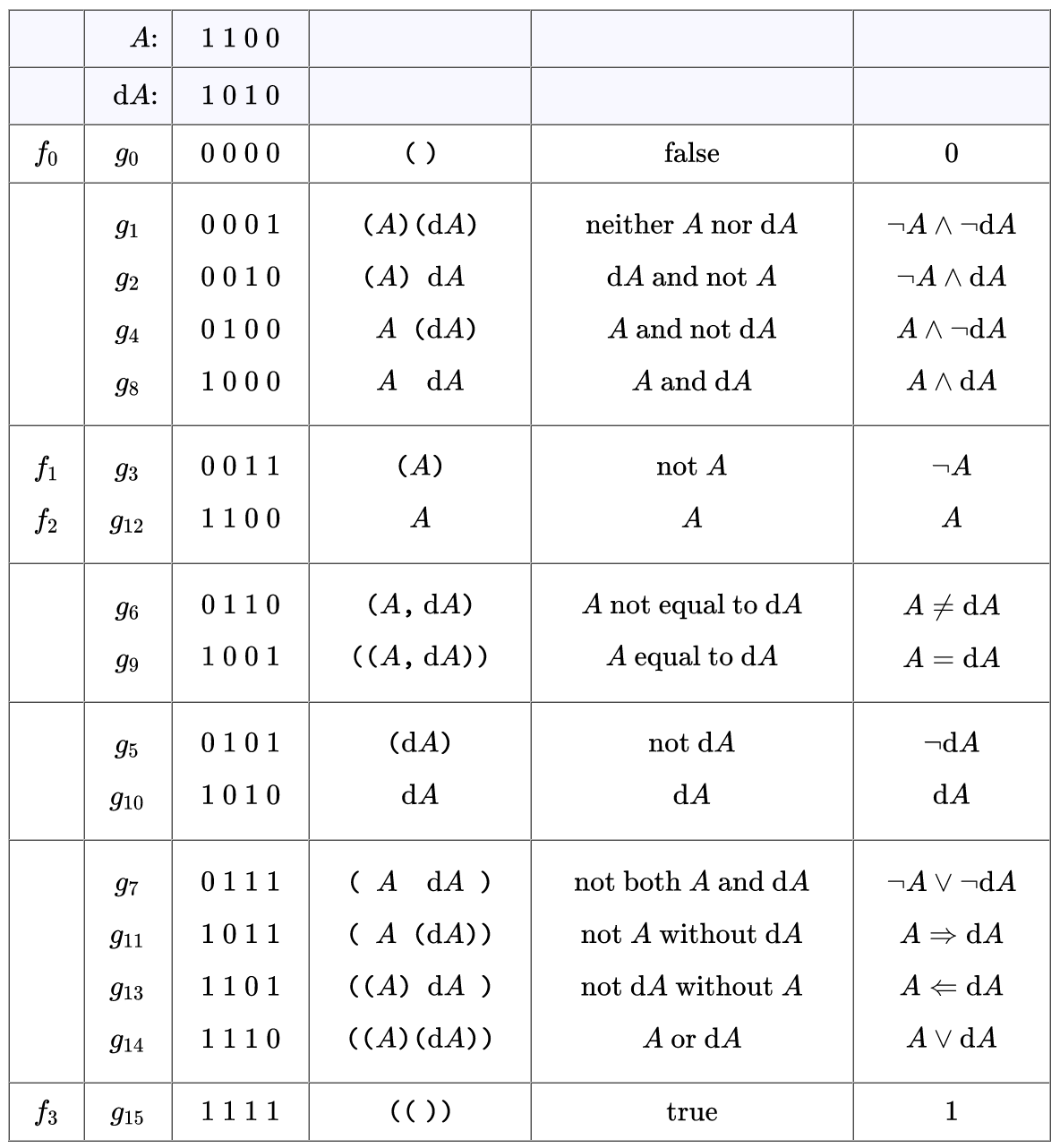
Aside from changing the names of variables and shuffling the order of rows, the Table follows the format previously used for boolean functions of two variables. The rows are grouped to reflect natural similarity classes holding among the propositions. In a future discussion the classes will be given additional explanation and motivation as the orbits of a certain transformation group acting on the set of 16 propositions. Notice that four of the propositions, in their logical expressions, resemble those given in the table for 


Resources
cc: FB | Differential Logic • Laws of Form • Mathstodon • Academia.edu
cc: Conceptual Graphs (1) (2) • Cybernetics • Structural Modeling • Systems Science

 Inquiry Into Inquiry
Pingback: Survey of Differential Logic • 6 | Inquiry Into Inquiry
Pingback: Survey of Differential Logic • 7 | Inquiry Into Inquiry