Differential Propositional Calculus • 4

Casual Introduction (cont.)

Figure 3 extends the basis of description for the space X to a set of two qualities \{q, \mathrm{d}q\} and the corresponding terms of description to an alphabet of two symbols \{``q", ``\mathrm{d}q"\}.

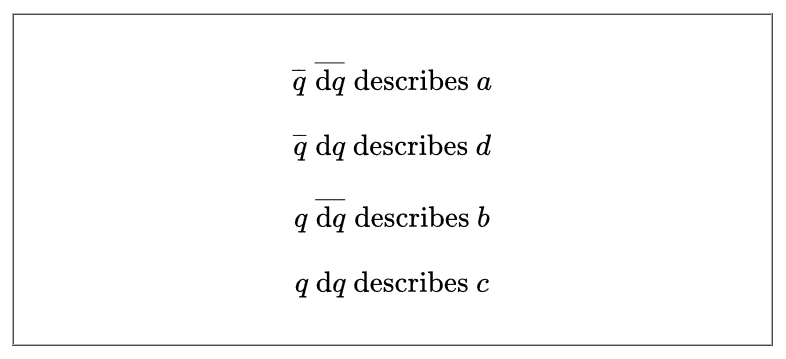
Any propositional calculus over two basic propositions allows for the expression of sixteen propositions all together.  Salient among those propositions in the present setting are the four which single out the individual sample points at the initial moment of observation.  Table 4 lists the initial state descriptions, using overlines to express logical negations.

\text{Table 4. Initial State Descriptions}
Initial State Descriptions

cc: FB | Differential LogicLaws of FormMathstodonAcademia.edu
cc: Conceptual GraphsCyberneticsStructural ModelingSystems Science

This entry was posted in Amphecks, Boolean Functions, C.S. Peirce, Cactus Graphs, Category Theory, Change, Computational Complexity, Cybernetics, Differential Analytic Turing Automata, Differential Calculus, Differential Logic, Discrete Dynamics, Dynamical Systems, Equational Inference, Functional Logic, Gradient Descent, Graph Theory, Group Theory, Hologrammautomaton, Indicator Functions, Logic, Logical Graphs, Mathematical Models, Mathematics, Minimal Negation Operators, Painted Cacti, Peirce, Propositional Calculus, Propositional Equation Reasoning Systems, Time, Visualization and tagged , , , , , , , , , , , , , , , , , , , , , , , , , , , , , , . Bookmark the permalink.

2 Responses to Differential Propositional Calculus • 4

  1. Pingback: Survey of Differential Logic • 6 | Inquiry Into Inquiry

  2. Pingback: Survey of Differential Logic • 7 | Inquiry Into Inquiry

Leave a comment

This site uses Akismet to reduce spam. Learn how your comment data is processed.