
These are the forms of time, which imitates eternity and revolves according to a law of number.
Re: Laws of Form • Seth • James Bowery (1) (2) (3) • Lyle Anderson
Dear Seth, James, Lyle,
Nothing about calling time an abstraction makes it a nullity. I’m too much a realist about mathematical objects to ever think that. As a rule, on the other hand, I try to avoid letting abstractions leave us so absent-minded as to forget the concrete realities from which they are abstracted. Keeping time linked to process, especially the orders of standard process we call “clocks”, is just part and parcel of that practice.
Synchronicity being what it is, this very issue came up just last night in a very amusing Facebook discussion about “windshield wipers slappin’ time …”
At any rate, this thread is already moving too fast for the pace I keep these days but maybe I can resolve remaining confusions about the game afoot by recycling a post I shared to the old Laws of Form list. This was originally a comment on Lou Kauffman’s blog back when he first started it. Sadly, he wrote only a few more entries there in the time since.
Re: Lou Kauffman • Iterants, Imaginaries, Matrices
As serendipity would have it, Lou Kauffman, who knows a lot about the lines of inquiry Charles Sanders Peirce and George Spencer Brown pursued into graphical syntaxes for logic, just last month opened a blog and his very first post touched on perennial questions of logic and time — Logos and Chronos — puzzling the wits of everyone who has thought about them for as long as anyone can remember. Just locally and recently these questions have arisen in the following contexts.
- Alpha Now, Omega Later • (1) • (2) • (3) • (4) • (5) • (6) • (7)
- Objects, Models, Theories • (1) • (2) • (3) • (4)
- Peirce List • (1) • (2) • (3)
Kauffman’s treatment of logic, paradox, time, and imaginary truth values led me to make the following comments I think are very close to what I’d been struggling to say before.
Let me get some notational matters out of the way before continuing.
I use 


As long as we’re reading 


On the other hand, the assignment statement 


Now suppose we are observing the time evolution of a system 

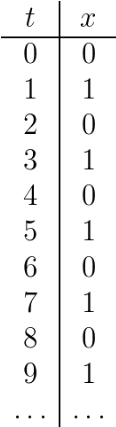
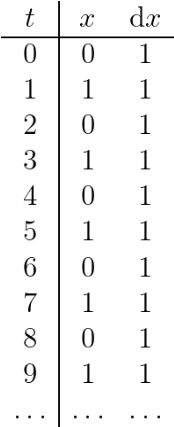
Computing the first differences we get:
Computing the second differences we get:
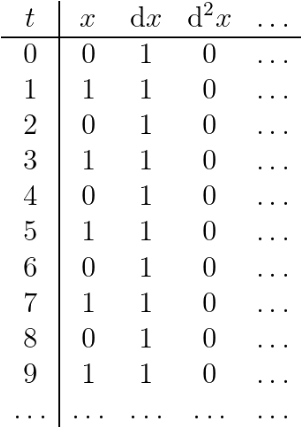
This leads to thinking of the system 

The following article has a few more examples along these lines.
Resources
- Differential Logic • Introduction
- Differential Logic • Part 1 • Part 2 • Part 3
- Differential Propositional Calculus • Part 1 • Part 2
- Differential Logic and Dynamic Systems • Part 1 • Part 2 • Part 3 • Part 4 • Part 5
cc: Cybernetics • Laws of Form • Ontolog Forum • Peirce List
cc: FB | Cybernetics • Structural Modeling • Systems Science

 Inquiry Into Inquiry
Pingback: Survey of Differential Logic • 3 | Inquiry Into Inquiry
Pingback: Survey of Differential Logic • 4 | Inquiry Into Inquiry
Pingback: Survey of Differential Logic • 5 | Inquiry Into Inquiry
Pingback: Survey of Differential Logic • 6 | Inquiry Into Inquiry
Pingback: Survey of Differential Logic • 7 | Inquiry Into Inquiry
Pingback: Survey of Differential Logic • 8 | Systems Community of Inquiry
Pingback: Survey of Differential Logic • 8 | Inquiry Into Inquiry