
Re: Dick Lipton & Ken Regan • (1) • (2)
We continue with the differential analysis of the proposition in Example 1.
Example 1
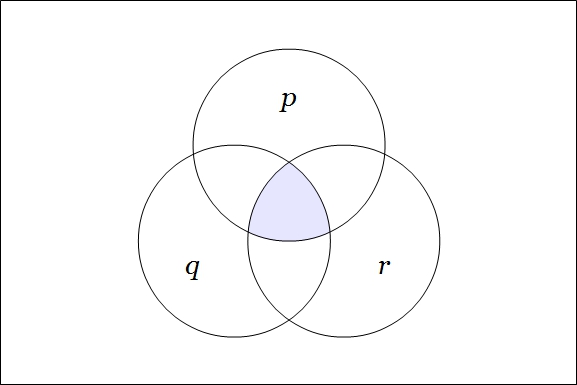 |
(1) |
A proposition defined on one universe of discourse has natural extensions to larger universes of discourse. As a matter of course in a given context of discussion, some of these extensions come to be taken for granted as the most natural extensions to make in passing from one universe to the next and they tend to be assumed automatically, by default, in the absence of explicit notice to the contrary. These are the tacit extensions that apply in that context.
Differential logic, at the first order of analysis, treats extensions from boolean spaces of type 


In our present example, the tacit extension 



The boolean expansion of

![\begin{array}{*{8}{l}} & p q r ~ \texttt{(} \mathrm{d}p \texttt{)(} \mathrm{d}q \texttt{)(} \mathrm{d}r \texttt{)} & + & p q r ~ \texttt{(} \mathrm{d}p \texttt{)(} \mathrm{d}q \texttt{)~} \mathrm{d}r \texttt{~} & + & p q r ~ \texttt{(} \mathrm{d}p \texttt{)~} \mathrm{d}q \texttt{~(} \mathrm{d}r \texttt{)} & + & p q r ~ \texttt{(} \mathrm{d}p \texttt{)~} \mathrm{d}q \texttt{~~} \mathrm{d}r \texttt{~} \\[4pt] + & p q r ~ \texttt{~} \mathrm{d}p \texttt{~(} \mathrm{d}q \texttt{)(} \mathrm{d}r \texttt{)} & + & p q r ~ \texttt{~} \mathrm{d}p \texttt{~(} \mathrm{d}q \texttt{)~} \mathrm{d}r \texttt{~} & + & p q r ~ \texttt{~} \mathrm{d}p \texttt{~~} \mathrm{d}q \texttt{~(} \mathrm{d}r \texttt{)} & + & p q r ~ \texttt{~} \mathrm{d}p \texttt{~~} \mathrm{d}q \texttt{~~} \mathrm{d}r \texttt{~} \end{array}](https://s0.wp.com/latex.php?latex=%5Cbegin%7Barray%7D%7B%2A%7B8%7D%7Bl%7D%7D++%26++p+q+r+%7E++%5Ctexttt%7B%28%7D+%5Cmathrm%7Bd%7Dp+%5Ctexttt%7B%29%28%7D+%5Cmathrm%7Bd%7Dq+%5Ctexttt%7B%29%28%7D+%5Cmathrm%7Bd%7Dr+%5Ctexttt%7B%29%7D++%26+%2B+%26++p+q+r+%7E++%5Ctexttt%7B%28%7D+%5Cmathrm%7Bd%7Dp+%5Ctexttt%7B%29%28%7D+%5Cmathrm%7Bd%7Dq+%5Ctexttt%7B%29%7E%7D+%5Cmathrm%7Bd%7Dr+%5Ctexttt%7B%7E%7D++%26+%2B+%26++p+q+r+%7E++%5Ctexttt%7B%28%7D+%5Cmathrm%7Bd%7Dp+%5Ctexttt%7B%29%7E%7D+%5Cmathrm%7Bd%7Dq+%5Ctexttt%7B%7E%28%7D+%5Cmathrm%7Bd%7Dr+%5Ctexttt%7B%29%7D++%26+%2B+%26++p+q+r+%7E++%5Ctexttt%7B%28%7D+%5Cmathrm%7Bd%7Dp+%5Ctexttt%7B%29%7E%7D+%5Cmathrm%7Bd%7Dq+%5Ctexttt%7B%7E%7E%7D+%5Cmathrm%7Bd%7Dr+%5Ctexttt%7B%7E%7D++%5C%5C%5B4pt%5D++%2B+%26++p+q+r+%7E++%5Ctexttt%7B%7E%7D+%5Cmathrm%7Bd%7Dp+%5Ctexttt%7B%7E%28%7D+%5Cmathrm%7Bd%7Dq+%5Ctexttt%7B%29%28%7D+%5Cmathrm%7Bd%7Dr+%5Ctexttt%7B%29%7D++%26+%2B+%26++p+q+r+%7E++%5Ctexttt%7B%7E%7D+%5Cmathrm%7Bd%7Dp+%5Ctexttt%7B%7E%28%7D+%5Cmathrm%7Bd%7Dq+%5Ctexttt%7B%29%7E%7D+%5Cmathrm%7Bd%7Dr+%5Ctexttt%7B%7E%7D++%26+%2B+%26++p+q+r+%7E++%5Ctexttt%7B%7E%7D+%5Cmathrm%7Bd%7Dp+%5Ctexttt%7B%7E%7E%7D+%5Cmathrm%7Bd%7Dq+%5Ctexttt%7B%7E%28%7D+%5Cmathrm%7Bd%7Dr+%5Ctexttt%7B%29%7D++%26+%2B+%26++p+q+r+%7E++%5Ctexttt%7B%7E%7D+%5Cmathrm%7Bd%7Dp+%5Ctexttt%7B%7E%7E%7D+%5Cmathrm%7Bd%7Dq+%5Ctexttt%7B%7E%7E%7D+%5Cmathrm%7Bd%7Dr+%5Ctexttt%7B%7E%7D++%5Cend%7Barray%7D&bg=ffffff&fg=000000&s=0&c=20201002)
In other words, 

To be continued …


 Inquiry Into Inquiry
Pingback: Frankl, My Dear : 8 | Inquiry Into Inquiry
Pingback: Frankl, My Dear : 9 | Inquiry Into Inquiry
Pingback: Survey of Differential Logic • 1 | Inquiry Into Inquiry
Pingback: Survey of Differential Logic • 2 | Inquiry Into Inquiry
Pingback: Animated Logical Graphs • 24 | Inquiry Into Inquiry
Pingback: Survey of Differential Logic • 3 | Inquiry Into Inquiry
Pingback: Survey of Differential Logic • 4 | Inquiry Into Inquiry
Pingback: Survey of Differential Logic • 5 | Inquiry Into Inquiry
Pingback: Survey of Differential Logic • 6 | Inquiry Into Inquiry
Pingback: Survey of Differential Logic • 7 | Inquiry Into Inquiry
Pingback: Survey of Differential Logic • 8 | Systems Community of Inquiry
Pingback: Survey of Differential Logic • 8 | Inquiry Into Inquiry