
Grammar 5
With the foregoing array of considerations in mind, one is gradually led to a grammar for 
![\begin{array}{ccll} S & :> & \varepsilon & \\[6pt] q & :> & W, & \text{with}~ q \in \{ ``S" \} \cup \mathfrak{Q} ~\text{and}~ W \in (\mathfrak{Q} \cup \mathfrak{A})^+ \end{array}](https://s0.wp.com/latex.php?latex=%5Cbegin%7Barray%7D%7Bccll%7D++S+%26+%3A%3E+%26+%5Cvarepsilon+%26++%5C%5C%5B6pt%5D++q+%26+%3A%3E+%26+W%2C+%26+%5Ctext%7Bwith%7D%7E+q+%5Cin+%5C%7B+%60%60S%22+%5C%7D+%5Ccup+%5Cmathfrak%7BQ%7D+%7E%5Ctext%7Band%7D%7E+W+%5Cin+%28%5Cmathfrak%7BQ%7D+%5Ccup+%5Cmathfrak%7BA%7D%29%5E%2B++%5Cend%7Barray%7D&bg=ffffff&fg=000000&s=0&c=20201002)
A grammar fitting that description is called a context‑free grammar. The first type of rewrite rule is called a special production while the second type of rewrite rule is called an ordinary production.
An ordinary derivation is one composed solely of ordinary productions. An ordinary production 


The feature just described is known as the non‑contracting property of productions, derivations, and grammars. A grammar is said to have the property if all of its covering productions, with the possible exception of 
In particular, context‑free grammars are special cases of non‑contracting grammars. The presence of the non‑contracting property in a grammar makes the length of the augmented string available as a parameter to figure into mathematical induction and motivate recursive proofs. A handle like that on the generative process makes it possible to establish results about the generated language which are not easy to achieve in more general cases, nor even by other means in the context‑free case.
Grammar 5 is a context‑free grammar for the painted cactus language 

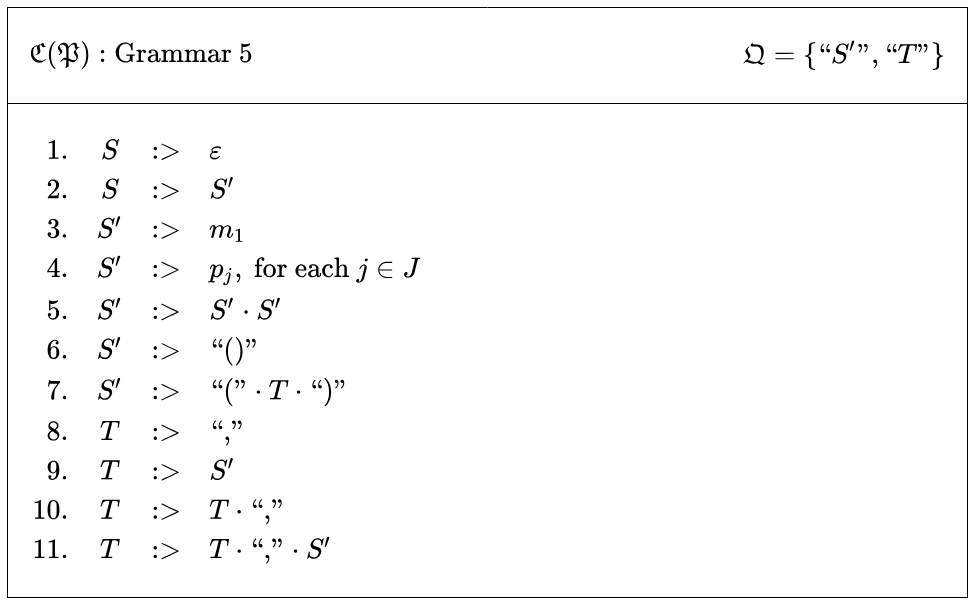
Finally, it is worth trying to bring together the separate advantages of diverse styles of grammar, to the extent they are compatible. To do that, a prospective grammar must be capable of maintaining a high level of intermediate organization, like that exhibited by Grammar 2, while respecting the principle of intermediate significance, thus accumulating the benefits of the context‑free style in Grammar 5. A plausible synthesis of those features is given in Grammar 6.
Resources
cc: Academia.edu • BlueSky • Laws of Form • Mathstodon • Research Gate
cc: Conceptual Graphs • Cybernetics • Structural Modeling • Systems Science


 Inquiry Into Inquiry
Pingback: Survey of Animated Logical Graphs • 8 | Inquiry Into Inquiry
Pingback: Survey of Animated Logical Graphs • 8 | Systems Community of Inquiry