
Cactus Language • Syntax 7

Grammar 3 (cont.)

Cactus Language Grammar 3

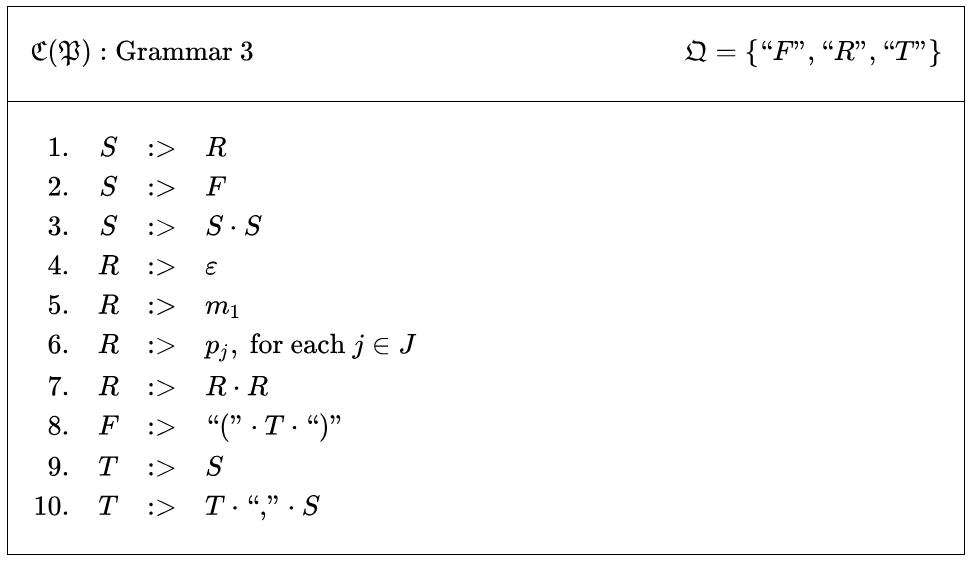
In Grammar 3, the first three Rules say a sentence (a string of type S), is either a rune (a string of type R), a foil (a string of type F), or formed by concatenating strings of those two types.

Rules 4 through 7 say a rune R is either an empty string \varepsilon, a blank symbol m_1, a paint p_j, or formed by concatenating strings of those three types.

Rule 8 characterizes a foil F as a string of the form ``(" \cdot T \cdot ``)", where T is a tract.

The last two Rules say a tract T is either a sentence S or the concatenation of a tract, a comma, and a sentence, in that order.

At this point in the succession of grammars for \mathfrak{C} (\mathfrak{P}), the problematic applications of indefinite iterations, like the kleene star operator, are now reduced to finite forms of concatenation but the problems stemming from permitting non‑terminal symbols to cover both themselves and empty strings have yet to be resolved.

A moment’s reflection on the issue raises the general question:  What is a practical strategy for accounting for the empty string in the organization of any formal language which counts it among its sentences?

One answer presenting itself is the following:  If the empty string belongs to a formal language, it suffices to count it once at the beginning of the formal account which enumerates its sentences and then move on to more interesting materials.

Resources

cc: Academia.edu • BlueSky • Laws of FormMathstodonResearch Gate
cc: Conceptual GraphsCyberneticsStructural ModelingSystems Science

This entry was posted in Automata, Boolean Algebra, Boolean Functions, C.S. Peirce, Cactus Graphs, Differential Logic, Equational Inference, Formal Grammars, Formal Languages, Graph Theory, Logic, Logical Graphs, Mathematics, Minimal Negation Operators, Painted Cacti, Propositional Calculus, Visualization and tagged , , , , , , , , , , , , , , , , . Bookmark the permalink.

2 Responses to Cactus Language • Syntax 7

  1. Pingback: Survey of Animated Logical Graphs • 8 | Inquiry Into Inquiry

  2. Pingback: Survey of Animated Logical Graphs • 8 | Systems Community of Inquiry

Leave a comment

This site uses Akismet to reduce spam. Learn how your comment data is processed.