Cactus Language • Syntax 6

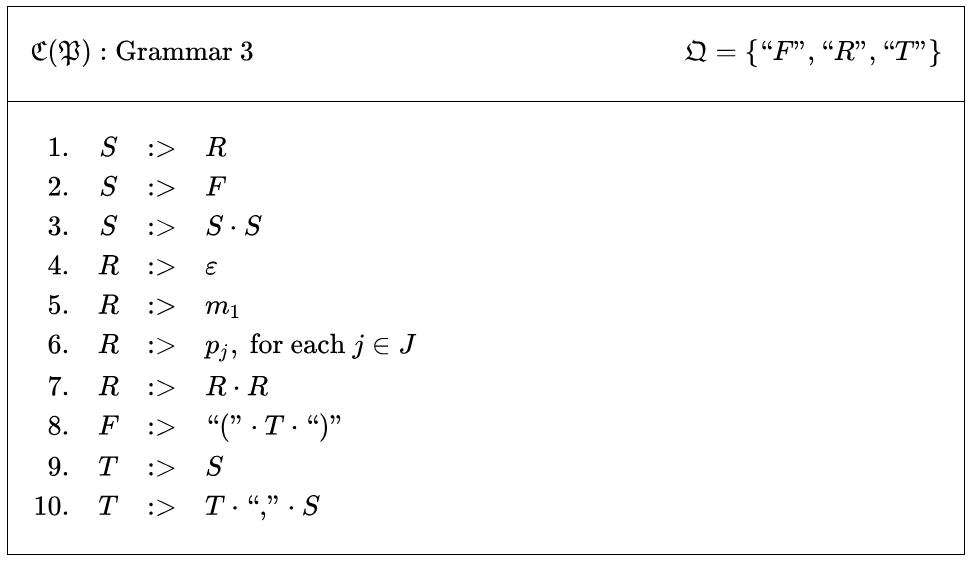
Grammar 3

It is possible to organize the materials of our developing grammar in a more easily graspable fashion by recognizing two recurring types of strings appearing in typical cactus expressions.  In doing so one arrives at the next two definitions.

A rune is a string of blanks and paints concatenated together.  Thus, a typical rune R is a string over \{ m_1 \} \cup \mathfrak{P}, possibly the empty string.

R \in ( \{ m_1 \} \cup \mathfrak{P} )^*

When there is no risk of confusion, the letter ``R" may be used either as a string variable ranging over the set of runes or as a type name for the class of runes.  The latter reading amounts to the recruitment of a new intermediate symbol ``R" \in \mathfrak{Q} to form a new grammar for \mathfrak{C} (\mathfrak{P}).  Thus ``R" accords grammatical recognition to any rune forming a part of a sentence in \mathfrak{C} (\mathfrak{P}).  In situations where the variant usages are likely to be confused the types of strings may be indicated by way of expressions like r <: R and W <: R.

A foil is a string of the form ``(" \cdot T \cdot ``)", where T is a tract, giving a foil F the following form.

\begin{array}{*{15}{l}}  F & = & ``(" & \cdot & S_1 & \cdot & ``," & \cdot & \ldots & \cdot & ``," & \cdot & S_k & \cdot & ``)"  \end{array}

Thus a foil is nothing other than the surcatenation of a sequence of sentences S_1, \ldots, S_k.  In the case where the sequence of sentences is empty and thus where the tract T is the empty string, we have the minimal foil F_0 = ``()".

Explicitly marking each foil F embodied in a cactus expression is tantamount to recognizing a new intermediate symbol, ``F" \in \mathfrak{Q}, further articulating the structure of expressions and expanding the grammar for the language \mathfrak{C} (\mathfrak{P}).  All the same remarks about the versatile uses of intermediate symbols, as string variables and as type names, apply again to the letter ``F".

Cactus Language Grammar 3

Resources

cc: Academia.edu • BlueSky • Laws of FormMathstodonResearch Gate
cc: Conceptual GraphsCyberneticsStructural ModelingSystems Science

This entry was posted in Automata, Boolean Algebra, Boolean Functions, C.S. Peirce, Cactus Graphs, Differential Logic, Equational Inference, Formal Grammars, Formal Languages, Graph Theory, Logic, Logical Graphs, Mathematics, Minimal Negation Operators, Painted Cacti, Propositional Calculus, Visualization and tagged , , , , , , , , , , , , , , , , . Bookmark the permalink.

2 Responses to Cactus Language • Syntax 6

  1. Pingback: Survey of Animated Logical Graphs • 8 | Inquiry Into Inquiry

  2. Pingback: Survey of Animated Logical Graphs • 8 | Systems Community of Inquiry

Leave a comment

This site uses Akismet to reduce spam. Learn how your comment data is processed.