Casual Introduction (cont.)
Figure 3 returns to the situation in Figure 1, but this time interpolates a new quality specifically tailored to account for the relation between Figure 1 and Figure 2.
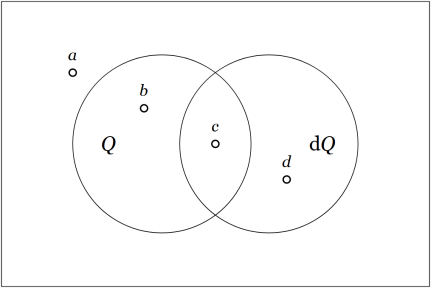

The new quality,  is marked as a differential quality on account of its absence or presence qualifying the absence or presence of change occurring in another quality. As with any quality, it is represented in the venn diagram by means of a “circle” distinguishing two halves of the universe of discourse, in this case, the portions of
  outside and inside the region
Figure 1 represents a universe of discourse  together with a basis of discussion
  for expressing propositions about the contents of that universe. Once the quality
  is given a name, say, the symbol
  we have the basis for a formal language specifically cut out for discussing in terms of
  That language is more formally known as the propositional calculus with alphabet
In the context marked by and  there are just four distinct pieces of information which can be expressed in the corresponding propositional calculus, namely, the constant proposition
  the negative proposition
  the positive proposition
  and the constant proposition
For example, referring to the points in Figure 1, the constant proposition  holds of no points, the negative proposition
  holds of
  and
and  the positive proposition holds of
  and
and  and the constant proposition
  holds of all points in the sample.
Figure 3 preserves the same universe of discourse and extends the basis of discussion to a set of two qualities,  In corresponding fashion, the initial propositional calculus is extended by means of the enlarged alphabet,
Resources
cc: Academia.edu • Cybernetics • Structural Modeling • Systems Science
cc: Conceptual Graphs • Laws of Form • Mathstodon • Research Gate



 Inquiry Into Inquiry
Pingback: Survey of Differential Logic • 7 | Inquiry Into Inquiry
Pingback: Survey of Differential Logic • 7 | Inquiry Into Inquiry
Pingback: Survey of Differential Logic • 8 | Inquiry Into Inquiry
Pingback: Survey of Differential Logic • 8 | Systems Community of Inquiry