Semiotic Transformations
Re: Transformations of Logical Graphs • (4) • (5) • (6) • (7) • (8) • (9)
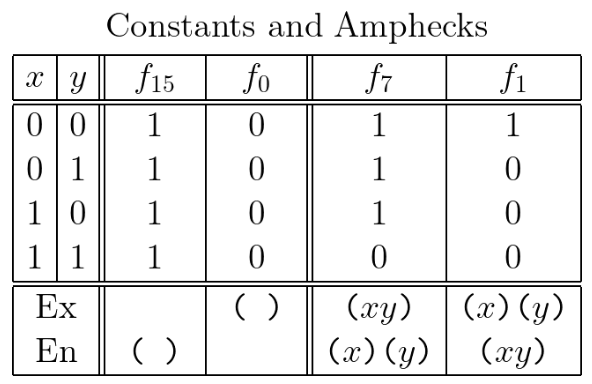
After the four orbits of self‑dual logical graphs we come to six orbits of dual pairs. In no particular order of importance, we may start by considering the following two.
- The logical graphs for the constant functions
and
are dual to each other.
- The logical graphs for the ampheck functions
and
are dual to each other.
The values of the constant and ampheck functions for each 
Resources
- Logic Syllabus
- Amphecks • Zeroth Order Logic
- Survey of Animated Logical Graphs
- Survey of Semiotics, Semiosis, Sign Relations
cc: FB | Logical Graphs • Laws of Form • Mathstodon • Academia.edu
cc: Conceptual Graphs • Cybernetics • Structural Modeling • Systems Science

 Inquiry Into Inquiry
Pingback: Survey of Animated Logical Graphs • 7 | Inquiry Into Inquiry
Pingback: Transformations of Logical Graphs • 11 | Inquiry Into Inquiry
Pingback: Transformations of Logical Graphs • 12 | Inquiry Into Inquiry
Pingback: Transformations of Logical Graphs • 13 | Inquiry Into Inquiry
Pingback: Transformations of Logical Graphs • 14 | Inquiry Into Inquiry
Pingback: Survey of Animated Logical Graphs • 7 | Inquiry Into Inquiry
Pingback: Survey of Animated Logical Graphs • 8 | Inquiry Into Inquiry