
Re: Transformations of Logical Graphs • 1
Another way of looking at the dual interpretation of logical graphs from a group-theoretic point of view is provided by the following Table. In this arrangement we have sorted the rows of the previous Table to bring together similar graphs 


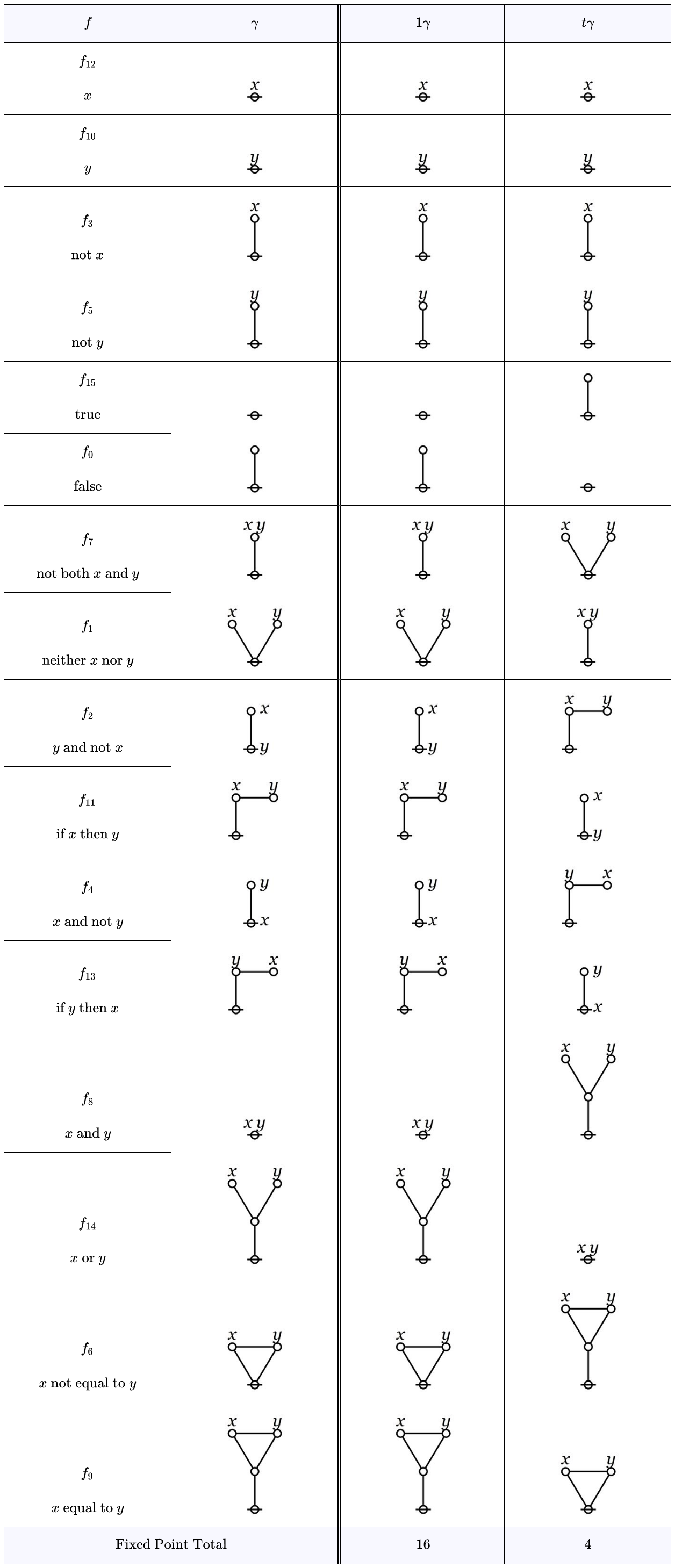
Scanning the Table we observe the 16 points of 


I leave it as an exercise for the reader to investigate the relationship between the group order 


Resources
cc: FB | Logical Graphs • Laws of Form • Mathstodon • Academia.edu
cc: Conceptual Graphs • Cybernetics • Structural Modeling • Systems Science


 Inquiry Into Inquiry
Pingback: Survey of Animated Logical Graphs • 7 | Inquiry Into Inquiry
Pingback: Transformations of Logical Graphs • 3 | Inquiry Into Inquiry
Pingback: Transformations of Logical Graphs • 8 | Inquiry Into Inquiry
Pingback: Survey of Animated Logical Graphs • 7 | Inquiry Into Inquiry
Pingback: Survey of Animated Logical Graphs • 8 | Inquiry Into Inquiry
Pingback: Survey of Animated Logical Graphs • 8 | Systems Community of Inquiry