Inquiry Into Inquiry
Home | Pages | Archives
Peirce’s 1870 “Logic of Relatives” • Comment 11.11
May 9, 2014 3:00 pm
The preceding exercises were intended to beef-up our “functional literacy” skills to the point where we can read our functional alphabets backwards and forwards and recognize the local functionalities immanent in relative terms no matter where they reside among the domains of relations. These skills will serve us in good stead as we work to build a catwalk from Peirce’s platform of 1870 to contemporary scenes on the logic of relatives, and back again.
By way of extending a few very tentative planks, let us experiment with the following definitions.
- A relative term
 and the corresponding relation
 are both called functional on rèlates if and only if
 is a function at
 We write this in symbols as

- A relative term and the corresponding relation are both called functional on correlates if and only if is a function at
 We write this in symbols as

When a relation happens to be a function, it may be excusable to use the same name for it in both applications, writing out explicit type markers like 
 and
 as the case may be, when and if it serves to clarify matters.
From this current, perhaps transient, perspective, it appears our next task is to examine how the known properties of relations are modified when aspects of functionality are spied in the mix. Let us then return to our various ways of looking at relational composition and see what changes and what stays the same when the relations in question happen to be functions of various kinds at some of their domains. Here is one generic picture of relational composition, cast in a style that hews pretty close to the line of potentials inherent in Peirce’s syntax of this period.
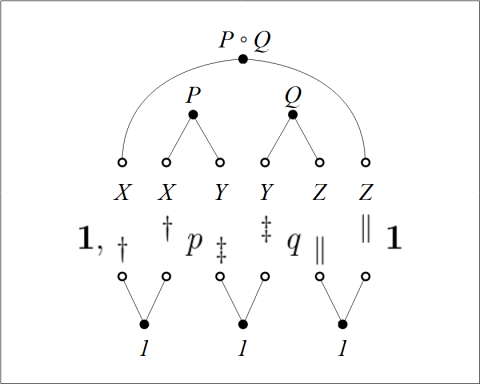

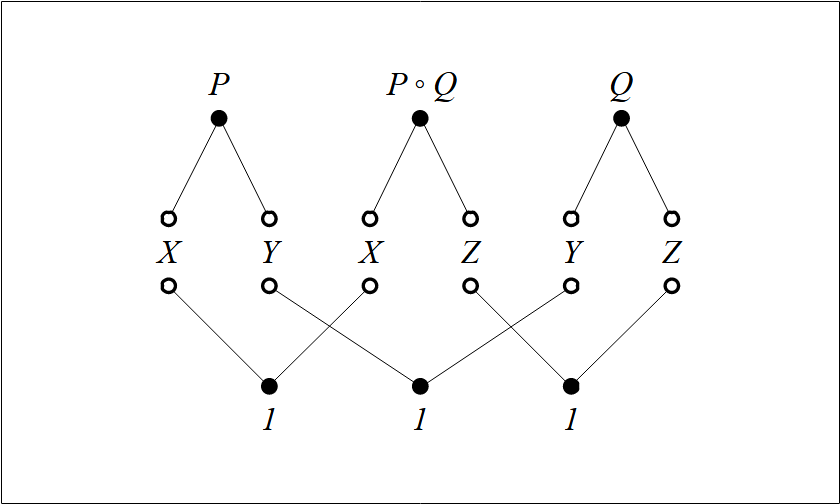
From this we extract the hypergraph picture of relational composition.
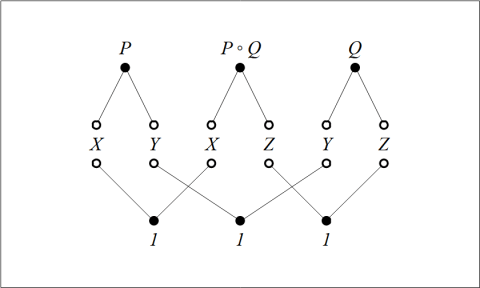

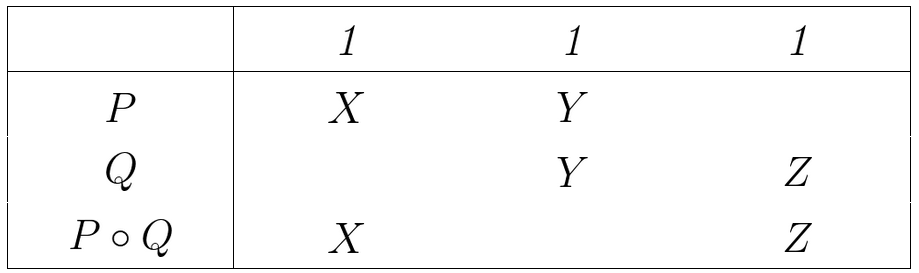
All the information contained in these Figures can be expressed in the form of a constraint satisfaction table, or spreadsheet picture of relational composition.

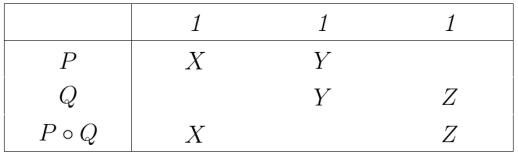
The following plan of study then presents itself, to see what easy mileage we can get in our exploration of functions by adopting the above templates as the primers of a paradigm.
Resources
cc: Cybernetics • Ontolog Forum • Structural Modeling • Systems Science
cc: FB | Peirce Matters • Laws of Form • Peirce List (1) (2) (3) (4) (5) (6) (7)
Posted by Jon Awbrey
Categories: C.S. Peirce, Logic, Logic of Relatives, Logical Graphs, Mathematics, Relation Theory, Visualization
Tags: C.S. Peirce, Logic, Logic of Relatives, Logical Graphs, Mathematics, Relation Theory, Visualization
« Older Newer »
Leave a Reply
Mobile Site | Full Site
Get a free blog at WordPress.com Theme: WordPress Mobile Edition by Alex King.
[…] Comment 11.11 […]
LikeLike
By Survey of Relation Theory • 3 | Inquiry Into Inquiry on January 17, 2017 at 5:01 pm
[…] Comment 11.11 […]
LikeLike
By Peirce’s 1870 “Logic Of Relatives” • Overview | Inquiry Into Inquiry on September 24, 2019 at 10:51 am
[…] Comment 11.11 […]
LikeLike
By Peirce’s 1870 “Logic Of Relatives” • Comment 1 | Inquiry Into Inquiry on October 22, 2019 at 9:32 am
[…] Comment 11.11 […]
LikeLike
By Survey of Relation Theory • 4 | Inquiry Into Inquiry on May 15, 2020 at 5:51 pm
[…] Comment 11.11 […]
LikeLike
By Survey of Relation Theory • 5 | Inquiry Into Inquiry on November 9, 2021 at 7:41 am
[…] Comment 11.11 […]
LikeLike
By Survey of Relation Theory • 6 | Inquiry Into Inquiry on April 1, 2023 at 9:05 am
[…] Comment 11.11 […]
LikeLike
By Survey of Relation Theory • 7 | Inquiry Into Inquiry on July 26, 2023 at 12:01 pm
[…] Comment 11.11 […]
LikeLike
By Survey of Relation Theory • 8 | Inquiry Into Inquiry on March 23, 2024 at 4:28 pm
[…] Comment 11.11 […]
LikeLike
By Survey of Relation Theory • 9 | Inquiry Into Inquiry on May 5, 2025 at 12:06 pm
[…] Comment 11.11 […]
LikeLike
By Survey of Relation Theory • 9 | Systems Community of Inquiry on November 18, 2025 at 12:04 pm